Chattel Loan Rates in 2026: Current Averages & Ranges
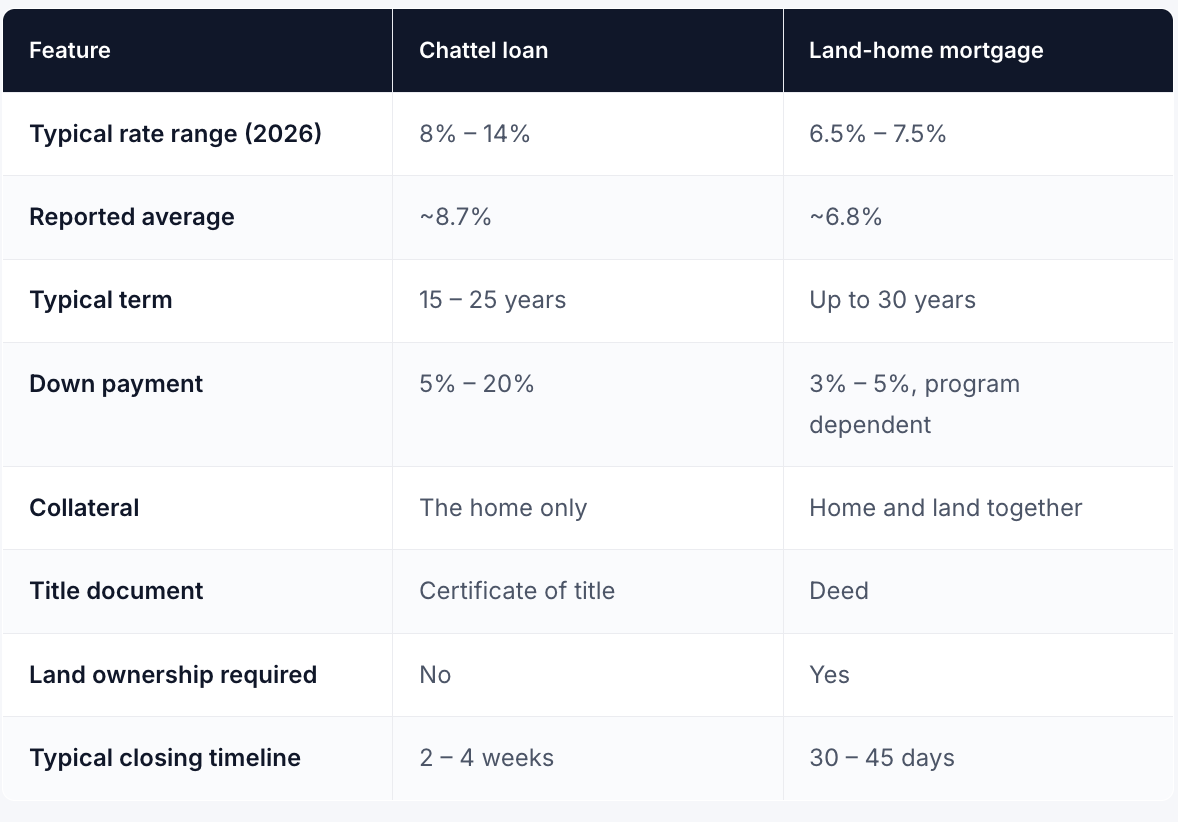
Chattel loan rates for manufactured homes in the United States generally run between 8% and 14% in 2026, with reported averages around 8.7%. For comparison, Freddie Mac's Primary Mortgage Market Survey put the average 30-year fixed mortgage at 6.58% for the week ending July 23, 2026, so a chattel borrower typically pays roughly two percentage points more than someone financing a site-built home. The gap exists because a chattel loan is secured only by the home itself, which is titled as personal property rather than real estate, giving the lender less to recover if the loan defaults.
This page covers chattel loans for manufactured and mobile homes in the United States, financed under HUD Code standards and eligible for FHA programs. If you're researching a chattel mortgage for a vehicle or business equipment, a common product in Australia, that's an entirely different type of loan and the rates below won't apply.
At a glance
Chattel loan rates: roughly 8% to 14%, averaging near 8.7%
Land-home mortgage rates: roughly 6.5% to 7.5%
Terms run 15 to 25 years, not 30
Down payments typically 5% to 20%
FHA Title I does not require you to own the land
In a qualified New Hampshire ROC, conventional pricing may be available instead
To see what a specific rate does to your payment, our chattel loan calculator runs both chattel and land-home scenarios side by side on the same home price.
Chattel loan rates vs. mortgage rates
A chattel loan almost always carries a higher rate than a mortgage on the same manufactured home, typically 1.5 to 3 percentage points higher, with shorter terms. The Federal Reserve's Survey of Consumer Finances reported an average chattel rate of 8.69% against 6.81% for traditional manufactured home mortgages, and the Consumer Financial Protection Bureau estimates that about 42% of all manufactured home purchase loans are chattel loans.
Why the gap exists
A mortgage is secured by real property. If the borrower defaults, the lender forecloses on land and a structure permanently attached to it, an asset that generally holds value and cannot be moved. A chattel loan is secured by a titled object, closer in legal structure to a vehicle loan than to a mortgage. The home can depreciate, it can be relocated, and the lender has no claim on the ground underneath it.
That difference shows up three ways in pricing: a higher rate, a shorter maximum term, and a larger down payment requirement. It also shows up in borrower protections, which are thinner under personal property law than under real estate law.
One more thing to check when you compare quotes: the rate is not the same thing as the annual percentage rate. Our guide to APR vs. interest rate explains why two loans at the same rate can cost different amounts, and our New Hampshire mortgage rate forecast covers where the broader market is heading.
What determines your chattel loan rate
Two borrowers financing identical homes in the same community can be quoted rates several points apart. These are the factors that move the number.
Credit score
Some chattel lenders will consider scores as low as 575, and FHA Title I chattel loans generally accept 580 with 5% down. Most private chattel lenders want 620 or above to access their better pricing tiers. Between the bottom and the top of that range, the rate difference is often three points or more. See our guides to the credit score needed for a mortgage and getting a mortgage with a 580 credit score in NH.
Down payment
Chattel down payments commonly fall between 5% and 20%. Beyond reducing the amount financed, a larger down payment lowers the lender's loss exposure, which can move you into a better rate tier. Expect closing costs and fees on top of the down payment. If family is helping, read the rules on using gift funds for a down payment first, because documentation requirements are strict.
Home age
Homes built before June 15, 1976 predate the HUD Manufactured Home Construction and Safety Standards. These are pre-Code homes, they lack the red HUD certification label, and most chattel lenders will not finance them at all, leaving personal loans or cash as the only options. Homes over roughly 25 years old frequently trigger an inspection requirement, and repair findings can affect approval.
New versus pre-owned
New homes generally price better than resales. Lenders treat a new home as a more predictable asset with a longer useful life and a clearer valuation.
Where the home sits
A home in a land-lease park, a home on private leased land, and a home in a resident-owned community are three different risk profiles, and the community's legal status determines which loan programs are even available to you. This factor matters more than most buyers expect. See the New Hampshire section below.
Term length
Chattel terms usually run 15 to 25 years. Shorter terms carry lower rates but higher monthly payments. Because rate and term interact, comparing quotes on monthly payment alone can be misleading. Run both through the mobile home loan calculator, and if you have cash to spend at closing, our explainer on buying down your rate with points applies to chattel loans too.
Debt-to-income ratio
Chattel lenders underwrite income the same way mortgage lenders do, and if your home sits on leased land, lot rent counts as an ongoing housing obligation alongside the loan payment. Our guide to DTI ratio for a mortgage covers how the calculation works.
How much a chattel loan actually costs
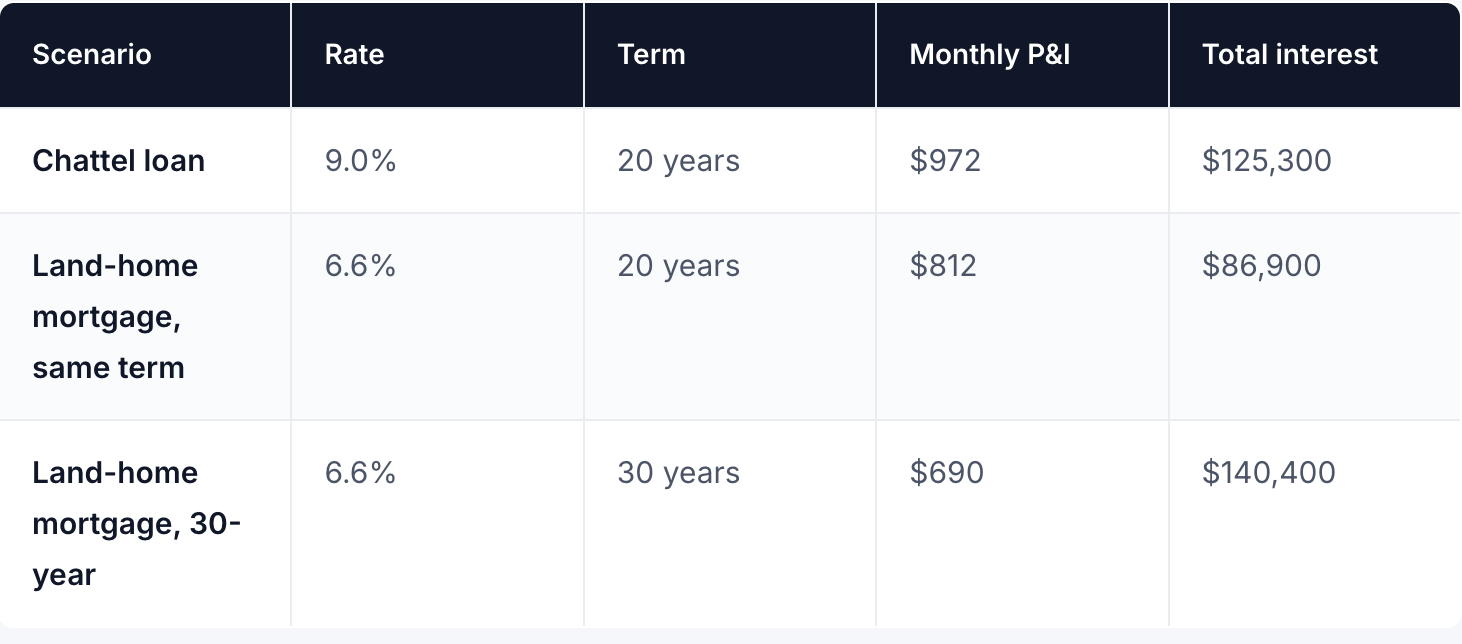
On a $120,000 manufactured home with 10% down, a $108,000 chattel loan at 9% over 20 years works out to about $972 per month in principal and interest, and roughly $125,300 in total interest over the life of the loan.
Here is the same loan amount priced three ways:
Two things are worth reading carefully here.
Compared at the same 20-year term, the mortgage saves $160 a month and about $38,400 in total interest. That figure is the true cost of the chattel rate.
Compared against a 30-year mortgage, the monthly payment drops much further, $282 less than the chattel loan, but total interest rises to $140,400, higher than the chattel loan's. Stretching the term buys monthly cash flow and costs lifetime interest. Neither is automatically the right answer; it depends on whether your constraint is monthly budget or total cost.
One cost the table doesn't show: if your home sits on leased land, lot rent is a separate obligation on top of the loan payment, governed by your community's lease and subject to increase over time. Factor it into affordability from the start.
For context on price levels, recent US Census Bureau data put the average sale price of a new single-section manufactured home at about $78,900 and a double-section at about $148,100. If you're weighing a manufactured home against a site-built one, our guide to how much house you can afford in NH works through the budgeting side.
Government-backed programs that can beat chattel rates
Many buyers assume that not owning land rules out government-backed financing. It does not.
FHA Title I
FHA Title I is the program most chattel borrowers have never heard of, and its defining feature is that it does not require you to own the land. It can finance the home alone, the lot alone, or both together. Credit score requirements start at 580 with 3.5% down through an FHA-approved lender. See our FHA loan qualifications for New Hampshire for the full requirement list.
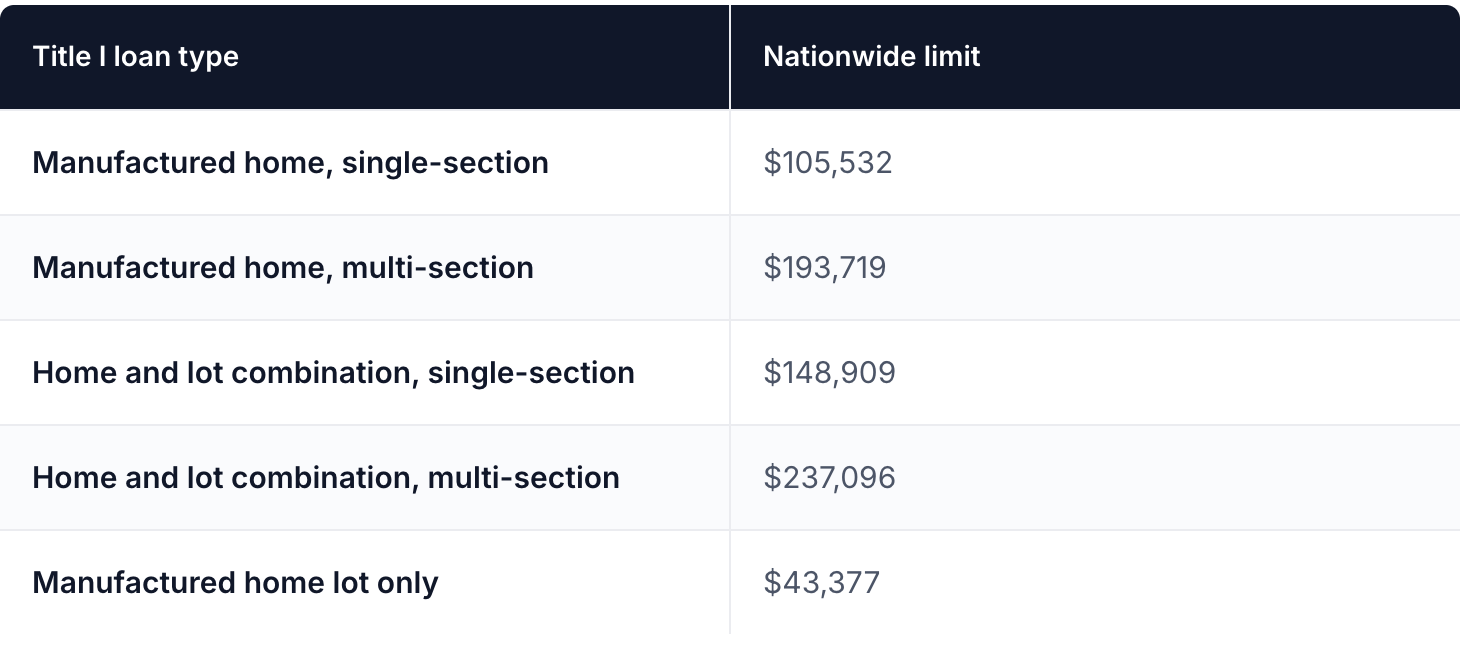
These limits took effect for FHA case numbers assigned on or after March 29, 2024, the first increase to the program since 2008. HUD now recalculates them annually. Note that not every lender offers Title I; it's worth asking specifically.
FHA Title II
Title II treats a manufactured home like a site-built one. The home must be permanently affixed to a foundation on land you own or are purchasing, meet HUD Code, and have been built after June 15, 1976. In exchange, it prices like a standard FHA loan. County-level ceilings apply. Our FHA loan limits for NH by county page has the current figures.
Fannie Mae MH Advantage and Freddie Mac CHOICEHome
Both government-sponsored enterprises run manufactured housing programs under their Duty to Serve obligations, offering fixed-rate conventional financing for qualifying homes. Down payments can start as low as 3%, with pricing slightly above standard conventional but well below chattel.
VA and USDA
Eligible veterans and service members with full entitlement can finance a manufactured home with no down payment and no county loan limit through a VA loan, provided the lender's qualification standards are met. USDA financing is available in designated rural and suburban areas subject to income limits, which covers a large share of New Hampshire.
Our manufactured home loan options page compares eligibility across all of these programs in one place.
How to get out of a chattel rate
If you're already in a chattel loan, there are two paths to a lower rate.
Convert to real property
This is the structural fix. The steps:
Purchase the land under your home, if you currently lease it
Install a permanent foundation meeting HUD standards and local building code
Retire the certificate of title and retitle the home as real property with your local assessor
Refinance into a conventional, FHA, VA, or USDA mortgage
Conversion costs typically run $10,000 to $30,000, depending on location, foundation work required, and land price.
The break-even math decides whether it's worth it. Using the figures above: if conversion costs $20,000 and moves you from $972 a month to $690 on a 30-year mortgage, you save $282 monthly and recover the cost in about six years. Hold the term at 20 years instead and the saving is $160 a month, pushing break-even out to roughly ten years, though you keep the lower lifetime interest. Either way, conversion favors owners who plan to stay put. Our refinance break-even calculator runs this for your own numbers.
Refinance chattel-to-chattel
If conversion isn't realistic, either because you're in a land-lease community with no purchase option or because the foundation work isn't feasible, you can still refinance the chattel loan itself. You won't reach mortgage pricing, but if your credit has improved since origination or rates have moved, a new chattel loan can still lower your payment. This is also the route for homes that can't meet permanent foundation requirements.
Either way, the timing question is the same one every borrower faces. See when to refinance in New Hampshire, how a rate-and-term refinance works, and what you need to refinance. Our refinance loan options page covers the programs available once your home is titled as real property.
Chattel loan rates in New Hampshire
Here is the thing most national guidance on chattel loans gets wrong for New Hampshire buyers: living in a manufactured home community here does not automatically mean you're stuck with a chattel rate.
New Hampshire originated the resident-owned community model. Roughly 150 manufactured home parks in the state have converted to resident ownership, preserving close to 9,000 affordable homes, and the New Hampshire Community Loan Fund's ROC-NH program helped create ROC-USA, which has since spread the model to around 15 states. In a ROC, each home is individually owned while the land is owned cooperatively by the homeowners themselves.
That structure unlocks financing that isn't available in an investor-owned park:
New Hampshire Housing's Home Preferred Manufactured Housing ROC program, built in partnership with Fannie Mae and the NH Community Loan Fund, offers conventional financing in qualified ROCs with a low fixed rate, low down payment, and reduced mortgage insurance options. It serves borrowers with qualifying incomes up to $184,500.
Welcome Home Loans from the NH Community Loan Fund are fixed-rate, long-term conventional mortgages for new and pre-owned manufactured homes in ROCs or on land the buyer owns or is buying, with down payment assistance available below certain income levels.
So the first question for any New Hampshire buyer quoted a chattel rate should be: is this community a qualified ROC? If it is, conventional pricing may be on the table without buying land at all, a difference of two points or more on the rate.
ROC approvals carry expiration dates and eligibility has to be verified at the time of reservation, which is one of several reasons to work through a broker familiar with the program rather than assuming a given community qualifies. If you're also looking at state assistance, our guide to NH down payment assistance programs for 2026 covers what stacks with what.
NextGen Mortgage is licensed in New Hampshire, Massachusetts, Maine, Florida, and Rhode Island. We work with buyers across Nashua, Manchester, Concord, and Portsmouth, and serve clients across the border as a Massachusetts mortgage broker as well.
Chattel loan rate FAQ
What is the interest rate on a chattel loan?
Chattel loan rates generally run 8% to 14% in 2026, averaging around 8.7% according to Federal Reserve data. Your specific rate depends most heavily on credit score, down payment, home age, and whether the home is new or pre-owned. Rates below 8% are usually reserved for strong credit with a substantial down payment on a new home.
Are chattel loan rates higher than mortgage rates?
Yes, typically 1.5 to 3 percentage points higher. Freddie Mac reported a 6.58% average 30-year fixed mortgage rate for the week ending July 23, 2026, against chattel averages near 8.7%. The difference reflects collateral: a chattel loan is secured by the home as personal property, with no land behind it and weaker recovery prospects for the lender.
Can you refinance a chattel loan?
Yes, two ways. You can refinance into another chattel loan, which is available even in a land-lease community and can help if your credit has improved. Or you can convert the home to real property by buying the land, installing a permanent foundation, and retitling, then refinance into a conventional, FHA, VA, or USDA mortgage at substantially lower pricing. Conversion typically costs $10,000 to $30,000.
What credit score do you need for a chattel loan?
Some lenders consider scores as low as 575, and FHA Title I chattel loans generally accept 580 with 5% down. Most private chattel lenders want 620 or higher for their better rate tiers.
How long are chattel loan terms?
Chattel terms typically run 15 to 25 years, compared with up to 30 years on a mortgage. The shorter maximum term is part of why chattel monthly payments can be higher even when the loan amount is smaller.
Do chattel loans have PMI?
Chattel loans generally don't carry private mortgage insurance, since PMI is a real estate product. That's not the savings it appears to be, because the higher interest rate more than absorbs what PMI would have cost, and unlike PMI, the rate doesn't fall away once you build equity. On a conventional mortgage, by contrast, you can eventually remove PMI and keep the lower payment.
Who are the main chattel loan lenders?
The chattel market is concentrated among specialty lenders rather than retail banks. The names you'll encounter most often are 21st Mortgage, Triad Financial Services, Cascade Financial Services, Vanderbilt Mortgage, and Credit Human. Each has different credit thresholds, community approval requirements, and pricing tiers, which is why quotes on the same home can vary widely. A broker's role is to compare across them rather than presenting a single lender's pricing as the market. See how to shop for a mortgage and questions to ask a mortgage broker.
Can a first-time buyer get a chattel loan?
Yes. Manufactured homes are one of the more accessible entry points to ownership, and there's no first-time buyer restriction on chattel financing. If this is your first purchase, our first-time homebuyer resources and the New Hampshire first-time buyer guide walk through the process end to end.
Find out what you'd actually pay
We'll check whether your community is a qualified ROC, whether FHA Title I applies, and what the conversion math looks like if you own or could buy the land.
Not ready to apply? Run your numbers through the mobile home loan calculator first, browse all our mortgage calculators, or read what to expect from the mortgage pre-approval process in New Hampshire.
Disclaimer: The rates and figures on this page are industry averages and published program limits from Freddie Mac, the Federal Reserve, the US Department of Housing and Urban Development, and the US Census Bureau. They are for illustration only and are not a loan offer, quote, or commitment to lend. Actual rate, term, fees, taxes, and insurance vary by lender and by your financial profile. NextGen Mortgage is a broker; we arrange but do not make mortgage loans. NMLS #1621958, NH Broker license #1621958MBRR, MA Broker license #MB1621958, ME Broker License #1621958, FL Broker License #MBR4542, RI Broker License #20265029LB.

