How to Remove PMI From Your Mortgage in New Hampshire
You can remove PMI from a conventional mortgage in one of three ways: request cancellation once you reach 20% equity, wait for automatic termination at 22% equity, or refinance into a new loan without PMI. The right path depends on your loan type, how much equity you have built, and whether your home has appreciated since you bought it.
If you bought a home in New Hampshire with less than 20% down, you are likely paying private mortgage insurance every month. PMI typically costs between 0.3% and 1.5% of your loan balance per year, which adds up fast on a $400,000 NH home. The good news is that PMI is not permanent on most loans, and many NH homeowners qualify to drop it sooner than they realize.
This guide walks through every method, the federal rules that protect you, what to do for FHA loans, and how to leverage strong NH home appreciation to get rid of PMI faster.
What Is PMI and Why Do You Pay It?
Private mortgage insurance is a policy that protects the lender (not you) if you default on a conventional mortgage with less than 20% down. It is required on most conventional loans where the loan-to-value ratio exceeds 80%.
PMI is bundled into your monthly mortgage payment. It commonly runs $30 to $70 per $100,000 borrowed each month, depending on your credit score, loan-to-value ratio, and loan term. On a typical NH home purchase, that often translates to $150 to $300 added to your monthly payment.
Two important distinctions before we go further:
PMI applies to conventional loans (Fannie Mae and Freddie Mac backed)
MIP (mortgage insurance premium) applies to FHA loans and follows different rules
VA loans and USDA loans have their own funding fee or guarantee fee structures, not PMI
The removal rules below apply to conventional PMI unless otherwise noted.
When Does PMI Go Away on a Conventional Loan?
The Homeowners Protection Act of 1998 (HPA) sets the federal rules for PMI removal on most conventional loans. Under the HPA, you have three pathways to drop PMI.
1. Automatic Termination at 78% LTV
Your servicer must automatically cancel PMI on the date your loan balance is scheduled to reach 78% of the original purchase price (or original appraised value, whichever is less). This is based on your original amortization schedule, not your actual paydown.
According to the Consumer Financial Protection Bureau, this automatic termination applies as long as you are current on your payments. If you are behind, the cancellation is delayed until you bring the loan current.
2. Borrower-Requested Cancellation at 80% LTV
You have the right to request PMI cancellation once your loan balance reaches 80% of the original value. You do not have to wait for automatic termination. To qualify, you typically need:
A written request to your servicer
A good payment history (no payments 30+ days late in the past 12 months and no payments 60+ days late in the past 24 months)
No subordinate liens like a HELOC, in some cases
Current value confirmation if your servicer requires it
3. Final Termination at the Loan Midpoint
If for some reason your PMI has not been canceled by the time you reach the midpoint of your amortization (year 15 of a 30-year loan, for example), the servicer must drop it then, even if you have not hit the equity thresholds.
How to Remove PMI From Your Mortgage Faster
The HPA timeline assumes you only paid down the loan on schedule. But many NH homeowners can cancel PMI years earlier by leveraging home appreciation, extra principal payments, or a refinance.
Method 1: Request Cancellation Based on Current Value
If your home has appreciated, you may have already crossed the 80% LTV threshold without paying down the loan that far. New Hampshire home values, particularly in Hillsborough, Rockingham, and Strafford counties, have seen substantial gains in recent years. A home purchased in 2020 may have built significant equity from appreciation alone.
To pursue this path:
Contact your loan servicer (not the original lender if your loan was sold)
Ask for their specific PMI cancellation requirements based on current value
Order a Broker Price Opinion or full appraisal at your expense, often $150 to $600
Submit the appraisal with a written cancellation request
Important seasoning rules: Fannie Mae and Freddie Mac investor guidelines typically require the loan to be at least 2 years old to cancel PMI based on appreciation, and at least 5 years old if your current LTV is between 75% and 80%. If you have made substantial improvements that boosted the value, the 2-year rule may be waived.
Method 2: Pay Down the Principal
Making extra principal payments accelerates the date you hit 80% LTV based on the original purchase price. Even an extra $100 or $200 per month can shave years off the PMI timeline.
A NextGen loan officer can run an amortization scenario showing exactly when extra payments would push you below the 80% threshold. Many borrowers are surprised how quickly modest additional payments compound.
Method 3: Refinance Out of PMI
If you have built enough equity to refinance into a new loan at 80% LTV or less, the new loan will not require PMI. This is often the fastest route when:
Home values have surged in your area
You are already considering a refinance for a better rate or term
You have an FHA loan and want to escape lifetime MIP
A refinance carries closing costs, so the math has to work. We dig into the breakeven analysis below in the FHA section.
How to Get Rid of PMI on an FHA Loan
FHA loans use mortgage insurance premium (MIP), not PMI, and the rules are stricter. For FHA loans originated on or after June 3, 2013, HUD policy is:
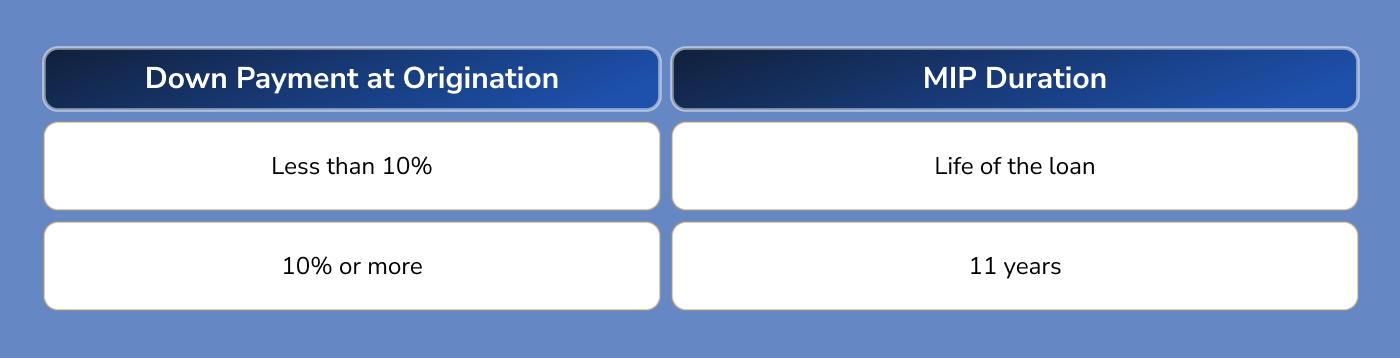
If you put less than 10% down on an FHA loan, you cannot cancel MIP by reaching 20% equity. The only practical way to get rid of PMI fha (technically MIP) is to refinance into a conventional loan once you have at least 20% equity.
This is one of the most common refinance triggers we see in New Hampshire. A buyer who used FHA to get into their first home is often a strong candidate for a conventional refinance two to three years later, especially given the appreciation across most NH towns.
The math to evaluate:
Calculate your current MIP cost annually (loan balance multiplied by your MIP rate, often around 0.55%)
Estimate refinance closing costs (typically 2% to 3% of the new loan amount)
Divide closing costs by annual MIP savings to find your breakeven in months
If you plan to stay in the home longer than the breakeven, refinancing pays off
A NextGen broker can compare conventional refinance options across multiple lenders, since broker access usually surfaces better rates than going to one bank. Use our mortgage calculators to estimate the savings before scheduling a consultation.
PMI Removal Rules: Quick Reference
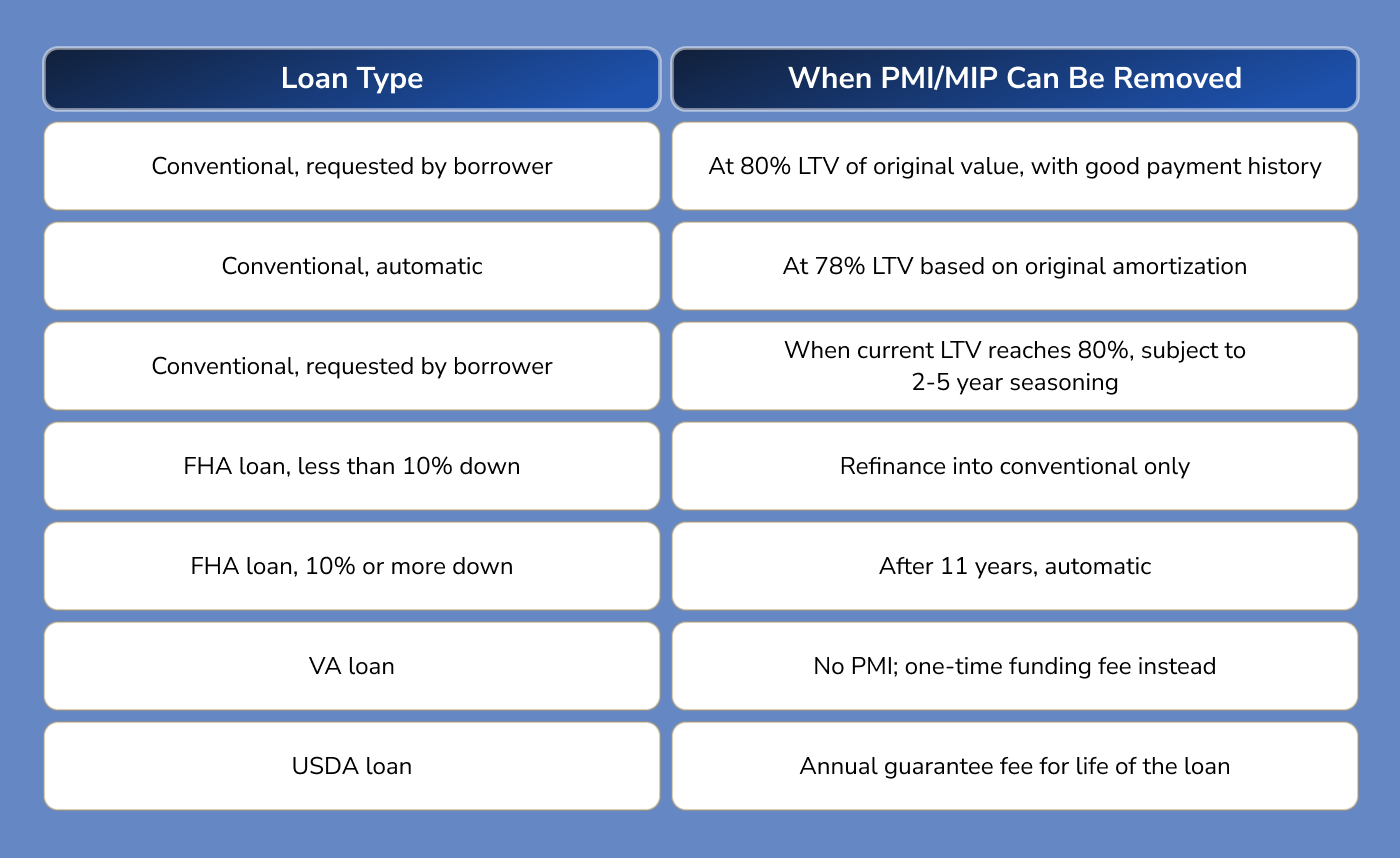
Below is a summary of the main pmi removal rules you need to know.
What NH Homeowners Should Watch For
A few NH-specific factors can affect your PMI cancellation strategy.
Strong appreciation in southern NH: If you bought between 2020 and 2022 in Manchester, Nashua, Concord, Portsmouth, or surrounding towns, you may already have 20% equity from appreciation alone. Pull recent comparable sales before paying for an appraisal.
Property tax timing: New Hampshire has high property taxes and no state income tax. If your escrow account balance shifts after a tax assessment, your monthly payment may change even if your principal balance has not. Do not confuse a payment increase with rising PMI.
Loan-level pricing changes: Loan-level price adjustments from Fannie Mae and Freddie Mac affect what PMI costs at origination. If you locked in 2022 or earlier, your PMI rate may be higher than current quotes, which strengthens the case for a refinance.
How NextGen Mortgage Loans Can Help
Removing PMI is one of the highest-impact moves a homeowner can make, often saving $1,800 to $3,600 per year on a typical NH mortgage. The challenge is figuring out which path actually pencils out for your loan, your home's current value, and your goals.
NextGen Mortgage Loans is a New Hampshire-based broker, which means we shop your scenario across multiple lenders rather than steering you toward a single bank's products. We can review your current loan, model PMI cancellation timelines, run a refinance breakeven analysis, and tell you straight whether it is worth pursuing now or in 12 months.
Consultations are free and there is no obligation. Contact a NextGen loan officer for a 15-minute call, or run the numbers yourself first with our mortgage payment calculator.
Frequently Asked Questions
How much equity do I need to remove PMI?
For a borrower-requested cancellation on a conventional loan, you need 20% equity (80% LTV). Automatic termination kicks in at 22% equity (78% LTV) based on your original amortization. If you are using current home value rather than original purchase price, your servicer's rules and Fannie Mae or Freddie Mac seasoning requirements apply.
Can I remove PMI without a new appraisal?
Sometimes. If your loan balance has reached 80% of the original purchase price through scheduled payments or extra principal, you typically do not need a new appraisal. If you are claiming current value based on appreciation, your servicer will almost always require a Broker Price Opinion or full appraisal at your expense.
Does PMI go away automatically?
Yes, on most conventional loans. Under the Homeowners Protection Act, your servicer must automatically cancel PMI when your loan balance reaches 78% of the original value, assuming you are current on payments. FHA MIP does not automatically go away on loans with less than 10% down; it stays for the life of the loan.
How long does it take to cancel private mortgage insurance after I request it?
Once you submit a complete request with any required appraisal, servicers typically process PMI cancellation within 30 to 60 days. The exact timeline depends on the servicer, whether they need to verify current value, and your payment history. Follow up in writing if you do not get a response within 30 days.
Is it worth refinancing just to remove PMI?
It depends on your interest rate, closing costs, remaining loan term, and how long you plan to stay in the home. If you have an FHA loan with lifetime MIP and at least 20% equity, refinancing often makes sense. If your conventional PMI is a few years from cancellation anyway, a refinance solely to drop PMI may not pay off. Run the breakeven math or ask a broker to do it for you.
Will making extra mortgage payments help me drop PMI faster?
Yes. Extra principal payments lower your loan balance, which gets you to 80% LTV sooner. Once you are there, you can submit a written request to cancel PMI. Even an extra $100 to $200 per month can move the cancellation date up by a year or more on a 30-year loan.
What is the difference between PMI and MIP?
PMI is private mortgage insurance on conventional loans. MIP is the mortgage insurance premium charged on FHA loans. They serve a similar purpose (protecting the lender), but the cancellation rules are very different. MIP on FHA loans with less than 10% down lasts the life of the loan, while PMI on conventional loans can be canceled at 20% equity.

