Questions to Ask a Mortgage Broker: NH Buyer's Guide
The right questions to ask a mortgage broker fall into five buckets: their credentials, the loan options they can offer, total cost (not just the rate), their timeline to close, and how they handle situations specific to your finances or your state. Asking these upfront protects you from surprise fees, slow closings, and loans that do not actually fit your goals.
If you are buying or refinancing in New Hampshire, the questions get sharper. Property tax burdens, county loan limits, and NHHFA programs all shape which loan structure makes sense for you. This guide gives you the exact questions to ask, what to listen for in the answers, and how to spot red flags before you sign anything.
Why the Questions You Ask Your Mortgage Broker Matter
A mortgage is the largest financial commitment most households will ever make. The difference between a well-matched loan and a poorly matched one can amount to tens of thousands of dollars over the life of the loan, plus weeks of friction during closing.
Mortgage brokers are not all the same. A broker who works with 30 lenders has more options than one who works with three. A broker who closes 100 NH transactions a year understands local appraisers, title companies, and town-specific quirks in ways that an out-of-state call center cannot match.
Good questions surface those differences fast. You are not being difficult by asking. You are doing the job a homebuyer is supposed to do.
Questions to Ask About a Mortgage Broker's Credentials and Experience
Start here. If a broker cannot answer these clearly, the rest of the conversation does not matter.
Are you licensed to originate loans in New Hampshire?
Every mortgage loan originator must be registered through the Nationwide Multistate Licensing System (NMLS). Ask for the broker's NMLS ID and verify it at the NMLS Consumer Access site. The record will show their license history, employer, and any disciplinary actions.
How long have you worked in the New Hampshire market specifically?
NH has its own appraisers, its own town-level property tax variations, and its own pace of closings. A broker with five years of NH-specific experience will navigate Rockingham County faster than one who just added NH to their license map last quarter.
How many lenders do you work with?
This is the single biggest broker advantage. A bank can offer you one set of products at one set of rates. A broker can shop dozens of wholesale lenders to find the best fit for your file. If a broker only works with two or three lenders, you are not getting the broker advantage you came for.
How many loans did you close last year?
Volume signals fluency. A broker closing 50 to 150 loans a year has likely seen your situation before, whether you are self-employed, buying a multi-family, or moving up from a starter home.
Questions to Ask About Loan Options and Programs
This is where mortgage broker interview questions get specific. You want to know what you actually qualify for, not just what the broker wants to sell.
Which loan programs do I qualify for, and which do you recommend for my situation?
A good answer compares at least two or three options side by side. Conventional, FHA, VA, USDA, and jumbo loans each have different down payment, credit score, and debt-to-income requirements. Your broker should explain why one fits better than another for your specific goals.
Do you work with NHHFA Home Preferred or Home Flex programs?
The New Hampshire Housing Finance Authority offers down payment assistance and below-market interest rate options for eligible buyers. Not every broker is approved to originate NHHFA loans, so confirm this directly if you are a first-time buyer or moderate-income borrower.
Can you handle my situation if I am self-employed, a 1099 contractor, or recently changed jobs?
Bank statement loans, profit-and-loss statements, and asset-depletion programs exist for borrowers whose tax returns do not tell the full income story. Ask whether the broker has lenders who specialize in non-traditional income documentation. If the answer is vague, keep looking.
What is the minimum down payment for each loan type I am considering?
Per the U.S. Department of Veterans Affairs, VA loans require zero down for eligible veterans. FHA loans require 3.5 percent down with a 580+ FICO, per HUD. Conventional loans can go as low as 3 percent down through Fannie Mae HomeReady or Freddie Mac Home Possible. A broker who can recite these by program is showing you they know the playbook.
Should I consider buying down my rate with discount points?
Discount points cost money upfront in exchange for a lower interest rate. Whether they make sense depends on how long you plan to keep the loan. Run the math with a mortgage calculator before deciding, and ask your broker for a written break-even analysis.
Questions to Ask About Rates, Fees, and Total Cost
This is the cluster of questions where buyers lose the most money by not asking. Rate is one number. Total cost is the number that matters.
What rate can I expect today, and how was that rate priced?
Rates depend on your credit score, loan-to-value ratio, loan type, occupancy, and property type. A broker quoting a rate without first asking about those variables is guessing. Ask for the rate sheet logic: what assumptions produced that quote.
What are your origination fees, broker fees, and any other lender-paid compensation?
By law, brokers must disclose their compensation. Mortgage broker compensation typically falls between 1 and 2 percent of the loan amount, paid either by you (borrower-paid) or by the lender (lender-paid). Ask which model applies to your loan and how it affects your rate.
Can you provide a Loan Estimate within three business days?
The Loan Estimate is a standardized three-page form required by the Consumer Financial Protection Bureau. It lists rate, monthly payment, closing costs, and cash to close in a format designed to be compared across lenders. If a broker cannot or will not produce one, that is a red flag.
What are typical closing costs in New Hampshire?
NH closing costs include lender fees, title insurance, recording fees, and the NH real estate transfer tax. The transfer tax is paid by both buyer and seller in most NH transactions. A local broker should be able to estimate your all-in closing costs within a few hundred dollars.
Will my rate be locked, and for how long?
Rate locks typically run 30, 45, or 60 days. Ask whether your lock is free, what happens if your closing slips past the lock date, and whether float-down options exist if rates drop before closing.
Questions to Ask About the Pre-Approval and Closing Timeline
These are the questions before getting preapproved that most buyers skip and later regret.
What is the difference between pre-qualification and pre-approval, and which will I get?
Pre-qualification is a soft estimate based on stated information. Pre-approval involves a credit pull, income and asset verification, and a written commitment letter. In a competitive NH market, sellers expect pre-approval, not pre-qualification. Ask which one your broker will issue.
How long does pre-approval take, start to finish?
A solid broker can issue pre-approval within 24 to 72 hours once you submit your documents. If you are quoted a week or longer, ask why.
What is your average time from contract to close?
Most NH purchase transactions close in 30 to 45 days. Some brokers consistently close in 21 days. Ask for the broker's average and what could slow your specific file down.
What documents will you need from me upfront?
Expect to provide two years of W-2s or tax returns, two months of pay stubs, two months of bank statements, photo ID, and a list of debts. Self-employed borrowers should also expect to provide profit-and-loss statements and business tax returns. The faster you supply complete documents, the faster you close.
Who will I be working with day to day?
Some brokers hand you off to a processor or assistant after the initial conversation. That is not necessarily bad, but you should know upfront who answers your texts at 7 p.m. when you are in a bidding war.
Questions Specific to Buying a Home in New Hampshire
Local context separates a generic broker from one who actually understands your market.
How do NH property taxes affect my qualification amount?
NH has no state income tax, but it relies heavily on local property taxes. Towns like Claremont, Berlin, and Charlestown carry some of the highest effective rates in the state, while towns along the Seacoast can be substantially lower. Your debt-to-income calculation includes your property tax bill, so a higher-tax town can reduce the maximum home price you qualify for.
Are conforming loan limits different in any NH counties?
The Federal Housing Finance Agency sets conforming loan limits annually. Most NH counties follow the standard limit, but Rockingham and Strafford counties are part of the Boston-Cambridge-Newton metropolitan area, which sometimes carries a higher conforming limit. Ask your broker to confirm current limits before you start shopping.
Do you handle condo financing and warrantable condo reviews in NH?
Condo financing has extra hurdles: HOA budget reviews, owner-occupancy ratios, and project warrantability. If you are looking at condos in Portsmouth, Manchester, Nashua, or the Lakes Region, ask whether the broker has lenders who routinely approve NH condo projects.
Can you finance a multi-family or owner-occupied 2 to 4 unit property?
NH has a healthy stock of two and three-unit properties, especially in Manchester and Nashua. Owner-occupant financing on these properties allows low down payments and rental income offsets. Ask whether your broker has experience structuring these loans.
Mortgage Broker vs. Bank: A Quick Comparison
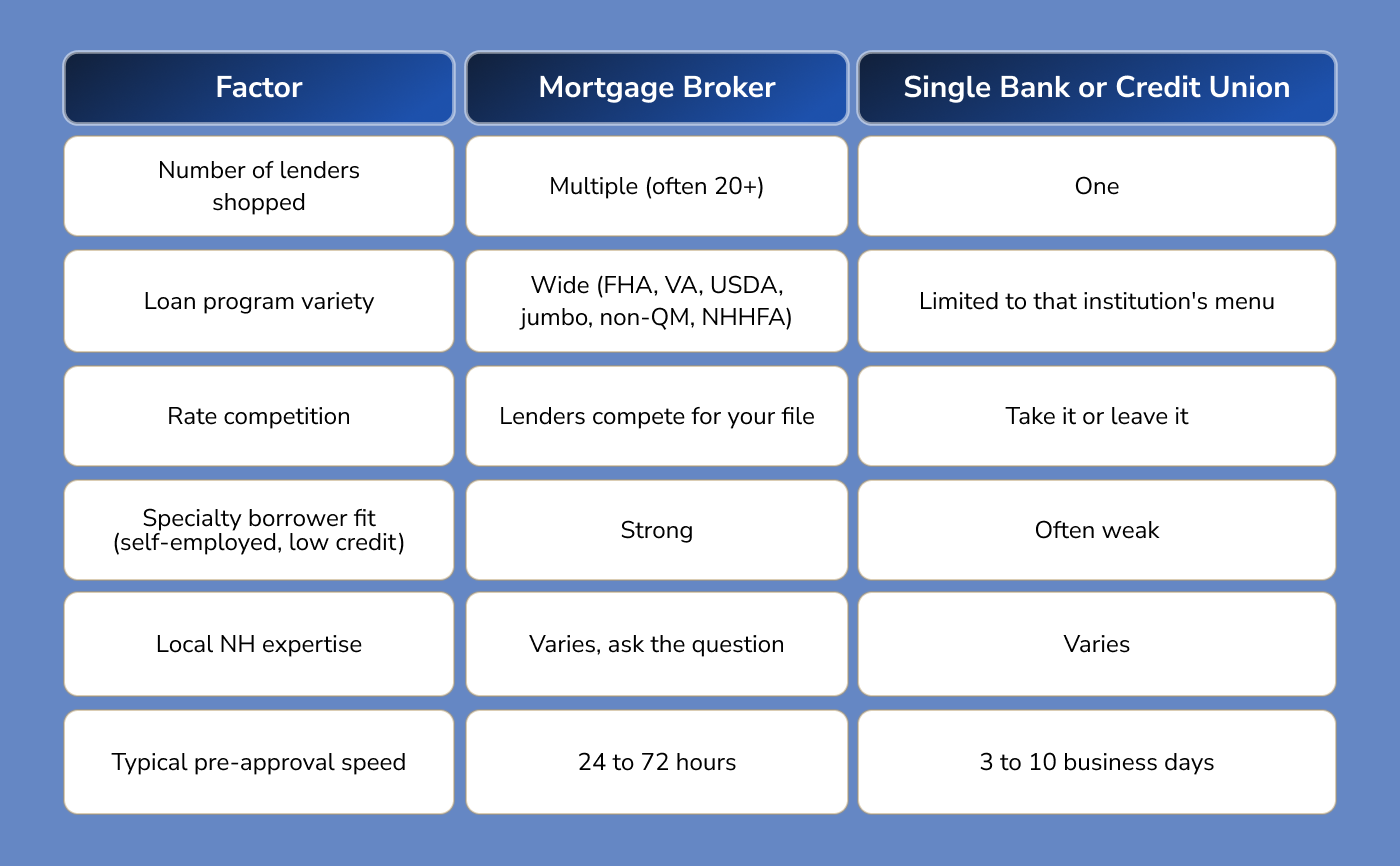
This is why so many NH buyers start with a broker. You get one application and one point of contact, with multiple lenders bidding for your loan.
Red Flags to Watch For When Interviewing a Mortgage Broker
Trust your instincts when something feels off. These are the most common warning signs:
The broker quotes a rate before asking about your credit, income, or down payment
The broker pressures you to sign a Loan Estimate the same day
Fees are vague or change between conversations
You cannot get a clear NMLS ID or license verification
The broker discourages you from shopping other lenders
Communication is slow during the pre-approval phase (it only gets slower at closing)
The broker promises a specific approval outcome before reviewing your file
A trustworthy broker invites comparison, explains every fee on the Loan Estimate, and tells you when a different lender might serve you better.
How NextGen Mortgage Loans Can Help
NextGen Mortgage Loans is a New Hampshire-based mortgage broker working with multiple wholesale lenders so your file gets shopped, not pigeonholed. We handle conventional, FHA, VA, USDA, jumbo, and non-traditional income loans, and we know NH towns, NH appraisers, and NH closing timelines because we work in them every day.
When you talk to a NextGen loan officer, you get a no-cost consultation, a clear breakdown of which loan programs fit your situation, and a written Loan Estimate you can compare against any other quote. Pre-approvals typically turn around in 24 to 72 hours.
Ready to get started? Contact a NextGen loan officer for a free consultation, or run the numbers yourself with our mortgage calculators before your first call. If you are a veteran, our VA loan calculator will give you a quick estimate of monthly payment and funding fee.
Frequently Asked Questions
What is the most important question to ask a mortgage broker?
The single most useful question is "How many lenders do you work with, and can you show me Loan Estimates from at least two of them?" The whole point of using a broker is competition between lenders, and that question forces it into the open.
Should I get pre-approved before talking to a mortgage broker?
You get pre-approved through the broker, not before. The first conversation is where you collect documents, run credit, and compare loan options. In NH purchase markets, plan to be pre-approved before you start touring homes seriously.
Are mortgage broker fees worth it?
In most cases, yes. Brokers shop multiple lenders, and the rate savings often exceed the broker fee. Ask for a borrower-paid versus lender-paid comparison so you can see the math for your specific loan amount.
How many mortgage brokers should I interview?
Two or three is standard. You want enough comparison to spot outliers in rate, fees, and service quality, but not so many that you delay your purchase. Get a Loan Estimate from each and compare them line by line.
Can a mortgage broker get me a better rate than a bank?
Often, yes. Brokers access wholesale rates from multiple lenders, while a bank only offers its own retail rates. The advantage is biggest for borrowers with strong credit, self-employed borrowers, and anyone with a unique situation that a single bank's underwriting box does not fit.
What documents will a mortgage broker ask for?
Plan to provide two years of tax returns or W-2s, two months of pay stubs, two months of bank and asset statements, photo ID, and a list of monthly debts. Self-employed borrowers should also bring profit-and-loss statements and business returns. Submitting clean, complete documents up front is the fastest way to a 21-day close.
Is a mortgage broker the same as a mortgage lender?
No. A mortgage lender funds the loan with its own money. A mortgage broker is a licensed intermediary who matches your file to a wholesale lender that funds the loan. Brokers do not lend their own money, which is why they can shop multiple lenders for you. Both must be licensed through NMLS, and both are regulated under federal and state lending laws.

