2026 Mortgage Rate Forecast: What NH Buyers Should Expect
The 2026 mortgage rate forecast points to 30-year fixed rates staying in the low-to-mid 6% range through year-end, with major institutions projecting a finish somewhere between 5.9% and 6.4%. As of early May 2026, the Freddie Mac 30-year fixed-rate average sits at 6.30%, and both Fannie Mae and the Mortgage Bankers Association have signaled that most of the rate relief from late 2025 is already priced in. For New Hampshire buyers and homeowners weighing a refinance, the practical takeaway is simple: planning around current rates is more useful than waiting for a return to the pandemic-era 3% range.
This guide walks through where rates are now, what the major forecasters expect, what is driving the outlook, and what it all means if you are shopping a home in NH this year.
Where Mortgage Rates Stand Right Now (May 2026)
Quick answer: As of the week ending April 30, 2026, the Freddie Mac 30-year fixed-rate average is 6.30% and the 15-year fixed is 5.64%. A year earlier, the 30-year average was 6.76%.
So far in 2026, rates opened the year just above 6%, dipped to 5.98% in late February (the lowest in three and a half years), and climbed back through April amid renewed inflation pressure and geopolitical volatility. Daily lender quotes can sit slightly above or below the Freddie Mac weekly survey, depending on credit profile, loan type, and lock period.
For NH buyers, that movement matters more than the snapshot. A 0.40 percentage point swing on a $400,000 loan changes the monthly payment by roughly $100, which is significant when you are qualifying at the edge of your debt-to-income ratio.
If you want to see how today's rates affect your budget specifically, the mortgage calculators on our site let you run scenarios with current pricing.
Will Mortgage Rates Go Down in 2026? What the Forecasts Say
Quick answer: Most major forecasts expect rates to drift slightly lower or hold near current levels through the end of 2026, but no major institution is calling for a return below 5.5%.
Here is where the major sources land for the rest of 2026:
Fannie Mae (April 2026 Housing Forecast): 30-year fixed at 6.3% for Q2 2026, then 6.1% throughout the rest of 2026 and 2027.
Mortgage Bankers Association: average rate between 6% and 6.5% by the end of 2026, with projection materials calling for 6.4% in Q4 2026.
Wells Fargo Economic Outlook: a 30-year fixed average of 6.14% in 2026 and 6.19% in 2027.
National Association of Home Builders: an average of 5.99% in 2026, falling slightly below 6% by year-end.
Bankrate's lender survey put the average 30-year mortgage rate at 6.37% as of April 29, in line with the institutional outlook. The shared message across these forecasts: expect the new normal for the 30-year fixed to settle between roughly 5.7% and 6.5% rather than fall sharply below it.
Anyone waiting for rates to return to 3% or 4% should plan around a different scenario. The forecasters do not see a path back there without a recession or a major shift in the inflation picture.
What Is Driving the 2026 Mortgage Rate Forecast
Mortgage rates do not move in a vacuum. They follow several big inputs at once.
The 10-Year Treasury Yield
The 30-year fixed mortgage tracks closely with the 10-year Treasury yield, plus a spread that compensates lenders for prepayment and credit risk. The 10-year Treasury yield came in at 4.414% in early May 2026, which puts a floor under mortgage rates regardless of what the Fed does next.
Federal Reserve Policy
The Fed sets the federal funds rate, which influences short-term borrowing costs. The Federal Reserve is maintaining a target federal funds rate of 4.25% to 4.50% as of early May 2026. The Fed does not set mortgage rates directly, but its signals about future cuts move the bond market and, through it, mortgage pricing.
Inflation
As of early 2026, inflation is sticking around the 2.7% to 3.3% mark, above the Fed's 2% target. Persistent inflation reduces the odds of aggressive rate cuts and keeps long-term yields elevated.
The Mortgage Spread
The gap between the 10-year Treasury and the 30-year fixed mortgage rate has been wider than its historical average. Historically, this gap is around 1.5% to 2.0%. Recently, due to market volatility and lender risk mitigation, the spread has been abnormally wide, sometimes exceeding 2.5% to 3.0%. If that spread compresses as market volatility eases, mortgage rates could fall even if Treasury yields stay flat.
Geopolitical and Energy Shocks
Conflict in the Middle East has pushed oil prices higher in 2026, which feeds back into inflation expectations and rate forecasts. This is the most volatile input on the list and the one most likely to push rates outside the forecast range in either direction.
Mortgage Rate Predictions 2026: A Side-by-Side Look
The table below summarizes what the major forecasters expect for 30-year fixed rates by the end of 2026.
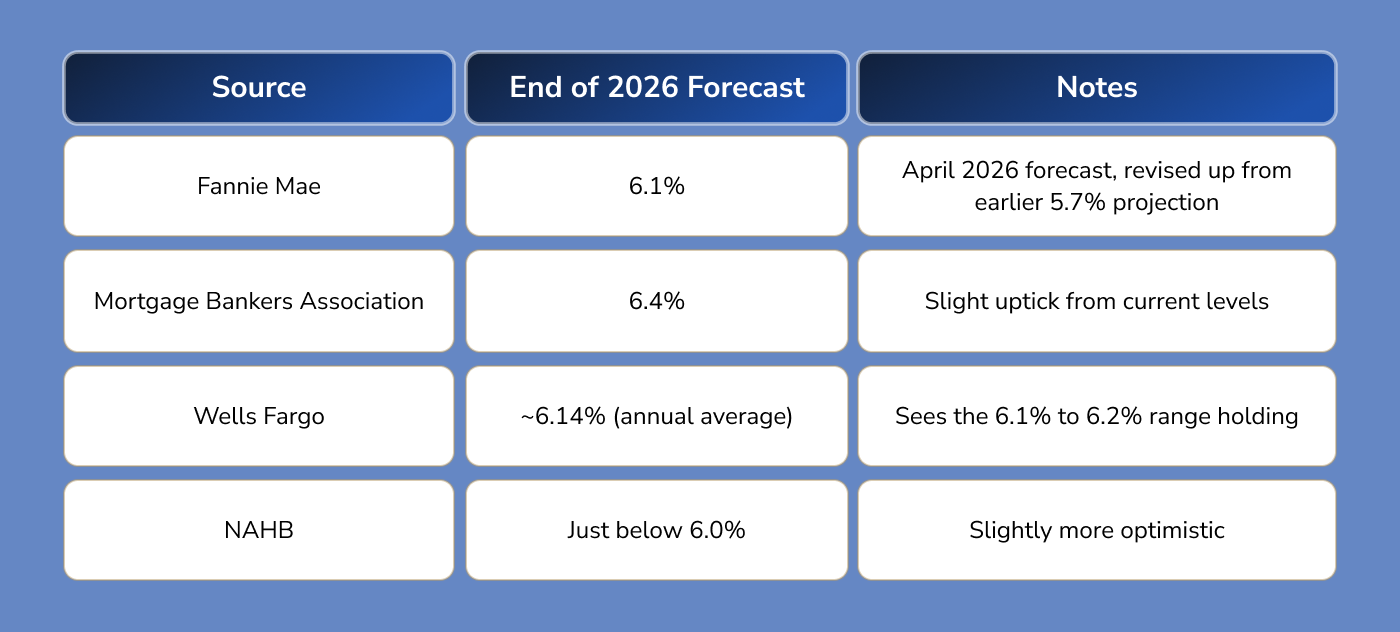
Three things to read into this:
The range is tight. Even the most optimistic and pessimistic forecasts are within about 0.4 percentage points of each other.
Forecasts have moved up, not down, over the past year. In March, Fannie Mae had predicted a rate as low as 5.7% in 2026 and 5.6% in 2027 before geopolitical risk and stickier-than-expected inflation pushed those numbers higher.
None of the major forecasters expect a sub-6% finish with confidence. A few see it as possible. Most see it as unlikely without a meaningful economic surprise.
What This Interest Rate Forecast Means for the Housing Market in New Hampshire
Rates in the low-to-mid 6% range have a few clear effects on the NH housing market.
Inventory stays tight. Many existing NH homeowners locked in rates between 3% and 4% during 2020 and 2021. With current rates near 6.3%, those owners are reluctant to sell and trade into a higher payment. A drop to 6.0% or 5.9% might be the psychological tipping point required to encourage these homeowners to list their properties, especially in Hillsborough, Rockingham, and Strafford counties where demand remains strongest.
Home prices hold up. With limited supply and steady demand from Massachusetts buyers relocating to NH, home prices are not expected to fall meaningfully in 2026. Fannie Mae forecasts national home price growth of 1.3% in 2026 and 1.2% in 2027, with regional variation.
Buyer leverage improves modestly. Compared to 2021 and 2022, today's market gives buyers more room to negotiate. Inspection contingencies are returning to most contracts. Sellers in some submarkets are offering rate buydowns or closing cost credits to make payments more affordable.
The refinance window remains narrow. Owners who closed in 2023 or 2024 at rates above 7% may already have a viable refinance opportunity at current pricing. Owners with rates in the low 6s should run the math carefully, since closing costs may eat into the savings.
A NextGen loan officer can walk you through both the purchase math and the refinance break-even analysis based on your specific scenario.
NH-Specific Context: Loan Limits, Affordability, and What to Watch
If you are shopping in New Hampshire, three local factors matter alongside the national rate picture.
2026 Conforming Loan Limits in NH
The Federal Housing Finance Agency raised the 2026 baseline conforming loan limit to $832,750 for one-unit properties, an increase of $26,250 from 2025. The new ceiling for high-cost areas is $1,249,125, which is 150 percent of the baseline.
For FHA borrowers, NH limits vary by county. In 2026, the FHA one-unit limit is $962,550 in Rockingham and Strafford counties, $589,950 in Hillsborough County, and $541,287 in Belknap, Carroll, Cheshire, Coos, Grafton, Merrimack, and Sullivan counties.
These limits matter because loan amounts above them require jumbo financing, which typically carries different qualifying criteria and pricing. In Hillsborough's higher-priced towns (Bedford, Amherst, Hollis), more buyers cross into jumbo territory than they did three years ago. If you are weighing FHA against conventional, our guide on FHA loan qualifications in New Hampshire walks through the trade-offs.
NHHFA Programs
The New Hampshire Housing Finance Authority offers down payment assistance and below-market-rate programs for income-eligible first-time buyers. Programs change from year to year, so verify current offerings at nhhfa.org. These programs can be layered with FHA, VA, or conventional loans and are particularly valuable for buyers in the $300,000 to $500,000 price range.
Property Tax Context
NH property taxes are among the highest in the country in absolute dollars per home, even though the state has no income or sales tax. When you are estimating what you can afford, the property tax line on your monthly payment matters as much as the interest rate. Towns vary significantly. Equalized rates in some Merrimack and Sullivan County towns are notably higher than in Rockingham or Strafford. Always run the numbers with the actual tax bill from the property you are targeting, not a state average.
Should You Buy or Refinance in 2026 Given Current Rates?
Quick answer: If you can afford the payment at today's rate and the home fits your life, buying makes sense. If you are refinancing from a rate above roughly 7.25%, the math may already work.
A few practical filters:
Run the affordability test at today's rate, not a hoped-for future rate. If the payment only works at 5.5%, you do not have enough margin.
Compare lender quotes carefully. A NextGen broker can pull pricing from multiple wholesale lenders in one application, which often surfaces a meaningful pricing advantage compared to going to a single bank.
Consider a temporary buydown or seller-paid points. In a slower NH market, sellers are sometimes willing to fund a 2-1 buydown that lowers your effective rate for the first two years.
Don't ignore non-QM options. Self-employed and retired NH buyers may qualify on bank statements or asset depletion when traditional documentation falls short.
Mortgage rate predictions 2026 are useful for planning, but they are forecasts, not guarantees. The buyers who do best are usually those who lock when the math works for them, not those trying to call the bottom.
How NextGen Mortgage Loans Can Help
NextGen Mortgage Loans is a New Hampshire-based broker, which means we shop your loan across multiple wholesale lenders rather than offering one bank's pricing. For most borrowers, that translates to a real rate advantage and access to a wider set of programs, including FHA, VA, USDA, conventional, jumbo, and non-QM options for self-employed and unique-income borrowers.
We focus on the New Hampshire market, so we know the local towns, the property tax patterns, and the NHHFA programs that can lower your costs. Pre-approvals come back fast, and our team walks you through the rate-lock decision with the current 2026 forecast in mind, not last year's data.
If you want a no-cost review of your scenario, contact a NextGen loan officer or run preliminary numbers with our mortgage calculators before your next conversation.
Frequently Asked Questions
Will mortgage rates go down in 2026?
Most major forecasts expect 30-year fixed rates to drift slightly lower or stay near current levels through the end of 2026, finishing somewhere between 5.9% and 6.4%. Fannie Mae's April 2026 outlook calls for 6.1%, while the MBA expects closer to 6.4%. A return below 5.5% is not in any major institutional forecast.
What is the average mortgage rate in New Hampshire right now?
NH rates typically track the national average within a tenth of a point. As of early May 2026, the Freddie Mac national 30-year fixed average is 6.30%. Individual NH borrowers may see slightly higher or lower rates depending on credit score, loan type, down payment, and county. A NextGen broker can quote your specific scenario.
Are mortgage rates expected to drop below 6% in 2026?
A move below 6% is possible but not the consensus expectation. NAHB's forecast calls for rates to dip just under 6% by late 2026, while Fannie Mae and the MBA both expect rates to stay in the low-to-mid 6% range. A larger drop would generally require softer inflation, lower Treasury yields, or a meaningful Fed pivot.
How does the Federal Reserve affect my mortgage rate?
The Fed sets the federal funds rate, which influences short-term borrowing costs. Mortgage rates follow the 10-year Treasury yield more closely, but Fed signals about future cuts or hikes move the bond market and, indirectly, mortgage pricing. A Fed rate cut does not always lead to a same-day drop in mortgage rates.
What is the 2026 conforming loan limit in New Hampshire?
The baseline 2026 conforming loan limit is $832,750 for one-unit properties, set by the Federal Housing Finance Agency. Two NH counties, Rockingham and Strafford, are designated high-cost areas with elevated FHA ceilings of $962,550 for one-unit homes. Loans above your county's limit are classified as jumbo.
Should I lock in my mortgage rate now or wait?
This depends on how close you are to closing and your tolerance for rate risk. If you have an accepted offer and the payment works at today's rate, locking removes uncertainty. If you are 60 to 90 days out, a float-down option or a longer lock may make sense. A NextGen loan officer can walk you through the lock-versus-float math in 15 minutes.
How accurate are mortgage rate forecasts?
Mortgage rate forecasts from major institutions are useful for planning but rarely precise to the basis point. Fannie Mae itself revised its 2026 forecast upward by roughly 0.4 percentage points between March and April 2026 after geopolitical events shifted the picture. Use forecasts as a range, not a target, and make decisions based on the rate you can actually qualify for today.

