APR vs Interest Rate Mortgage: What NH Buyers Need to Know
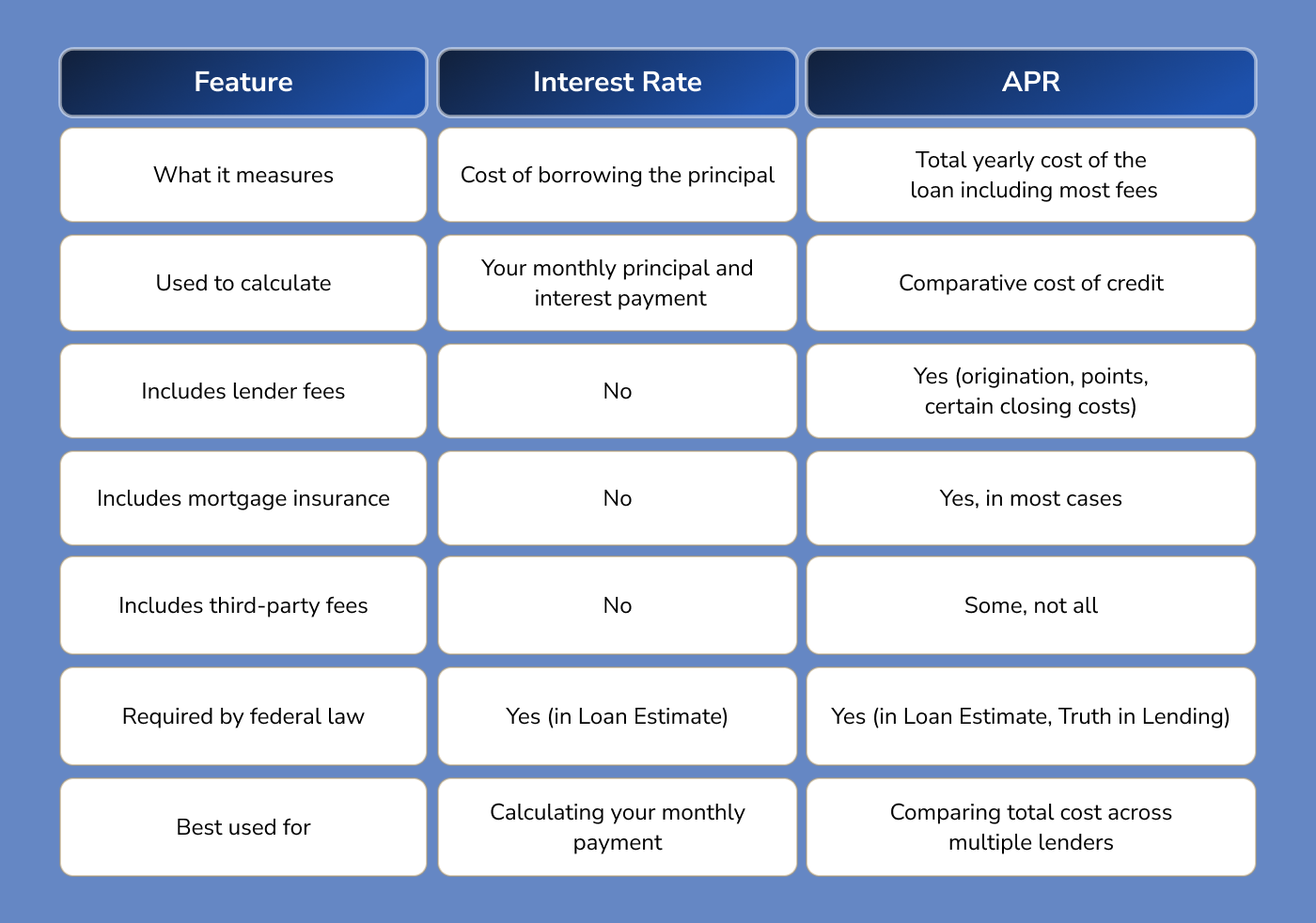
The interest rate on a mortgage is the cost of borrowing the principal. The APR is a broader number that includes the interest rate plus most lender fees and certain closing costs, expressed as a yearly percentage. When you compare loan offers, the interest rate tells you what your monthly payment will be built on, and the APR tells you what the loan actually costs you over time.
If you are shopping for a home in New Hampshire, this distinction matters more than most buyers realize. Two lenders can quote you the same interest rate and end up costing you thousands of dollars more or less, and the APR is where that difference shows up. This guide breaks down apr vs interest rate mortgage comparisons in plain English, explains what is included and excluded in APR, and shows you how to use both numbers to make a smarter decision.
Quick Answer: APR vs Interest Rate
Interest rate is the percentage a lender charges to borrow the loan amount. It determines your monthly principal and interest payment.
APR (Annual Percentage Rate) includes the interest rate plus most upfront loan costs (points, lender fees, mortgage insurance in some cases) expressed as a yearly rate. It is designed to show the true annualized cost of the loan.
Rule of thumb: if two loans have the same interest rate, the one with the lower APR is the cheaper loan.
What Is the Interest Rate on a Mortgage?
The interest rate is the percentage your lender charges you each year to borrow the loan amount. It is the foundation of your monthly payment, but it is not the full picture.
On a 30-year fixed mortgage of $400,000 at 6.5%, your monthly principal and interest payment is roughly $2,528. That figure is driven entirely by the interest rate, the loan term, and the loan amount. It does not reflect any of the fees you pay to get the loan in the first place.
Interest rates are influenced by:
Your credit score and credit history
Your down payment and loan-to-value ratio
The loan type (conventional, FHA, VA, USDA)
The loan term (15-year rates are typically lower than 30-year)
Whether you pay discount points to buy down the rate
Broader market conditions, including the 10-year Treasury yield and Federal Reserve policy
Freddie Mac publishes a weekly Primary Mortgage Market Survey that tracks the average 30-year and 15-year fixed rates nationally. That number is a reference point, not a quote. Your actual rate depends on your file.
What Is APR on a Mortgage?
The APR on a mortgage is a federally required disclosure designed to help you compare loans on a more apples-to-apples basis. It rolls the interest rate together with most of the upfront costs of getting the loan and expresses the total as a yearly percentage.
The Truth in Lending Act (TILA) and Regulation Z require lenders to disclose APR on every closed-end mortgage. According to the Consumer Financial Protection Bureau (CFPB), APR is intended to give borrowers a single number that reflects the cost of credit, not just the interest charge.
Here is the key insight: APR is almost always higher than the interest rate, because it folds in fees. If a lender quotes you an interest rate of 6.5% and an APR of 6.75%, the gap of 0.25% reflects the cost of points, origination charges, and other lender fees spread across the life of the loan.
The bigger the gap between the interest rate and the APR, the more the loan is costing you in upfront fees.
APR vs Interest Rate Mortgage: Side-by-Side Comparison
What's Included in Mortgage APR (and What Isn't)
This is where most borrowers get tripped up. Mortgage APR is not a complete picture of every dollar you will spend at closing. It is a regulated calculation with specific inclusions and exclusions.
Typically included in APR:
The interest rate itself
Discount points (each point is 1% of the loan amount)
Origination fees and lender processing fees
Mortgage broker fees
Private mortgage insurance (PMI) or FHA mortgage insurance premiums
Certain prepaid interest charges
Typically excluded from APR:
Appraisal fees
Credit report fees
Home inspection fees
Title insurance (in many cases)
Recording fees and transfer taxes
Homeowners insurance and property tax escrows
Attorney fees (relevant in NH closings)
The exclusions matter in New Hampshire specifically because closing costs here often include attorney representation, NH transfer tax (the Real Estate Transfer Tax, paid by both buyer and seller at $0.75 per $100 of consideration each), and title work that may not flow into the APR calculation. Your APR can look attractive while your actual cash to close tells a different story. Always review the full Loan Estimate, not just the headline rate and APR.
Why APR Can Be Misleading
APR is a useful tool, but it has real limitations. Knowing where the math breaks down helps you avoid being steered into the wrong loan.
APR assumes you will keep the loan for its full term. APR amortizes upfront fees across 30 years (or 15, or whatever the term is). If you sell or refinance in five or seven years, which is typical for many homeowners, you never recover the cost of those upfront fees the way the APR math assumes you will. A loan with a slightly higher rate but lower fees may actually be cheaper if you do not stay long.
APR calculations are not perfectly standardized across lenders. While the CFPB sets the rules, lenders can interpret which third-party fees flow into APR slightly differently. Two lenders quoting the same APR may have built that number from different fee assumptions.
Adjustable-rate mortgages (ARMs) make APR less reliable. For an ARM, APR is calculated using current rates and assumed adjustments, but your actual rate will move based on the underlying index. The APR number is a snapshot, not a forecast.
Discount points distort comparisons. A lender can quote a low rate and low APR by assuming you pay several points upfront. Always check the points and fees on the Loan Estimate, not just the rate and APR.
How to Compare Loan Offers Using APR and Interest Rate
When you have two or three Loan Estimates side by side, here is the right way to read them.
Confirm the loan type and term match. A 30-year fixed at 6.5% cannot be compared to a 7/1 ARM at 6.0%. Compare the same product.
Look at the interest rate first. This drives your monthly payment.
Look at the APR second. A lower APR at the same interest rate means lower fees. A higher APR at the same interest rate means higher fees.
Check Section A on the Loan Estimate (Origination Charges). This shows points and lender fees in dollar terms.
Check the "Comparisons" section on page 3 of the Loan Estimate. It shows the total you will have paid in five years and the total interest percentage.
Calculate your break-even on points. If a lender wants you to pay $4,000 in points to save $50 a month, that is an 80-month break-even. If you plan to refinance or move sooner, do not buy the points.
Account for cash to close. A lower APR means little if it requires significantly more money at closing than you have available.
A NextGen loan officer can walk you through a side-by-side Loan Estimate comparison in about 15 minutes and flag the line items that actually move the needle for your situation.
APR vs Interest Rate for New Hampshire Homebuyers
NH buyers face a few specific factors that interact with how you should weigh APR vs interest rate.
NH home prices push many buyers above the conforming line in some cases. The 2026 conforming loan limit set by the FHFA is $806,500 for one-unit properties in most of the country, including all NH counties. Loans above that limit are jumbo loans and often carry different fee structures, which means the APR-to-rate gap can look different than on a conventional conforming loan.
Property taxes are high, which affects total housing cost but not APR. NH has no state income tax or general sales tax, but property taxes are among the highest in the country. Property taxes are not included in your APR. They are escrowed into your monthly payment, so two loans with identical APRs can produce very different monthly payments depending on the town. Concord, Manchester, Nashua, Portsmouth, and the Lakes Region all have different tax rates.
NHHFA programs change the math. The New Hampshire Housing Finance Authority offers down payment assistance and below-market-rate first mortgages for eligible buyers. These programs can affect both the rate and the APR. If you might qualify, factor that into your shopping. Our first-time homebuyer guide walks through what to look for.
Out-of-state buyers crossing from MA need to compare carefully. If you are working with a MA-based lender and a NH-based broker, the fee structures and required services can differ. NH closings typically use attorneys rather than escrow agents, and that affects which fees show up where on the Loan Estimate.
For a quick estimate of what your monthly payment looks like at different rates, our mortgage calculators let you model principal, interest, taxes, and insurance for any NH town.
How NextGen Mortgage Loans Can Help
As a New Hampshire-based mortgage broker, NextGen Mortgage Loans gives you access to multiple wholesale lenders rather than the single rate sheet you get walking into a retail bank. That matters specifically for the apr vs interest rate mortgage comparison, because we can pull Loan Estimates from several lenders and show you where one is winning on rate, another on fees, and which one actually costs less for your specific situation.
We work with NH first-time buyers, move-up buyers, refinancers, veterans using VA loans, and self-employed borrowers whose files do not fit the standard bank box. There is no cost to talk through your numbers, and pre-approvals typically come back fast.
If you are ready to compare real Loan Estimates side by side, contact a NextGen broker or start with our mortgage calculators to model your monthly payment.
Frequently Asked Questions
What is the difference between APR and interest rate on a mortgage?
The difference between APR and interest rate is what each number includes. The interest rate is the cost of borrowing the principal and drives your monthly payment. The APR includes the interest rate plus most lender fees, points, and mortgage insurance, expressed as a yearly percentage. APR is almost always higher than the interest rate, and the gap between them shows you how much you are paying in upfront costs.
Is a lower APR always better on a mortgage?
Not always. A lower APR is better when comparing two loans with the same interest rate, term, and structure, because it means lower fees. However, APR assumes you keep the loan for the full term. If you plan to sell or refinance within a few years, a loan with a slightly higher rate and lower upfront fees may cost you less in the real world.
What is APR on a mortgage typically?
Mortgage APR is typically 0.10% to 0.50% higher than the interest rate, depending on points, origination fees, and mortgage insurance. A larger gap usually signals higher upfront costs. If a lender shows an APR that is more than half a percentage point above the rate, ask for an itemized breakdown of fees on the Loan Estimate.
Does APR include closing costs?
APR includes most lender-related closing costs, including origination fees, discount points, and mortgage insurance. It generally excludes third-party fees such as appraisal, credit report, home inspection, title insurance in many cases, recording fees, and attorney fees. This is why your total cash to close can be higher than the APR alone suggests.
Why is my mortgage APR higher than my interest rate?
Your APR is higher because it folds in the upfront cost of getting the loan, not just the cost of borrowing money. Points, origination charges, mortgage broker fees, and mortgage insurance all push APR above the interest rate. The bigger the fees, the bigger the gap.
How does APR work on an adjustable-rate mortgage?
On an adjustable-rate mortgage, APR is calculated using the initial rate and assumed future rate adjustments based on current index values. Because the actual rate will change with the index, the APR on an ARM is a snapshot rather than a guarantee. Compare ARMs by looking at the initial rate, the margin, the index, the adjustment caps, and the lifetime cap, in addition to APR.
Should I focus on APR or interest rate when shopping for a mortgage?
Look at both, in order. The interest rate determines your monthly payment, so start there to make sure the payment fits your budget. Then use APR to compare the total cost of loans with similar interest rates. Finally, look at the actual fees on the Loan Estimate, your cash to close, and how long you plan to keep the loan. The right answer depends on your timeline as much as the numbers.

