

DTI Ratio for Mortgage: Limits, Math, and How to Qualify
Your debt-to-income ratio is one of the three biggest factors a lender uses to decide whether you qualify for a mortgage, alongside credit score and down payment. Most loan programs cap your DTI ratio for mortgage approval somewhere between 43% and 50%, though the exact ceiling depends on the loan type, your credit profile, and compensating factors like cash reserves.
This guide walks you through how DTI works, how to calculate it for a mortgage application, where program limits sit in 2026, and what New Hampshire buyers need to know about how local property taxes affect the math. If you are getting ready to buy or refinance, understanding your DTI before you apply gives you control over the outcome.
What Is DTI Ratio for a Mortgage?
A debt-to-income ratio is the percentage of your gross monthly income that goes toward paying recurring debts. Lenders use it to gauge whether you can comfortably take on a new mortgage payment without becoming overextended.
Quick answer: DTI = (total monthly debt payments / gross monthly income) × 100.
Mortgage lenders look at the debt to income ratio mortgage applicants submit in two forms: front-end and back-end. Both numbers come from the same income figure but measure different slices of your obligations.
Front End vs Back End DTI: What Lenders Actually Measure
The difference between the two ratios trips up a lot of first-time applicants. Here is the clean breakdown.
Front-End DTI (Housing Ratio)
Your front-end DTI includes only your projected monthly housing payment. That payment is often called PITI, which stands for principal, interest, taxes, and insurance. If the property has HOA dues or PMI, those are added in too.
Formula: PITI / gross monthly income = front-end DTI.
Most lenders want to see a front-end ratio at or below 28% to 31%, though program rules vary and many lenders no longer enforce a hard front-end cap if the back-end DTI passes.
Back-End DTI (Total Debt Ratio)
Your back-end DTI is the more important number for most loan programs. It includes your future housing payment plus all other recurring debt obligations.
Formula: (PITI + all other monthly debts) / gross monthly income = back-end DTI.
When someone says "the max DTI for a conventional loan is 45%," they almost always mean the back-end ratio.
How to Calculate DTI for a Mortgage in Five Steps
Run your own numbers before you talk to a lender. Knowing how to calculate DTI for a mortgage is simple math, but the inputs need to be accurate.
Add up your gross monthly income. Use pre-tax income from W-2 wages, self-employment, bonuses, alimony received, retirement, and any other documented sources. For variable income, lenders typically average 24 months.
List every recurring monthly debt payment. Include minimum credit card payments, auto loans, student loans, personal loans, child support, alimony paid, and any co-signed loan payments that show on your credit report.
Add your projected housing payment (PITI). Estimate principal and interest based on a realistic loan amount, plus property taxes, homeowners insurance, and PMI or HOA dues if applicable.
Add the housing payment to your other debts to get total monthly obligations.
Divide total debts by gross monthly income and multiply by 100. That is your back-end DTI.
Example: If you earn $8,000 per month gross and have $700 in non-housing debts plus a projected $2,100 PITI, your back-end DTI is ($2,800 / $8,000) × 100 = 35%. That sits comfortably inside conventional, FHA, and VA guidelines.
What Counts as Debt for DTI (and What Does Not)
Lenders do not include every bill you pay. They look at obligations that show up on your credit report or that are legally required.
Counted in DTI:
Minimum monthly credit card payments
Auto loan and lease payments
Student loan payments (more on this below)
Personal loans and installment debt
Existing mortgage payments on other properties
Child support and alimony you pay
Co-signed loans (usually counted unless you can document 12 months of someone else paying)
Not counted in DTI:
Utilities, cell phone, internet, streaming subscriptions
Groceries, gas, and other variable spending
Insurance premiums other than those bundled into PITI
Income taxes withheld from your paycheck
401(k) loans (in most cases)
Medical bills not in collections
Student loans deserve a note. Each program treats deferred or income-driven repayment plans differently. Conventional loans (Fannie Mae and Freddie Mac) generally allow lenders to use the actual payment shown on your credit report or 1% of the balance. FHA requires the actual documented payment, or 0.5% of the balance if no payment is reported. If your loans are in deferment or on an income-driven plan, this calculation can make or break your approval.
Max DTI by Loan Program in 2026
DTI ceilings shift slightly by program and by whether the loan runs through automated or manual underwriting. The table below summarizes where most borrowers land.
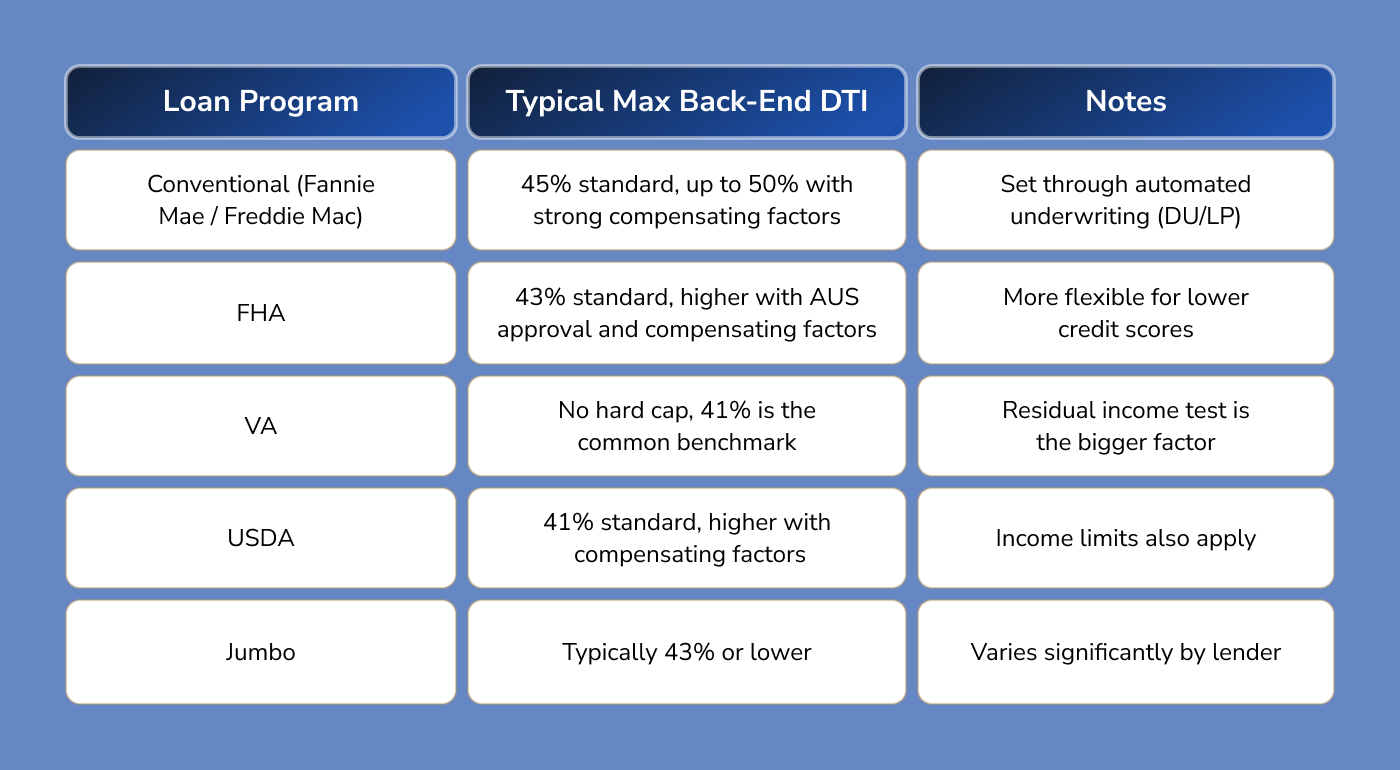
These are guidelines, not guarantees. Lender overlays (additional rules a lender adds on top of program guidelines) can make the actual cap stricter. This is where working with a broker pays off, since a broker can shop your file across multiple lenders to find the one with the most flexible guidelines for your situation.
Max DTI for Conventional Loan: The Detail
The max DTI for a conventional loan is technically 50% when run through Desktop Underwriter or Loan Product Advisor, the automated systems Fannie Mae and Freddie Mac use. To hit that ceiling, you typically need:
A credit score of 720 or higher (sometimes 680 with strong reserves)
Two or more months of cash reserves after closing
A loan-to-value ratio that is not aggressive
Stable, documented income
Below those thresholds, plan around 43% to 45% as your realistic cap.
Why DTI Hits Differently in New Hampshire
New Hampshire has one of the highest effective property tax rates in the country, according to the Tax Foundation. That matters for DTI because property taxes are part of your housing payment, which inflates the front-end and back-end ratios.
A $450,000 home in Manchester or Nashua can carry roughly $9,000 to $12,000 per year in property taxes depending on the town, which adds $750 to $1,000 per month to PITI before principal and interest. Compare that to a similarly priced home in a state with a 1% effective rate, and the NH buyer needs noticeably more income to hit the same DTI.
Practical implications for NH buyers:
Run your DTI using actual town tax rates, not state averages. NH towns vary widely (Hebron and New Castle sit well under 1%, while Berlin and Claremont push above 3%).
Factor in any property tax credits you qualify for, but do not rely on them for affordability.
The New Hampshire Housing Finance Authority (NHHFA) offers down payment assistance and below-market-rate programs that can lower your monthly payment and improve DTI math. Programs like Home Flex Plus are worth exploring with a NH-licensed broker.
If you are relocating from Massachusetts, Vermont, or another state, do not assume your prior tax burden translates. A NextGen loan officer can pull town-by-town tax rates and run accurate DTI scenarios before you commit to a specific area.
How to Lower Your DTI Before You Apply
If your numbers come in tight, you have more levers than you think. Most can move your ratio within 30 to 60 days.
Pay down credit card balances strategically. Credit card minimums fall when balances drop, which lowers your DTI. Pay down highest-utilization cards first to also boost your credit score.
Pay off small installment loans entirely. Eliminating a $250 monthly auto payment frees up significant DTI room. A $30,000 auto loan with eight months left is often worth paying off in cash if you have it.
Avoid taking on new debt. Do not finance furniture, a car, or appliances during the mortgage process. Even an inquiry can shift your file.
Document additional income. A second job or contract income counts after 12 to 24 months of history. Bonuses and commissions need a 24-month average.
Add a co-borrower. A spouse or partner with stable income can pull your combined DTI down quickly, as long as their credit and debts do not drag the file.
Choose a less expensive home or larger down payment. Both reduce PITI and the housing component of DTI.
What Lenders Look At Beyond DTI
DTI is critical, but it is not the whole picture. Underwriters also weigh:
Credit score and credit history depth
Down payment and loan-to-value ratio
Cash reserves (months of PITI in the bank after closing)
Employment stability and income type
Property type and occupancy (primary vs second home vs investment)
Strong performance in these areas can offset a higher DTI. This is what underwriters mean by "compensating factors." A borrower with a 760 credit score, 20% down, and six months of reserves will get more DTI flexibility than someone scraping in with the minimum on every front.
How NextGen Mortgage Loans Can Help
DTI is one of the most fixable parts of a mortgage application, but only if you know your numbers before the lender does. As a New Hampshire-based mortgage broker, NextGen Mortgage Loans works with multiple wholesale lenders, which means we can match your file to the program with the most flexible DTI guidelines for your specific situation. That includes conventional, FHA, VA, USDA, jumbo, and bank statement loans for self-employed buyers.
We will run your real numbers using actual NH town tax rates, walk you through what is hurting your ratio, and give you a clear plan to qualify, whether that is now or in 60 days. Pre-approvals are no-cost and typically turn around within 24 to 48 hours.
Get started with a free pre-approval or compare scenarios with our mortgage calculators.
Frequently Asked Questions
What is a good DTI ratio for a mortgage?
A back-end DTI under 36% is considered strong by most lenders and gives you flexibility across all loan programs. Between 37% and 43% is acceptable for most conventional and FHA loans. Above 43%, you start needing compensating factors or a program that allows higher ratios.
What is the max DTI for a conventional loan?
The max DTI for a conventional loan is 50% when approved through automated underwriting with strong compensating factors like a high credit score and cash reserves. Most borrowers should plan around a 45% ceiling as a realistic target.
Does DTI use gross or net income?
DTI uses gross income, meaning your pay before taxes, retirement contributions, and other deductions. This applies to W-2 wages, self-employment income, and any other documented income source.
Do utilities count in DTI?
No. Utilities, cell phone bills, internet, streaming services, groceries, and other variable expenses do not count toward DTI. Lenders only count obligations that appear on your credit report or are legally required, like child support.
How do student loans affect DTI for a mortgage?
It depends on the loan program. Conventional loans usually accept the payment shown on your credit report or 1% of the balance. FHA generally requires the actual documented payment, or 0.5% of the balance if no payment is reported. Loans in deferment or income-driven repayment can be calculated differently, so this is worth reviewing with a broker before applying.
Can I get a mortgage with a 50% DTI?
Yes, in some cases. Conventional loans run through automated underwriting can approve up to 50% with strong credit, reserves, and a solid down payment. FHA and VA also offer flexibility above 43% when other parts of the file are strong. The key is matching your file to the right program and lender.
How does New Hampshire property tax affect my DTI?
NH property taxes are among the highest in the country and add a meaningful amount to your monthly housing payment, which raises both your front-end and back-end DTI. Always calculate DTI using the actual property tax rate for the specific town you are buying in, not a state average.

