
Gift Funds for Down Payment: How They Work for NH Homebuyers
Yes, you can use gift funds for down payment on a home in New Hampshire, and most major loan programs allow 100% of your down payment to come from a gift if the money is properly documented. The catch is that lenders treat gifted money very differently from your own savings, and a missing signature on a gift letter or an unsourced deposit can stall your closing for weeks.
This guide explains who can gift money for a house, how down payment gift rules differ across FHA and conventional loans, and exactly what your lender will need to clear gift funds for closing. If you are a first-time buyer in NH leaning on family to help with the down payment, this is the playbook to follow.
What Are Gift Funds for a Down Payment?
Gift funds for down payment are money given to a homebuyer by a qualifying donor, with no expectation of repayment, that the buyer applies toward the down payment, closing costs, or reserves on a mortgage.
Three things separate a gift from any other deposit in your account:
The donor expects nothing back. No repayment, no equity stake, no IOU.
The funds are documented in writing. This is the gift letter.
The money is traceable. Both your account and the donor's account are sourced.
If any of those three legs is missing, the lender will not count the money as eligible funds. In most cases, they will treat it as a loan instead, which raises your debt-to-income ratio and can sink your approval.
Who Can Gift Money for a House?
The list of acceptable donors depends on your loan program, but in general, gifts must come from someone with a documented relationship to you. Anonymous gifts, business gifts, and gifts from anyone with an interest in the transaction (the seller, builder, real estate agent, or loan officer) are not allowed.
Here is who typically qualifies as a donor:
Family members: parents, grandparents, siblings, children, aunts, uncles, cousins, in-laws, step-relatives
Spouse, fiance, or domestic partner
Legal guardians
For FHA only: a close friend with a clearly documented interest in the borrower, an employer, a labor union, or a charitable organization
Down payment assistance programs: state, local, or nonprofit programs (in NH, this often means NHHFA programs)
Conventional loans tend to be stricter than FHA on who counts as family. If your donor is a friend, a non-relative, or a more distant connection, an FHA loan may give you more flexibility. A NextGen loan officer can review your specific situation and tell you within a single call whether your donor qualifies.
Gift Funds: FHA vs Conventional, VA, and USDA
The biggest practical question for most NH buyers is gift funds FHA vs conventional, but VA and USDA have their own quirks worth understanding. Here is how the four major programs compare.
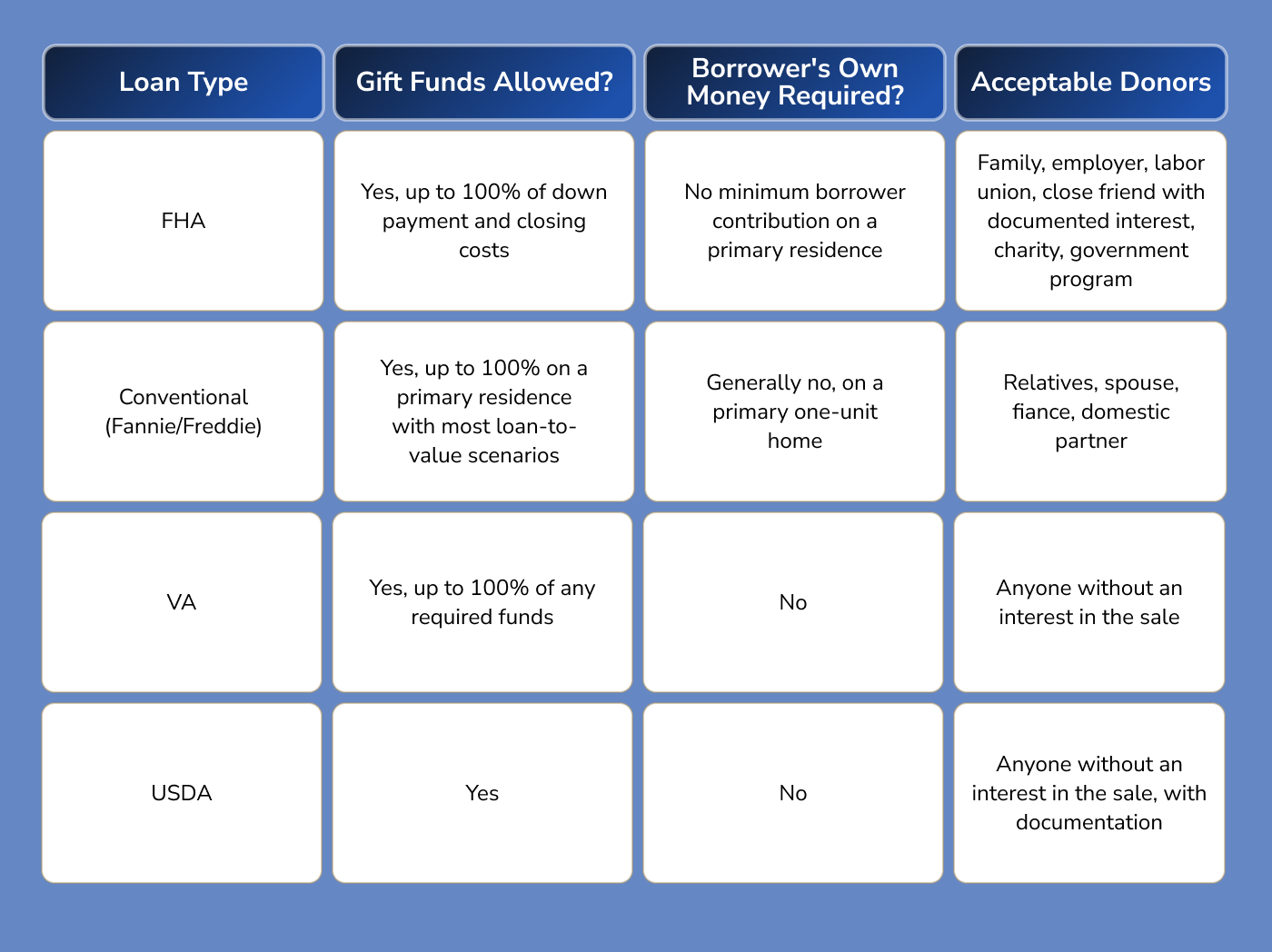
A few important notes on this table:
For second homes and investment properties, conventional guidelines often require a minimum borrower contribution from your own funds before gift money can be applied. Speak with a broker if the property is not your primary residence.
For conventional loans on multi-unit primary residences (a 2-to-4 unit owner-occupied property), a minimum borrower contribution may apply at higher loan-to-value ratios.
FHA is the most permissive program for buyers whose entire down payment is coming from a gift, which is why it is often the path of choice for first-time buyers without significant savings.
If you want help comparing programs side by side, our mortgage calculators let you model FHA and conventional payments using the same purchase price and gift amount.
What Is a Gift Letter for a Mortgage?
A gift letter for mortgage approval is a signed statement from the donor confirming that the money is a true gift, not a loan, and that no repayment is expected.
Every lender requires one, and the format is fairly standard. A complete gift letter includes:
Donor's full name, address, and phone number
Donor's relationship to the borrower
Exact dollar amount of the gift
Source of the funds (the donor's bank or account, in general terms)
Address of the property being purchased
A clear statement that no repayment is expected, in any form, at any time
Signatures and dates from both the donor and the borrower
Sample Gift Letter Language
I, [Donor Name], am gifting $[Amount] to [Borrower Name], my [relationship], for use toward the purchase of the property located at [Property Address]. These funds are a true gift. No repayment is expected or implied, and there is no lien or claim against the property as a result of this gift. The funds are coming from my account at [Bank Name].
Your loan officer will provide the lender's preferred template. Do not draft your own from scratch unless your broker tells you it is acceptable.
Down Payment Gift Rules: How Lenders Verify the Money
The gift letter is only the first step. Lenders also need to source and, in most cases, season the money. This is where most gift fund problems originate.
Sourcing the Donor
For conventional and FHA loans, the lender typically asks the donor for:
A copy of the check or wire transfer evidencing the gift
A bank statement showing the funds left the donor's account
In some cases, a bank statement showing the donor had the funds available before the transfer
This step exists to confirm the donor actually had the money to give. Cash gifts handed over in physical bills cannot be sourced and are not accepted. The funds must move through a verifiable financial institution.
Tracing the Deposit Into Your Account
You will need to show the matching deposit on your bank statement. The amount must line up exactly. If the donor wires $20,000 and your statement shows a $19,985 deposit because of a wire fee, your loan officer will need a written explanation and proof of the fee.
What "Seasoning" Means
If the gift sits in your account for more than two full bank statement cycles (roughly 60 days), some lenders will treat it as your own seasoned funds and skip the donor sourcing step. This is the cleanest path when timing allows. If you know a gift is coming and your closing is months away, ask your donor to send the funds early.
Tax Implications of Gifting a Down Payment
The tax burden on a down payment gift falls on the donor, not the recipient. The IRS allows individuals to give up to a set annual amount per recipient without filing a gift tax return, and that exclusion is indexed for inflation each year.
A few practical points:
The recipient does not pay income tax on the gift
A married couple can typically combine their annual exclusions and give double the amount per recipient
Gifts above the annual exclusion require the donor to file IRS Form 709, but in most cases no tax is actually owed because the excess is applied against the donor's lifetime exclusion
Gifts from foreign donors above certain thresholds trigger separate IRS reporting requirements for the recipient
Tax rules change, and individual circumstances vary widely. Consult a tax professional for advice specific to your situation before any large gift is finalized.
Common Mistakes That Delay or Derail Closings
Most gift fund problems are preventable. These are the issues we see most often.
Cash deposits. Physical cash deposited into the borrower's account cannot be sourced. If a donor wants to give cash, they need to deposit it into their own account, let it season, and then transfer it electronically to the borrower.
Wires that arrive after underwriting. Once the file is in underwriting, any new large deposit triggers a new round of documentation. Move gift funds early.
Vague gift letters. A letter that says "for your house" without naming the property, the amount, or the relationship will be sent back for revision.
Donor statements with other large activity. If the donor's bank statement shows other large deposits or transfers, the underwriter may ask about those too. A clean, simple donor statement saves time.
Gifts from non-qualifying parties. A gift from a business entity, an LLC owned by a relative, or an unrelated third party is almost always rejected. The donor must be an individual qualifying under program rules.
Treating a loan as a gift. Lenders can spot a sham gift quickly. If repayment is expected in any form, do not characterize the funds as a gift. Misrepresentation on a mortgage application is mortgage fraud.
What NH Buyers Should Know Specifically
A few items matter more in New Hampshire than in some other markets.
NHHFA down payment assistance can stack with gifts. The New Hampshire Housing Finance Authority offers programs that provide down payment and closing cost assistance to qualifying buyers. In many cases, you can combine NHHFA assistance with a family gift to cover both the down payment and closing costs on an FHA or conventional loan. Eligibility depends on income and purchase price limits set by NHHFA, and these limits vary by county.
Higher home prices in southern NH may require larger gifts. In Rockingham, Hillsborough, and Strafford counties, where median home prices are highest, a 3.5% FHA down payment on a $500,000 home is $17,500, and a 5% conventional down payment is $25,000. If your donor is gifting the full amount, plan ahead so the funds can be sourced and seasoned before closing.
Conforming loan limits matter for higher-priced homes. New Hampshire counties generally fall under the standard FHFA conforming loan limit, but if you are buying near or above that limit, the loan moves to jumbo territory and gift fund rules can be stricter. A NextGen broker can confirm the current FHFA limits for your county and structure the file accordingly.
MA-to-NH relocations are common, and gifts often cross state lines. If your parents in Massachusetts are gifting toward your NH purchase, the loan program rules apply the same way. The donor's location does not matter, only that the funds can be sourced and the donor qualifies under your loan type.
How NextGen Mortgage Loans Can Help
Gift funds are one of the most common reasons a smooth pre-approval turns into a stressful closing, and most of those problems trace back to documentation that could have been handled earlier. As a New Hampshire mortgage broker with access to multiple lenders, NextGen Mortgage Loans can match your situation to the program with the most flexible gift fund rules, whether that is FHA for a fully gifted down payment or conventional for a stronger long-term cost structure.
Our team will tell you upfront what your donor needs to provide, review the gift letter before it is signed, and coordinate timing so the funds are sourced and seasoned by the time you reach the closing table. There is no cost or obligation for the conversation. Contact a NextGen loan officer to get pre-approved and walk through your specific gift fund scenario in plain English.
Frequently Asked Questions
Can I use gift funds for the entire down payment on a house?
In most cases, yes. FHA, VA, USDA, and conventional loans on primary residences all allow up to 100% of the down payment to come from gift funds when the money is properly documented. Investment properties and some second-home scenarios may require a minimum contribution from your own funds.
Does the donor have to pay taxes on a down payment gift?
The donor may need to file a gift tax return if the amount exceeds the annual IRS exclusion, but in most cases no tax is actually owed because the excess is applied against the lifetime exclusion. The recipient does not pay income tax on the gift. Consult a tax professional for advice specific to your situation.
Can my parents loan me the down payment instead of gifting it?
A loan is treated very differently from a gift. The monthly repayment counts against your debt-to-income ratio and can reduce how much home you qualify for. If repayment is expected in any form, the funds cannot be characterized as a gift on the mortgage application.
How long do gift funds need to be in my account before closing?
There is no hard rule, but funds that have been in your account for more than two full statement cycles are typically treated as your own seasoned money, which simplifies documentation. Funds received during the loan process require a gift letter and donor sourcing.
Can a friend gift me money for a down payment?
For conventional loans, generally no. Donors must be relatives, a spouse, fiance, or domestic partner. For FHA loans, a close friend with a clearly documented interest in the borrower's well-being can qualify, but the lender will scrutinize the relationship. When in doubt, speak with a broker before accepting the funds.
What happens if I deposit cash from a family member?
Physical cash deposits cannot be sourced and are typically rejected as eligible funds. Ask your donor to deposit the cash into their own account, let it season, and then send the gift by check or wire. This is one of the most common and avoidable gift fund mistakes.
Do gift funds affect my mortgage interest rate?
No. The source of your down payment does not change your interest rate. Your rate is driven by credit score, loan-to-value ratio, loan type, occupancy, and current market conditions. A NextGen broker can compare rates across multiple lenders to find the best fit for your file.

