How to Shop for a Mortgage in New Hampshire: A Step-by-Step Guide
The most effective way to shop for a mortgage is to request written Loan Estimates from at least three to five lenders within a 14-day window, using the same loan amount and the same property. Doing this protects your credit score and gives you apples-to-apples pricing you can negotiate with.
Most New Hampshire homebuyers skip this step. Research from the Consumer Financial Protection Bureau (CFPB) has consistently found that nearly half of mortgage borrowers do not comparison shop, and the borrowers who do shop save thousands over the life of their loan. This guide walks you through exactly how to shop for a mortgage in NH without hurting your credit, how many lenders you should actually apply with, and what to compare beyond the headline interest rate.
What Does It Mean to Shop for a Mortgage?
Quick answer: Shopping for a mortgage means requesting written loan offers from multiple lenders for the same loan, then comparing the total cost (rate, fees, points, and closing costs) before choosing one.
A mortgage shop is not the same as getting pre-qualified or asking a friend who they used. Shopping requires you to submit a real application with each lender, receive a standardized Loan Estimate form, and compare the numbers side by side.
The Loan Estimate is a three-page document required by federal law under CFPB rules. Every lender must provide it within three business days of a complete application. It is the only reliable way to compare mortgage offers because every lender is required to use the same format.
How Many Lenders Should You Apply With?
Quick answer: Apply with three to five lenders. That is enough to create meaningful price competition without creating excessive paperwork.
Research from Freddie Mac has shown that borrowers who get multiple rate quotes save thousands over the life of their loan, with savings growing as more quotes are obtained. The biggest jump comes between getting one quote and getting two or three. After five quotes, the marginal benefit drops off.
A practical breakdown:
One lender only: You have no leverage, no benchmark, and likely the worst pricing.
Two lenders: Better, but two data points are not enough to spot an outlier.
Three to five lenders: The sweet spot for most buyers.
More than five: Diminishing returns and a lot of paperwork.
Working with a mortgage broker simplifies this. A NextGen broker submits your file to multiple wholesale lenders at once, so you receive competing offers without filling out five separate applications. You can speak with a NextGen broker to compare options across our lender network.
Does Applying for Multiple Mortgages Hurt Your Credit?
Quick answer: No, if you do it within the rate-shopping window. Multiple mortgage applications submitted within 14 to 45 days are treated as a single credit inquiry by the major credit scoring models.
Both FICO and VantageScore have rate-shopping protections built specifically for mortgage, auto, and student loan applications. The credit bureaus understand that comparison shopping is good consumer behavior, so they bundle the inquiries into one.
Specifics:
VantageScore 3.0 and 4.0: All mortgage inquiries within a rolling 14-day window count as one inquiry.
FICO Score 8 and newer: Mortgage inquiries within a 45-day window count as one inquiry. Older FICO models use 14 days.
A single inquiry typically lowers your score by less than 5 points, and the impact fades within a few months.
To stay safely within the window across all scoring models, complete your mortgage shopping within 14 days of your first application. That single window covers you regardless of which scoring model a lender pulls.
What does hurt your credit during mortgage shopping:
Applying for new credit cards or auto loans during your home search.
Letting credit card balances spike before underwriting.
Closing old credit accounts (which shortens your credit history).
Co-signing a loan for someone else.
How to Compare Mortgage Rates the Right Way
The biggest mistake NH buyers make when they compare mortgage rates is looking only at the interest rate on a marketing page. That number is meaningless without context.
Here is what actually matters on a Loan Estimate:
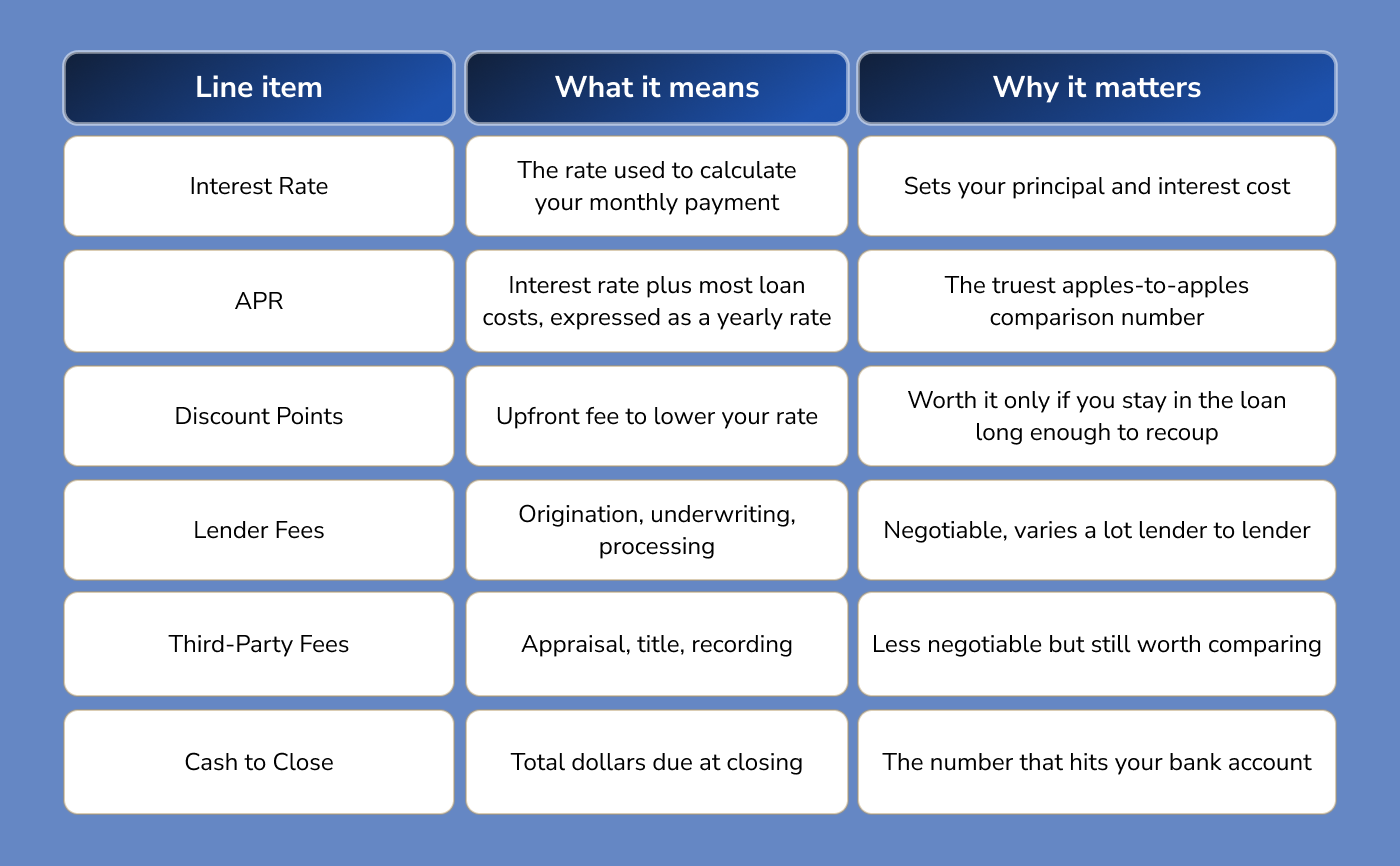
A loan with a low advertised rate can easily cost more than a loan with a slightly higher rate if the low-rate loan loads up on discount points and origination fees. Always compare the APR and the total cash to close, not the rate in isolation.
Our mortgage calculators can help you model the true cost of different rate and fee combinations before you commit.
Step-by-Step: How to Shop for a Mortgage in New Hampshire
Step 1: Check your credit before anyone else does
Pull your credit reports from AnnualCreditReport.com (free and federally authorized) and your FICO score from your credit card issuer or a free monitoring service. Dispute any errors before you start applying. Lenders use the middle of your three FICO scores from Equifax, Experian, and TransUnion.
Step 2: Get your documents ready
Every lender will ask for the same paperwork:
Two years of W-2s or 1099s
Two years of federal tax returns (especially if self-employed)
Most recent 30 days of pay stubs
Two months of bank statements (all pages)
Photo ID and Social Security number
Having a clean document package ready lets you complete applications in one sitting and stay inside the 14-day rate-shopping window.
Step 3: Decide which loan types fit your situation
Before you compare lenders, know which loan programs you may qualify for:
Conventional loans: Best for buyers with 5% or more down and credit scores above 620.
FHA loans: Lower credit and down payment thresholds, but with mortgage insurance for the life of the loan in most cases.
VA loans: Zero down payment for eligible veterans, no mortgage insurance, and very competitive rates.
USDA loans: Zero down for rural NH properties (much of northern and western NH qualifies).
NHHFA programs: New Hampshire Housing offers Home Flex Plus and Home First with down payment assistance for qualifying NH buyers.
Step 4: Apply with three to five lenders within 14 days
Mix your sources. A reasonable shop list:
One mortgage broker (access to multiple wholesale lenders in a single application)
One large national bank or credit union
One online lender
Optionally, one local NH bank or community lender
Step 5: Compare Loan Estimates side by side
When the Loan Estimates arrive, line them up. Look at:
The APR (Page 3)
Cash to close (Page 2)
Origination charges (Page 2, Section A)
Whether points are being charged
Whether the rate is locked, and for how long
Step 6: Negotiate
Mortgage pricing is negotiable. Take your best Loan Estimate to the other lenders and ask if they can match or beat it. Ask specifically about origination fees and discount points, which lenders have the most flexibility on.
Step 7: Lock your rate
Once you choose a lender, lock your rate in writing. Lock periods typically run 30, 45, or 60 days. In a rising-rate environment, longer locks can be worth a small fee.
Mortgage Rate Shopping and Your Credit Score
Your credit score is the single biggest factor in the rate you are offered. Here is roughly how it breaks down:
760 and above: You qualify for the best rates lenders publish.
700 to 759: Strong rates with slight pricing adjustments.
680 to 699: Solid conventional rates with more pronounced pricing adjustments.
620 to 679: Conventional eligible, but FHA may be cheaper.
580 to 619: FHA territory. Expect higher rates and mortgage insurance.
Below 580: Limited options. Focus on credit repair before applying.
The ideal mortgage rate shopping credit score is 740 or higher, which puts you at or near the top tier for conventional pricing. If you are close to a tier break (say, a 698), it is often worth waiting 30 to 60 days to push your score over 700 before applying. Even a 20-point improvement can mean thousands saved over the loan term.
What Is Different About Mortgage Shopping in New Hampshire
NH buyers face some specific dynamics worth factoring into your shop.
High property taxes change your DTI math. New Hampshire has no state income tax, but property tax rates are among the highest in the country. Lenders include property taxes in your debt-to-income ratio, so a buyer in a high-tax town like Claremont, Berlin, or Hudson may qualify for less house than the same buyer in a lower-tax town like New Castle or Hebron.
Loan limits matter near the seacoast. The FHFA sets conforming loan limits annually. Most NH counties fall under the standard baseline limit, but counties classified as part of higher-cost metro areas can have a higher limit. If you are buying in Portsmouth, Dover, or Exeter and your loan amount is near the cutoff, ask each lender to quote both conforming and jumbo options.
NHHFA programs are widely underused. New Hampshire Housing offers down payment assistance and below-market rates through its Home Flex Plus and Home First programs. Not every lender is approved to originate NHHFA loans, so if you want to consider them, confirm each lender's NHHFA participation status before you apply.
Out-of-state buyers face extra scrutiny. If you are relocating from Massachusetts or another state, lenders will verify your employment transition or remote work arrangement. Have a written job offer or employer letter ready before you apply.
Common Mistakes NH Buyers Make When Shopping for a Mortgage
Only getting one quote. Even one extra quote often pays for itself many times over.
Comparing rates from different days. Mortgage rates move daily. To compare fairly, get all your quotes within a 24 to 48 hour window, ideally on the same day.
Letting the shop drag past 14 days. This pushes you outside the safest credit-bureau window and can ding your score.
Ignoring fees because the rate looks good. A teaser rate with $8,000 in points is rarely a deal.
Applying only with the lender their realtor referred. Builder and realtor referrals can be fine, but they are starting points, not finish lines.
Forgetting to ask about NHHFA eligibility. Buyers under certain income thresholds can qualify for meaningful savings.
How NextGen Mortgage Loans Can Help
NextGen Mortgage Loans is a New Hampshire-based mortgage broker, which means we shop the market for you. Instead of applying with one bank, you submit one application with us and we put multiple wholesale lenders into competition on your behalf. You get the comparison shopping advantage without the paperwork burden of five separate applications.
Our team is licensed in New Hampshire and works with NH buyers every day, including first-time homebuyers, veterans, self-employed borrowers, and out-of-state buyers relocating to the state. We know which lenders price aggressively for which scenarios, which programs apply to which NH counties, and how to structure a file to clear underwriting cleanly.
A no-cost consultation with a NextGen loan officer takes about 15 minutes and gives you a clear picture of what you qualify for and at what rate. Contact NextGen Mortgage Loans to start your mortgage shop the right way.
Frequently Asked Questions
Is it better to use a mortgage broker or go directly to a bank?
A broker gives you access to multiple wholesale lenders through one application, which essentially handles your comparison shopping for you. A bank only offers its own products. For most NH buyers, working with a broker plus getting one or two outside quotes for comparison is the most efficient path.
How long does it take to shop for a mortgage?
Plan on 7 to 14 days from your first application to a final rate lock. Most of that time is waiting for Loan Estimates and reviewing them. The actual application paperwork takes about an hour per lender if you have your documents ready.
What credit score do I need to shop for a mortgage?
You can shop with a score as low as 580 (FHA territory) or 620 (conventional minimums for most lenders). VA loans have no set minimum, though most VA lenders apply an internal floor of 580 or 620. The higher your score, the better your pricing.
Does shopping for a mortgage hurt my credit?
Multiple mortgage inquiries within a 14-day window count as a single inquiry under both FICO and VantageScore models. A single mortgage inquiry typically reduces your score by less than 5 points and the impact fades within a few months.
Can I shop for a mortgage before I find a house?
Yes, and you should. Get pre-approved with at least one lender before you start house hunting. You can update or re-shop the loan once you have an accepted offer, which is when you receive the property-specific Loan Estimates that actually matter.
Should I lock my rate the moment I get a good quote?
Not always. Lock when you commit to a lender. Locks usually run 30 to 60 days and can be extended for a fee. In a rising-rate market, lock earlier. In a falling-rate market, ask about float-down options.
Are NHHFA loans worth applying for?
If you fall under the NHHFA income limits for your county, the down payment assistance and below-market rate options can save you thousands. Not every lender originates NHHFA loans, so confirm participation before you apply. A NextGen broker can tell you in about 5 minutes whether you qualify and whether NHHFA is the best fit for your scenario.

