Rate and Term Refinance in NH: When It Makes Sense
A rate and term refinance replaces your existing mortgage with a new loan that has a different interest rate, a different loan term, or both, without pulling equity out as cash. For New Hampshire homeowners, it is the most common type of refinance, and the right move can lower your monthly payment, shorten the years you owe, or both.
This guide explains how a rate and term refinance works, when it makes financial sense in today's market, what it costs, and how to qualify in NH. You will also see how it compares to a cash-out refinance and which streamlined options exist for FHA, VA, and USDA borrowers.
What Is a Rate and Term Refinance?
Quick answer: A rate and term refinance is a new mortgage that pays off your existing one with the goal of changing the interest rate, the loan term, or both. You receive no significant cash at closing (typically less than $2,000 in incidental funds, per Fannie Mae guidelines).
The new loan has its own rate, term, monthly payment, and closing costs. Your home stays as collateral. Your existing mortgage is paid off in full at closing and the new lender takes its place on the title.
Common reasons NH homeowners pursue a rate and term refinance:
Interest rates have dropped since they bought or last refinanced
Their credit score has improved enough to qualify for better pricing
They want to switch from a 30-year to a 15-year term to pay off the loan faster
They want to switch from a 15-year to a 30-year term to lower the monthly payment
They want to remove FHA mortgage insurance by moving to a conventional loan
They want to convert an adjustable-rate mortgage (ARM) into a fixed-rate loan
Rate and Term Refinance vs. Cash-Out Refinance: What's the Difference?
The two refinance types share the same basic structure but serve different goals.
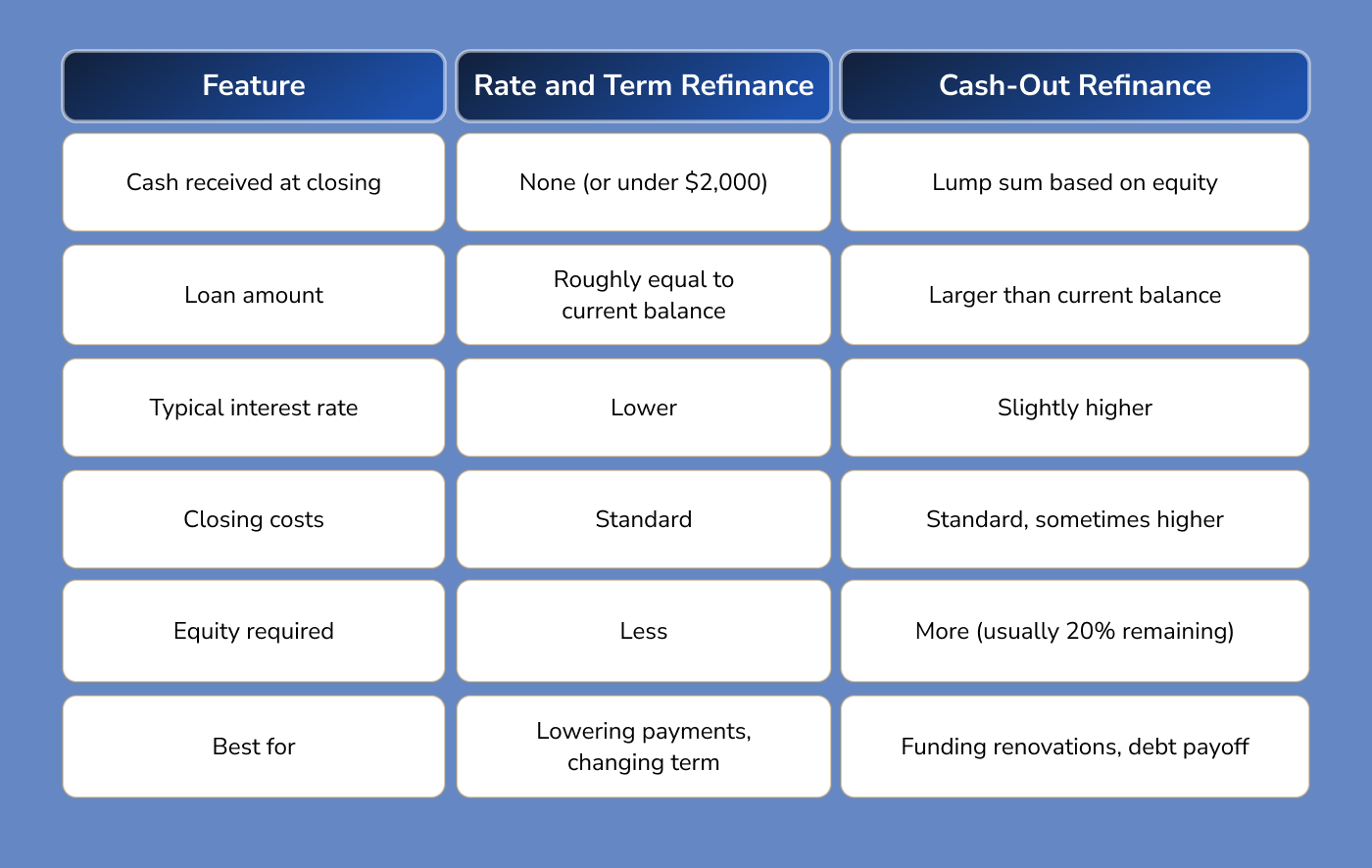
A rate and term refinance is generally the lower-cost, lower-risk option. Lenders price it more favorably because you are not increasing the loan-to-value ratio.
If you want to tap home equity for a project or to pay off high-interest debt, a cash-out refinance is a different conversation. A NextGen broker can model both side by side using your specific numbers.
When Does a Rate and Term Refinance Make Sense?
The honest answer: when the math works for your timeline. Here is how to check.
The break-even rule
Add up your total closing costs, then divide that number by your monthly savings. The result is the number of months it will take to recoup what you spent.
For example, if closing costs total $4,500 and you save $180 per month, your break-even point is 25 months. If you plan to stay in the home longer than that, the refinance pays for itself.
If you might sell or move within the break-even window, the refinance likely costs more than it saves. NH homeowners considering a move to a different town, or who took the loan during a job-relocation phase, should run this number carefully before locking in a new mortgage.
Common scenarios where it works
Rate drop of 0.75% or more. A meaningful rate decrease almost always justifies the cost over a typical NH ownership horizon.
Improved credit score. If your score has jumped 50 to 100 points since your original loan, you may qualify for materially better pricing.
Eliminating mortgage insurance. FHA borrowers who now have 20% equity can refinance into a conventional loan and drop monthly mortgage insurance.
Locking in a fixed rate. If your ARM is approaching its adjustment period, refinancing into a fixed-rate mortgage protects you from rate increases.
Shortening the term. Switching from 30 to 15 years raises the monthly payment but slashes lifetime interest paid.
When it usually does not make sense
You plan to sell within two to three years
Rates have only dropped 0.25% or less
You would restart the amortization clock late in your loan
You have been paying for 20+ years on a 30-year loan and most of your payment now goes to principal
How Much Does a Rate and Term Refinance Cost in New Hampshire?
Closing costs on a refinance in NH typically run between 2% and 5% of the loan amount, depending on the lender, the loan type, and which third-party services are required.
Common cost categories:
Lender fees: application fees, underwriting fees, origination charges
Third-party fees: appraisal, credit report, title search and title insurance, recording fees
Prepaid items: prorated property taxes, homeowners insurance, escrow setup
Discount points (optional): prepaying interest to lower your rate
NH-specific cost note: New Hampshire has comparatively high property taxes, which means escrow setup at closing can be larger than in lower-tax states. Your lender will collect several months of property taxes and insurance to fund the new escrow account.
You may have the option to roll closing costs into the loan rather than paying out of pocket. This raises your loan amount slightly but preserves your savings. Use a mortgage calculator to compare the two approaches before you commit.
Rate and Term Refinance Requirements: What You Need to Qualify
Underwriting for a rate and term refinance is similar to a purchase loan, with some differences. Lenders generally evaluate four areas.
Credit score
Most conventional lenders want a minimum 620 FICO score, with the best pricing reserved for scores of 740 and above. FHA and VA refinance options accept lower scores in many cases.
Equity (loan-to-value ratio)
For a conventional rate and term refinance, lenders typically allow up to 95% loan-to-value (LTV), meaning you need at least 5% equity. Some streamlined programs allow higher LTVs. If you have less than 20% equity, expect to pay private mortgage insurance (PMI) on the new loan, unless it is an FHA or VA refinance.
Debt-to-income ratio
Most lenders cap total debt-to-income (DTI) at around 43% to 50%, depending on the program. Your housing payment plus all other monthly debts should fit inside that ceiling.
Income and employment documentation
You will need to verify income through pay stubs, W-2s, and tax returns. Self-employed borrowers usually need two years of business tax returns plus year-to-date profit and loss statements. NextGen works with multiple wholesale lenders, including those who offer bank statement loans and other non-QM products for self-employed NH residents.
Property condition and appraisal
A standard rate and term refinance requires a new appraisal. The appraised value determines your LTV and whether you qualify for the loan you want. Some streamlined programs waive the appraisal entirely.
Loan-Specific Streamline Options for NH Borrowers
Government-backed loans offer reduced-documentation refinance programs that can save time and money.
FHA Streamline Refinance
Available to homeowners with an existing FHA loan. Per HUD guidelines, the FHA Streamline does not require a new appraisal in most cases, has reduced documentation requirements, and the refinance must produce a "net tangible benefit" (typically a meaningful reduction in your combined principal, interest, and mortgage insurance payment).
VA IRRRL (Interest Rate Reduction Refinance Loan)
Often called the VA Streamline. Available to homeowners with an existing VA loan. Per the U.S. Department of Veterans Affairs, the IRRRL allows refinancing without a new appraisal or income verification in most cases. NH has a significant veteran population, and the VA IRRRL is one of the lowest-friction refinances on the market.
If you served and are not sure whether you used your VA entitlement on your current home, talk to a VA loan specialist before assuming you do not qualify.
USDA Streamlined Assist
Available to homeowners with an existing USDA loan in eligible rural areas, which include large portions of northern and central New Hampshire. Per USDA guidelines, the Streamlined Assist program waives appraisal and credit underwriting requirements when the borrower can demonstrate at least $50 per month in payment savings.
Conventional rate and term refinance
The most flexible option. No prior loan type required. Subject to standard Fannie Mae or Freddie Mac underwriting. Best for borrowers with strong credit and meaningful equity.
The Rate and Term Refinance Process Step by Step
The full process typically takes 30 to 45 days from application to closing, though streamline programs can close faster.
Compare rates and quotes. Get loan estimates from multiple lenders or work with a broker who shops several at once. The CFPB recommends comparing at least three offers.
Choose a loan and lock the rate. Once you select your loan, you can lock the rate for a set period (typically 30 to 60 days) to protect against market moves.
Complete the application. Submit pay stubs, W-2s or tax returns, bank statements, and your current mortgage statement.
Underwriting and appraisal. The lender orders an appraisal (if required), reviews your documentation, and clears any conditions.
Closing disclosure. Federal TRID rules require you receive a closing disclosure at least three business days before closing. Review every line.
Close. Sign the documents, pay any out-of-pocket costs, and the new loan funds. Your old loan is paid off the same day.
Right of rescission. On owner-occupied refinances, federal law gives you three business days after closing to cancel the loan if you change your mind.
Common Mistakes NH Homeowners Make When Refinancing
Restarting the clock without thinking it through. A 30-year refinance after 7 years on the original loan adds 7 years of payments. Sometimes worth it for the cash flow relief, sometimes not.
Focusing only on the interest rate. APR includes lender fees and gives a more accurate picture of total cost. Two loans at the same rate can have very different APRs.
Skipping the rate shop. A 0.25% difference in rate over 30 years on a $400,000 loan adds up to roughly $20,000 in interest. One conversation with a broker can cover ground that would take you a week to handle alone.
Forgetting NH property taxes in the math. Rolling unpaid property tax bills into a new escrow shifts your effective monthly cost in ways the headline rate does not show.
Pulling credit at the wrong time. Multiple mortgage credit pulls within a 14 to 45-day window count as one inquiry per FICO scoring rules. Spread them out over months and you take multiple hits to your score.
How NextGen Mortgage Loans Can Help
NextGen Mortgage Loans is a New Hampshire-based mortgage broker, which means we are not tied to any single bank's rate sheet. We compare loan options across multiple wholesale lenders and bring you the most competitive offers we find for your specific profile.
For a rate and term refinance, broker access matters. The same borrower can see meaningfully different pricing across lenders, and a single application with us covers ground that would take a week of separate calls to handle alone. We work with conventional, FHA, VA, and USDA programs, and we have experience with self-employed borrowers, recent credit events, and unique NH property situations.
A consultation costs nothing and takes about 15 minutes. We will pull your numbers, run the break-even, and tell you honestly whether a refinance makes sense right now or whether it is worth waiting. Contact a NextGen loan officer to get started.
Frequently Asked Questions
How long do I have to wait to refinance after buying a home in NH?
Most conventional lenders require a six-month seasoning period before allowing a rate and term refinance. FHA Streamline and VA IRRRL programs require at least 210 days from your first mortgage payment, plus six on-time payments. There is rarely a benefit to refinancing earlier than that anyway, since closing costs would not yet be amortized.
Will I lose equity by refinancing?
No. A rate and term refinance does not reduce your equity. The new loan amount roughly equals your current balance. If you choose to roll closing costs into the new loan, your balance increases slightly, which reduces equity by that amount.
Can I refinance if my home value has dropped?
Possibly. If you have an existing FHA, VA, or USDA loan, streamline programs often do not require a new appraisal, so a drop in value is less of a concern. For conventional refinances, a high LTV may push you into PMI territory or require a different program. A broker can identify which lenders accept your specific situation.
How much does a rate and term refinance lower my monthly payment?
It depends on the rate change, the new term, and your remaining balance. As a rough rule, every 0.5% drop in rate on a $400,000 loan saves around $115 per month on a 30-year term. The exact number depends on your specific loan and credit profile.
Do I need a new home inspection when I refinance?
No. A rate and term refinance requires an appraisal in most cases (which estimates value), but not a home inspection (which evaluates condition). Inspections are typically only used in purchase transactions.
Are there tax implications to a rate and term refinance?
Mortgage interest may still be deductible on a refinanced loan, subject to IRS rules and current limits. Points paid on a refinance are typically deducted over the life of the loan rather than in the year paid. Consult a tax professional for advice specific to your situation.
Should I pay discount points to lower my rate?
That depends on your timeline. Each point typically costs 1% of the loan amount and lowers your rate by roughly 0.25%. The break-even calculation works the same as for closing costs: divide the cost by the monthly savings to see how many months it takes to recoup. If you plan to stay in the home long enough, points can save real money.

