
Fannie Mae HomeStyle Renovation Loan in New Hampshire: Requirements and Uses
What Is a HomeStyle Renovation Loan and How Does It Work?
A Fannie Mae HomeStyle Renovation loan is a conventional mortgage that rolls a home purchase or refinance together with renovation costs into a single loan. Unlike FHA renovation programs, HomeStyle carries no government backing, follows standard conventional private mortgage insurance rules, and covers a wider range of property types and project scopes. For New Hampshire buyers considering a fixer-upper, it is one of two main renovation loan paths worth evaluating.
If you are new to renovation financing in general, start with our guide to renovation loans in New Hampshire for a broad overview of how these programs work and when they make sense. This post focuses specifically on the HomeStyle program: what it covers, who qualifies, and how it compares to FHA's 203(k) option.
NextGen Mortgage Loans is an independent mortgage broker licensed in New Hampshire, Massachusetts, Maine, Rhode Island, and Florida. As a broker, NextGen shops HomeStyle Renovation financing across multiple approved lenders to find competitive terms for your project. NextGen does not fund loans directly.
What Makes HomeStyle Different from FHA 203(k)
Buyers researching renovation loans in New Hampshire will typically land on two programs: the Fannie Mae HomeStyle Renovation loan and the FHA 203(k). Both combine purchase and renovation costs into one mortgage, but they differ in backing, property eligibility, scope of work, and insurance structure.
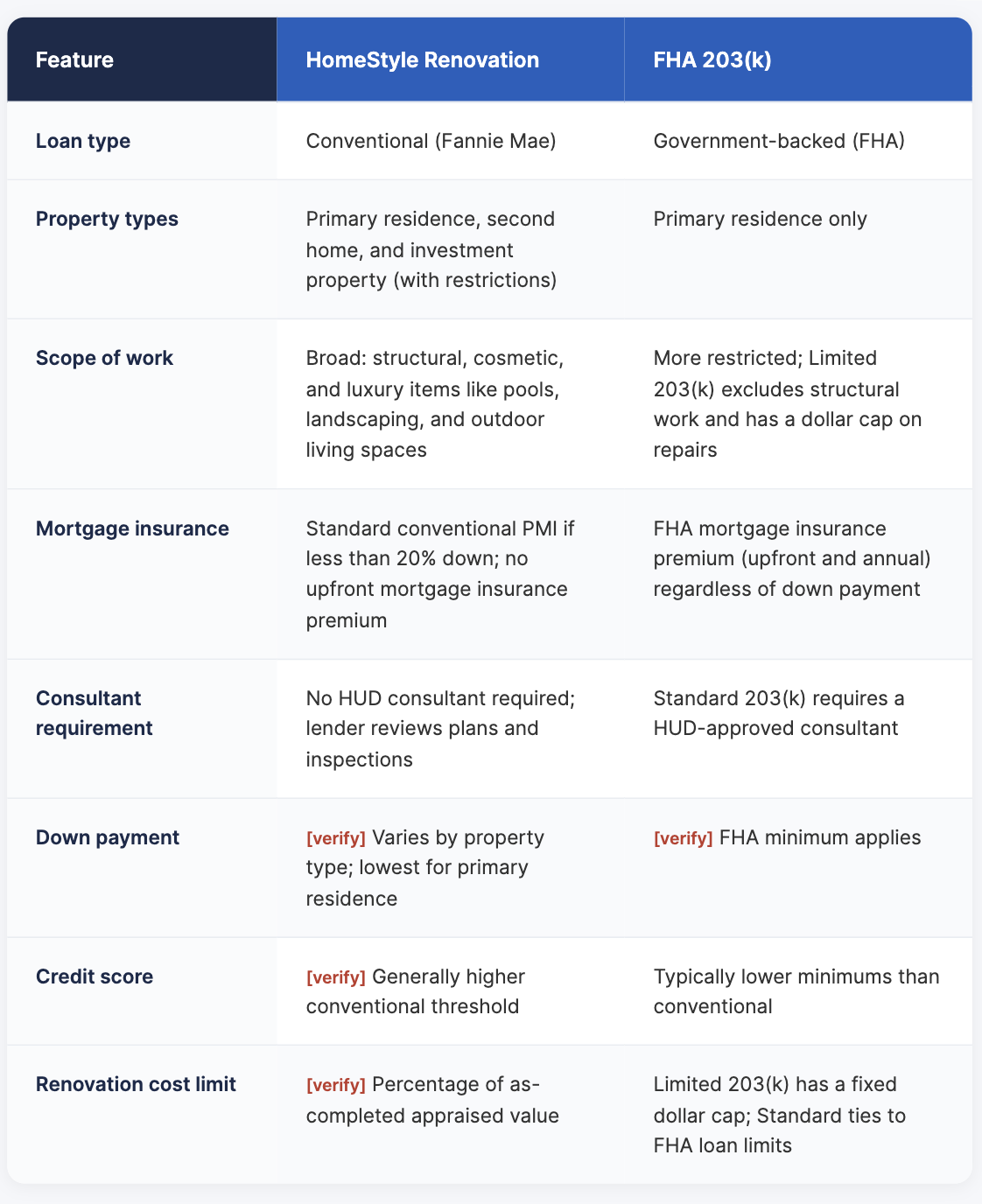
Every figure in the table above should be confirmed against current Fannie Mae and FHA guidelines before publishing, as both agencies update requirements periodically and individual lender overlays can shift thresholds further.
For a deeper look at how FHA and conventional loans compare in New Hampshire, that post covers the broader differences outside the renovation context.
Who Should Use a HomeStyle Renovation Loan
HomeStyle tends to fit a specific set of buyer profiles better than FHA 203(k). Understanding where each program has the edge can save time and money on the wrong path.
Buyers with stronger credit and down payment capacity. HomeStyle follows conventional underwriting, which typically expects higher credit scores than FHA. In return, borrowers avoid FHA's upfront mortgage insurance premium and can drop PMI once they reach 20% equity. If you are weighing the long-term cost of mortgage insurance and how to remove PMI, HomeStyle's conventional structure gives you that exit ramp.
Second-home and investment property buyers. This is the clearest differentiator. FHA 203(k) is limited to primary residences. HomeStyle can be used on second homes and, in some cases, investment properties with additional requirements. If you are exploring a multi-family mortgage in New Hampshire or a house-hacking strategy, HomeStyle opens renovation financing options FHA does not.
Projects with luxury or non-structural upgrades. Want to add a pool, upgrade landscaping, build an outdoor kitchen, or finish a basement as a media room? HomeStyle generally permits these as long as the improvements are permanently affixed and add value to the property. FHA 203(k) is more restrictive on luxury items.
Buyers who want a simpler oversight process. HomeStyle does not require a HUD-approved consultant. The lender handles plan review, and inspections during the draw process are typically fewer and less formal than what the FHA 203(k) Standard program requires.
Eligibility Requirements in New Hampshire
HomeStyle Renovation loans follow conventional lending guidelines set by Fannie Mae, with individual lenders sometimes adding their own overlays. Here is what to expect in general terms.
Credit score. Fannie Mae sets a baseline minimum, but most lenders will apply their own floor on top of it. Expect the threshold to be higher than what FHA programs require. [Verify current HomeStyle minimum credit score] before quoting any specific number. For a broader look at how credit scores affect mortgage options, see our post on what credit score you need for a mortgage.
Down payment. The minimum varies by property type. Primary residences have the lowest requirement, while second homes and investment properties require more. [Verify current HomeStyle minimum down payment] for each category. If you are purchasing a primary residence and looking at down payment assistance programs in New Hampshire, check whether those funds are compatible with a HomeStyle transaction, as compatibility depends on the specific assistance program and lender.
Debt-to-income ratio. Conventional loans have standard DTI ceilings, though Fannie Mae's automated underwriting can approve higher ratios with strong compensating factors. For a deeper explanation, see our guide on DTI ratio for a mortgage.
Renovation cost limits. HomeStyle caps the total renovation cost at a percentage of the property's as-completed appraised value. [Verify current HomeStyle renovation cost cap.] The as-completed appraisal is ordered before closing, and it establishes the ceiling for how much renovation work the loan will cover.
Property eligibility. HomeStyle covers 1-4 unit primary residences, second homes, and investment properties, each with different underwriting requirements. Manufactured housing and site condominiums may have additional restrictions. [Verify current property type restrictions] before assuming eligibility for a specific property.
The Contractor and Draw Process
One of the practical realities of any renovation loan is the construction oversight process. HomeStyle handles this through a structured but relatively straightforward system.
Contractor selection. The contractor must be licensed and insured, and the lender must approve them before closing. Borrowers cannot do the work themselves on most HomeStyle transactions. The lender reviews the contractor's credentials, and in some cases their financial standing, as part of the approval process.
Renovation plan submission. Before closing, the borrower and contractor submit a detailed scope of work, cost breakdown, and timeline. The lender reviews these against the as-completed appraisal to confirm the project makes financial sense and fits within the loan amount.
Escrow and draw schedule. Renovation funds are held in an escrow account after closing and released to the contractor in draws as work is completed. Before each draw, the lender (or a designated inspector) verifies that the work matches the approved plan. This inspection process is generally less intensive than the HUD consultant oversight required on an FHA 203(k) Standard loan.
Timeline expectations. Fannie Mae sets a window for completing the renovation work after closing. Most projects must be finished within that period, though specifics can vary. Delays can complicate the draw schedule and potentially affect the loan, so realistic project timelines matter during the planning stage.
If you are earlier in the buying process and have not started your mortgage pre-approval yet, that is a necessary first step before engaging contractors on a HomeStyle project.
HomeStyle vs. 203(k): Which Fits Your Project
Both programs solve the same core problem: financing a home and its renovations in one mortgage. The right choice depends on your credit profile, property type, project scope, and tolerance for oversight.
Choose HomeStyle when:
You have solid credit and want conventional PMI rules instead of FHA mortgage insurance. You are buying a second home or investment property that needs work. Your project includes luxury items like a pool, landscaping, or non-structural upgrades that FHA would restrict.
Choose FHA 203(k) when:
You need more flexible credit or down payment thresholds. The property is your primary residence and the work is within FHA's scope guidelines. You are comfortable with FHA's mortgage insurance structure in exchange for a lower barrier to entry.
For a complete walkthrough of the FHA side, see our guide to FHA 203(k) loans in New Hampshire, which covers the Standard vs. Limited versions, HUD consultant requirements, and project scope limits in detail.
The best approach is often to evaluate both programs side by side with a broker who can run the numbers on each. Since NextGen works across multiple lenders offering both HomeStyle and 203(k) products, we can show you how total costs compare for your specific property and project before you commit.
Frequently Asked Questions
What is the difference between a HomeStyle Renovation loan and an FHA 203(k) loan?
A HomeStyle Renovation loan is a conventional mortgage backed by Fannie Mae, while an FHA 203(k) is a government-backed loan insured by FHA. HomeStyle allows renovations on primary residences, second homes, and some investment properties, whereas 203(k) is limited to primary residences. HomeStyle also permits a broader scope of work, including luxury upgrades, and does not require a HUD-approved consultant.
Can I use a HomeStyle Renovation loan for an investment property in New Hampshire?
Yes, in some cases. HomeStyle is one of the few renovation loan programs that permits investment property use. However, down payment requirements, credit expectations, and reserve requirements are higher for investment properties than for primary residences or second homes. [Verify current HomeStyle investment property requirements] for exact thresholds.
Do I need a HUD consultant for a HomeStyle Renovation loan?
No. Unlike the FHA 203(k) Standard program, HomeStyle does not require a HUD-approved consultant. The lender handles plan review and work inspections directly, which can simplify the process and reduce costs compared to the 203(k) consultant requirement.
What credit score do I need for a HomeStyle Renovation loan?
Fannie Mae sets a baseline minimum, and most lenders apply their own overlay on top of that. The effective minimum is generally higher than what FHA programs require. [Verify current HomeStyle minimum credit score] with your lender, and review our post on credit scores needed for a mortgage for broader context.
Can I add a pool or landscaping with a HomeStyle Renovation loan?
In many cases, yes. HomeStyle allows luxury improvements such as pools, landscaping, outdoor kitchens, and similar upgrades as long as the improvements are permanently affixed to the property and the total project fits within the renovation cost cap. FHA 203(k) programs are more restrictive on these types of upgrades.
How much can I borrow for renovations with a HomeStyle loan?
The renovation amount is capped at a percentage of the property's as-completed appraised value. [Verify current HomeStyle renovation cost cap.] The as-completed appraisal, ordered before closing, determines the upper limit. Your total loan amount (purchase price plus renovation costs) must also fit within conforming loan limits for your county, which in New Hampshire follow the standard Fannie Mae limits unless the property is in a designated high-cost area.
Can I do the renovation work myself on a HomeStyle loan?
Generally, no. Most lenders require a licensed, insured contractor approved by the lender to perform the renovation work. There are limited exceptions in some cases for borrowers with documented construction experience, but self-performed work is not standard on HomeStyle transactions.
How does the draw process work on a HomeStyle Renovation loan?
After closing, renovation funds are held in escrow and released to the contractor in stages as work is completed. Before each draw, an inspector verifies that the completed work matches the approved renovation plan. This process is generally less intensive than the HUD consultant inspections required on an FHA 203(k) Standard loan, but it still requires clear documentation and adherence to the approved scope of work.
Talk to NextGen About Your Renovation Project
Choosing between HomeStyle and FHA 203(k) is easier when you can see the numbers side by side for your specific property and renovation plan. As an independent mortgage broker, NextGen shops renovation loan options across multiple lenders so you can compare rates, costs, and program requirements before making an offer.
If you are weighing a fixer-upper in New Hampshire and want to know which renovation loan fits your budget, credit profile, and project scope, contact NextGen Mortgage Loans to start the conversation.

