FHA vs Conventional Loan: Which Is Right for You?
Choosing between an FHA vs conventional loan comes down to three things: your credit score, your down payment, and how long you plan to stay in the home. FHA loans are easier to qualify for and require as little as 3.5% down, but they come with mandatory mortgage insurance. Conventional loans offer more flexibility for buyers with stronger credit and can eliminate mortgage insurance once you reach 20% equity.
Why This Choice Matters More Than Ever for NH Buyers
New Hampshire's housing market remains competitive in 2026. Median home prices in the Nashua metro have held above $450,000, meaning even a 1% difference in your loan terms adds up to thousands of dollars over time. Whether you're buying your first home in Manchester, upsizing in Concord, or relocating to the Seacoast, picking the right loan structure from day one can save you real money and serious stress.
This isn't a one-size-fits-all decision. The right loan depends on your credit profile, your savings, and your plans for the property. Here's how to make that call with confidence.
FHA Loans: What They Are and Who They're For
An FHA loan is a mortgage backed by the Federal Housing Administration. Because the government insures the loan, lenders can approve borrowers who might not qualify for conventional financing.
Credit Score & Down Payment Requirements
The minimum credit score for an FHA loan is 580 with a 3.5% down payment. If your score is between 500 and 579, you may still qualify, but you'll need at least 10% down. (Verify current FHA guidelines at HUD.gov.)
For many first-time buyers in New Hampshire, that low down payment threshold is the game-changer. On a $400,000 home, 3.5% down means you're bringing $14,000 to closing instead of $80,000.
The Mortgage Insurance Reality
Here's the honest part: FHA loans require two forms of mortgage insurance. You'll pay an upfront mortgage insurance premium (UFMIP) of 1.75% of the loan amount at closing, typically rolled into the loan. You'll also pay an annual MIP (mortgage insurance premium) that runs between 0.15% and 0.75% of the loan balance, depending on your loan term and down payment.
The catch? If you put less than 10% down, FHA mortgage insurance stays for the life of the loan. That's a meaningful long-term cost, and it's one that a conventional loan can help you avoid.
FHA Loan Limits in New Hampshire for 2026
FHA loan limits in New Hampshire are set annually by HUD and vary by county. For 2026, the standard limit across most NH counties is $541,287 for a single-unit property. Hillsborough County's limit is higher at $589,950, and Rockingham and Strafford counties, which sit closer to the Boston metro area, have the highest limits in the state at $962,550.
Conventional Loans: More Flexibility for the Right Borrower
A conventional loan isn't government-backed. It follows guidelines set by Fannie Mae and Freddie Mac. That means lenders hold borrowers to stricter standards, but the long-term math often works out better.
Credit Score & Down Payment Requirements
Most lenders require a minimum 620 credit score for a conventional loan, though borrowers with 740+ will see the best rates and terms. Down payment options start at 3% for first-time buyers through Fannie Mae's HomeReady program and Freddie Mac's Home Possible, and you don't need 20% to get started.
Private Mortgage Insurance: How to Escape It
If you put less than 20% down on a conventional loan, you'll pay private mortgage insurance (PMI). But unlike FHA's MIP, PMI is cancellable. Once your loan-to-value ratio reaches 80%, either through payments, appreciation, or a combination, you can request PMI removal. That's a meaningful difference for buyers who plan to stay in the home and build equity.
Conventional Loan Limits in New Hampshire for 2026
For 2026, the conforming loan limit for most NH counties is $806,500 for a single-family home, per Fannie Mae guidelines. That higher ceiling gives you more borrowing power without stepping into jumbo loan territory.
FHA vs Conventional: The Side-by-Side Comparison
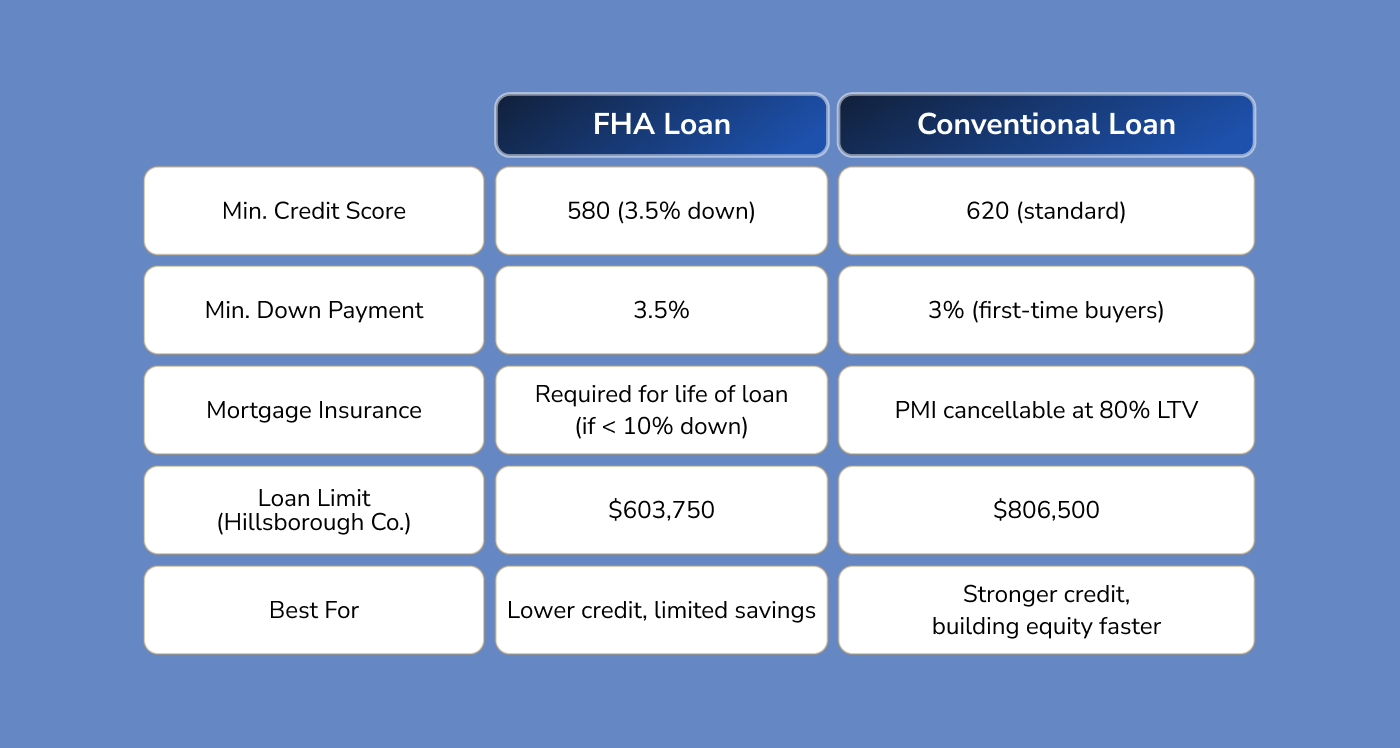
The common mistake buyers make is defaulting to FHA because it sounds easier. But if your credit score is above 680 and you have at least 5% to put down, a conventional loan may cost you less over time even with PMI in the early years.
Here's a practical decision framework:
Choose FHA if: Your credit score is below 680, your savings are tight, or you've had a recent credit event (bankruptcy, foreclosure) and you need flexibility.
Choose conventional if: Your credit score is 680+, you can put at least 5% down, and you plan to stay in the home long enough to cancel PMI.
There are scenarios where FHA loans win on pure numbers even for higher-credit borrowers particularly when seller concessions are part of the deal. Talk it through with a loan officer before deciding.
How NextGen Mortgage Can Help NH Buyers Choose the Right Loan
At NextGen Mortgage Loans, we don't run your application through an algorithm and hope for the best. Every file gets a real human review, which means we can find options that automated systems miss.
We originate both FHA and conventional loans for buyers across New Hampshire, Massachusetts, Maine, and Florida. Our team is headquartered in Nashua, New Hampshire (NMLS# 1621958), and we know the local market. We also close in as few as 14 days, which matters in a competitive NH market where sellers favor buyers who can move fast.
If you're not sure which loan is the better fit, that's exactly what a strategy call is for. Schedule yours here and we'll run the numbers on both options side by side.
Disclaimer: This content is for educational purposes only and does not constitute financial advice. Loan programs, rates, and eligibility requirements are subject to change. NextGen Mortgage Loans is licensed in NH (NMLS# 1621958), MA (MB1621958), ME (1621958), and FL (MBR4542), RI (#20265029LB). Contact a licensed loan officer to discuss your specific situation.
Frequently Asked Questions
What credit score do I need for an FHA loan vs a conventional loan in New Hampshire?
For an FHA loan, the minimum credit score is 580 with a 3.5% down payment, or 500–579 with 10% down. For a conventional loan, most NH lenders require at least a 620 score, though you'll get better rates with a 720 or higher. If your score is between 620 and 680, it's worth comparing both options. The difference in total cost can surprise you.
Is an FHA loan better for first-time homebuyers in NH?
It depends on your credit and savings. FHA loans are often the better fit for first-time buyers with limited savings or credit scores below 680, because the lower down payment and flexible credit requirements make qualifying easier. However, first-time buyers with solid credit may save more over time with a conventional loan through Fannie Mae's HomeReady program, which also allows 3% down.
Can I switch from an FHA loan to a conventional loan later?
Yes. Many NH homeowners refinance out of FHA loans once they've built enough equity and their credit profile has improved. This is a common strategy for buyers who start with FHA and want to eliminate the lifetime mortgage insurance requirement. Speak with a NextGen Mortgage Loans loan officer about current rates to see if refinancing makes sense for your situation.
What is the FHA loan limit in New Hampshire for 2026?
In Hillsborough County (Nashua) and Rockingham County, the 2026 FHA loan limit for a single-family home is $603,750, per HUD. Other NH counties may have different limits. Always verify the current limit at HUD.gov before assuming your purchase price qualifies.
How long does FHA mortgage insurance last?
If you put less than 10% down on an FHA loan, the annual mortgage insurance premium (MIP) stays for the life of the loan. If you put 10% or more down, MIP is removed after 11 years. This is the key reason buyers with stronger credit often choose conventional loans. PMI on a conventional loan can be cancelled once you reach 20% equity.
The Bottom Line
For most NH buyers in 2026, the right answer is: it depends on your credit score. FHA loans win on accessibility: they're easier to qualify for and require less cash upfront. Conventional loans win on long-term cost, especially once you can cancel PMI. Run the numbers on both before you commit.Talk to a NextGen loan officer today and we'll make it simple.

