
House Hacking in New Hampshire: A Practical FHA Guide
House hacking in New Hampshire means buying a 2 to 4 unit property, living in one unit yourself, and renting the others to help cover your mortgage. With an FHA loan, you can do this with as little as 3.5% down, which makes house hacking one of the most accessible paths to homeownership and rental income in the state.
If you are staring down high NH home prices and some of the highest property taxes in the country, this guide explains how house hacking works, how to qualify for an FHA multi-family loan, and how to evaluate whether a property actually pencils out.
What is House Hacking?
Quick answer: House hacking is a real estate strategy where you buy a property with multiple units (typically 2 to 4), live in one unit as your primary residence, and rent the others out. Tenant rent reduces or eliminates your monthly mortgage payment, letting you build equity while paying less out of pocket than you would on a comparable single-family home.
The strategy has been popular among investors for decades, but it has gained mainstream traction with first-time buyers priced out of single-family homes. Instead of waiting until you can afford a $500,000 single-family in Manchester or Portsmouth, you may be able to buy a higher-priced duplex with the same down payment, move into one side, and have a tenant cover a large share of your mortgage.
How House Hacking Works in New Hampshire
The mechanics are straightforward. You purchase a 2 to 4 unit property using an owner occupied multi family mortgage, occupy one unit, and lease the others. Your lender treats the loan as a primary residence purchase rather than an investment property, which means lower down payment requirements, more favorable interest rates, and easier qualification.
Here is what the process looks like in practice:
You get pre-approved for a multi-family loan based on your income and credit
You find a 2 to 4 unit property with workable rental potential
You close with as little as 3.5% down (FHA) or zero down (VA, if eligible)
You move into one unit and rent the others
Rent flows in monthly and offsets part or all of your mortgage payment
After the required 12 month occupancy period, you can move out, keep the property as a pure rental, and repeat the strategy on a new owner occupied multi-family. Many NH investors have built rental portfolios this way, one purchase at a time.
Why New Hampshire is a Strong Market for House Hacking
NH has several characteristics that make house hacking work better here than in many other states.
Strong rental demand in established markets. Cities like Manchester, Nashua, Concord, Dover, Rochester, and Portsmouth have steady year-round rental demand, driven by healthcare, manufacturing, and a tight regional housing supply.
College town rental engines. Durham (UNH), Plymouth (Plymouth State), Keene (Keene State), and Hanover (Dartmouth) all have predictable student and faculty rental demand. These markets favor multi-family ownership but require careful attention to local rental ordinances and seasonal vacancy patterns.
Boston commuter premium. Towns along Route 93 and the Massachusetts border (Salem, Derry, Londonderry, Windham, Nashua, Hudson) command higher rents because tenants get NH tax advantages within a reasonable Boston commute.
No state income tax on wages. NH does not tax earned income, which can affect tenant demand and your own returns on rental income.
A counterweight: high property taxes. NH consistently ranks among the highest states in the country for effective property tax rates. Property taxes can dramatically affect whether a multi-family deal works, so always run your numbers using actual tax bills from the assessor, not estimates.
Using an FHA Loan to House Hack in NH
The FHA loan is the most popular financing tool for house hacking, and for good reason. Federal Housing Administration guidelines (administered by HUD) allow you to buy a 2, 3, or 4 unit property with the same low down payment available on a single-family FHA purchase.
FHA Multi-Family Rules
To use an fha loan multi family nh purchase, you generally need to meet these requirements:
The property must have 1 to 4 units (5+ units are commercial, not FHA-eligible)
You must occupy one unit as your primary residence within 60 days of closing
You must continue to occupy that unit for at least 12 months
Minimum 3.5% down payment with a credit score of 580 or higher
The property must meet HUD minimum property standards
Loan amount must fall within FHA loan limits for the county and unit count
The 12 month occupancy rule is enforced. Lenders verify occupancy intent at application, and FHA can audit occupancy after closing.
FHA Self-Sufficiency Test for 3 and 4 Unit Properties
This rule trips up a lot of buyers. For 3 and 4 unit FHA purchases, the property must pass what HUD calls the self-sufficiency test. The net rental income from the property (75% of the appraiser's market rent estimate, after vacancy) must equal or exceed the full monthly mortgage payment, including principal, interest, taxes, insurance, and any HOA dues.
In high property tax markets like NH, this test is the make-or-break factor on triplex and fourplex deals. A property can look great on paper but fail self-sufficiency because of the tax bill alone. Two unit (duplex) purchases are not subject to this test, which is one reason duplexes are the most common house hacking target in NH.
FHA Loan Limits for Multi-Family in NH
FHA publishes county-by-county loan limits each year, and the limits are higher for 2, 3, and 4 unit properties than for single-family. You can look up current limits for any NH county on the HUD FHA Mortgage Limits search tool. Rockingham and Strafford counties typically carry the highest limits in the state due to median home values, while more rural counties carry the standard FHA floor.
A NextGen Mortgage Loans broker can pull current FHA limits for your target county and run your numbers against them in a single conversation.
Other Loan Options for House Hacking in New Hampshire
FHA is not the only path. Depending on your situation, another loan may serve you better.
VA Loans for Multi-Family
If you are a qualifying veteran, active-duty service member, or surviving spouse, the VA loan is often the best house hacking tool available. VA allows 2 to 4 unit purchases with zero down payment, no mortgage insurance, and competitive rates. You must occupy one unit as your primary residence. VA also has its own residual income and self-sufficiency rules, but the math typically works out more favorably than FHA on the same property.
Conventional Loans for 2 to 4 Unit Properties
Fannie Mae and Freddie Mac both offer owner occupied multi family mortgage products. Down payment minimums depend on the agency and unit count, but generally:
2 unit owner occupied: as low as 5% down (Freddie Mac Home Possible) or 15% down (standard conventional)
3 to 4 unit owner occupied: 20 to 25% down
Conventional loans avoid FHA mortgage insurance for life and can offer better long-term economics for buyers who can put more down. They also typically have less restrictive property condition requirements.
Comparing Your Options
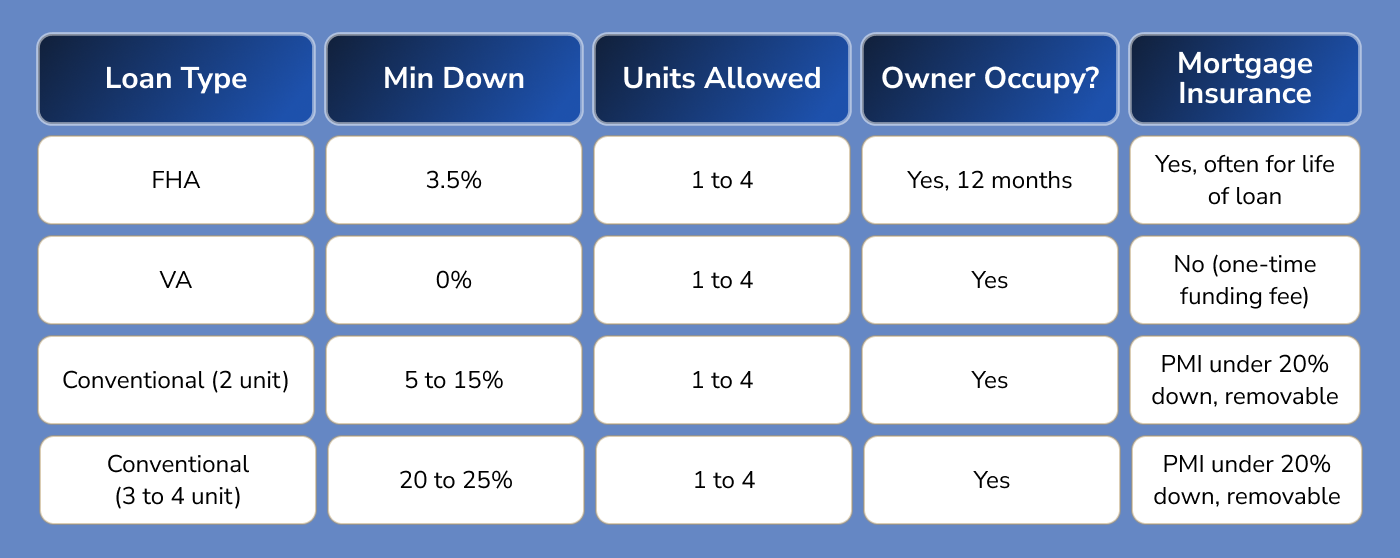
The right choice depends on your savings, credit, eligibility, and target property. A broker who can shop multiple lenders will usually find a better fit than walking into a single bank. That is exactly the conversation a NextGen loan officer can run for you in 15 minutes.
How to Buy a Duplex with an FHA Loan: Step by Step
If you want to buy a duplex with fha loan financing, here is the path most NH buyers follow.
1. Get pre-approved. Before you tour anything, get a real pre-approval from a lender that handles multi-family. Pre-approval establishes your purchase ceiling, your monthly payment estimates, and your credibility with sellers.
2. Build your rent assumptions. Pull rental comps for the area using Zillow, Apartments.com, Rentometer, and the local Facebook rental groups. Be conservative. If a unit has been listed at $1,800 for two months, the real market rent is below $1,800.
3. Run the numbers honestly. Total your projected PITI, then subtract your conservative net rental income (rent minus 5 to 10% vacancy and 5 to 10% maintenance reserve). What remains is your real out-of-pocket housing cost. Compare that to renting a comparable single unit. If house hacking does not save you money or build meaningful equity faster than renting, the deal is wrong, not the strategy.
4. Tour with rental eyes. Look at unit layouts, separate utilities, parking, laundry, and noise transfer between units. Two units that share a single boiler or one electric meter create headaches you will pay for every month.
5. Inspection and appraisal. FHA appraisals are stricter than conventional. The appraiser will flag peeling paint on pre-1978 properties (lead paint risk), missing handrails, roof issues, and other property condition items. Build a contingency for repair negotiations.
6. Close, move in, and place tenants. Screen carefully. NH landlord-tenant law (RSA 540) is generally landlord-friendly compared to Massachusetts, but eviction is still time-consuming and expensive. A good tenant beats a high-rent tenant every time.
For a deeper look at the financing side, our FHA loan page walks through credit requirements, debt-to-income limits, and document checklists.
Pros and Cons of House Hacking in New Hampshire
Advantages
Low down payment (3.5% FHA, 0% VA) on a property that produces income
Tenant rent can cover most or all of your mortgage payment
You build equity in a higher-value asset than a comparable single-family
After 12 months, the property can become a pure rental and you can repeat the strategy
Tax benefits including depreciation on the rented portion of the property (consult a tax professional for advice specific to your situation)
Disadvantages
You become a landlord. Tenants call you about leaks at midnight.
Living next to your tenants is a different experience than renting an arms-length investment property
NH property taxes can crush deals that would work in lower-tax states
FHA self-sufficiency test eliminates many 3 and 4 unit properties
Multi-family inventory in NH is limited compared to single-family
Repair and turnover costs come out of your pocket
Common Pitfalls to Avoid
Underestimating expenses. New investors plan for the mortgage and forget about maintenance, capex, vacancy, snow removal, lawn care, water and sewer, trash, and the occasional eviction. Use realistic reserves.
Skipping rent comps. Sellers and listing agents inflate "potential rent" numbers. Verify with multiple independent sources before you build a rent assumption into your deal.
Ignoring NH landlord-tenant law. RSA 540 governs evictions. RSA 540-A governs prohibited practices and security deposits. Read both before you become a landlord, or work with a local property manager who already has.
Forgetting about property tax reassessment. NH municipalities reassess on different cycles. A recent sale at a higher price can trigger a reassessment that pushes your tax bill up the following year.
Choosing the wrong loan. FHA is not always the best fit. If you can put 5 to 15% down, conventional often beats FHA over the long run because of the mortgage insurance difference. Run both before deciding.
How NextGen Mortgage Loans Can Help
NextGen Mortgage Loans is a New Hampshire-based mortgage broker, which means we shop your loan across multiple lenders rather than offering a single bank's products. For house hacking specifically, that matters: FHA multi-family overlays vary lender to lender, conventional 2 to 4 unit programs have different down payment options, and VA self-sufficiency rules can be interpreted differently across investors.
We work with first-time buyers, veterans, self-employed borrowers, and out-of-state buyers relocating to NH. Pre-approval is free and typically takes 15 to 20 minutes once we have your basic documents.
If you are ready to run the numbers on an actual property, or you want to know what you can qualify for before you start touring, contact a NextGen loan officer or use our mortgage calculators to model payments on the multi-family you have in mind.
Frequently Asked Questions
Can you house hack with an FHA loan in New Hampshire?
Yes. FHA allows 2 to 4 unit purchases with 3.5% down as long as you occupy one unit as your primary residence for at least 12 months. House hacking with FHA is one of the most common entry points into multi-family ownership in NH.
How much down payment do you need for an FHA multi-family in NH?
The minimum FHA down payment is 3.5% of the purchase price for borrowers with a credit score of 580 or higher. The same percentage applies to 1, 2, 3, or 4 unit properties, but loan limits and the self-sufficiency test on 3 and 4 unit properties may affect what you can actually buy.
Do you need landlord experience to qualify for an FHA multi-family loan?
No. FHA does not require prior landlord experience for 2 unit properties. For 3 and 4 unit properties, some lenders prefer to see landlord experience or property management arrangements, but it is not a hard FHA rule. The self-sufficiency test is the bigger qualifying hurdle.
What is the FHA self-sufficiency test?
For 3 and 4 unit FHA purchases, HUD requires that 75% of the appraiser's estimated market rent on the property must equal or exceed the full monthly PITI payment. This rule does not apply to 1 or 2 unit FHA purchases. In high property tax markets like NH, the self-sufficiency test eliminates many otherwise attractive triplex and fourplex deals.
Can you use rental income to qualify for an owner occupied multi family mortgage?
Yes, in most cases. Lenders typically allow you to count 75% of projected rental income from the non-occupied units toward your qualifying income. Rules vary by loan type and lender, so confirm with your loan officer before counting on a specific calculation.
Are there NH first-time homebuyer programs that work for house hacking?
The New Hampshire Housing Finance Authority (NHHFA) offers programs for first-time buyers, including down payment assistance and below-market rates on certain loans. Some NHHFA programs allow 2 to 4 unit owner occupied purchases, and some do not. Eligibility depends on income limits, purchase price limits, and program type. A broker can tell you which NHHFA option fits your scenario.
What happens if I move out of an FHA multi-family before 12 months?
FHA requires owner occupancy for at least 12 months from closing. Moving out earlier without a qualifying reason (job relocation, family change, military orders) can be considered occupancy fraud, which carries serious consequences. If your circumstances change, talk to your lender before you make any decisions.

