Multi Family Mortgage in New Hampshire: Your Complete Guide
A multi family mortgage in New Hampshire is a home loan used to purchase a property with two to four units, where you can live in one unit and rent out the others or hold the entire property as an investment. If you live in one of the units as your primary residence, you can access the same low down payment programs available to single family buyers, including FHA at 3.5% down, conventional at 5% down, and VA at 0% down for eligible veterans.
This guide walks you through every loan option for 2-4 unit financing in NH, how rental income helps you qualify, current loan limits, and the steps to get approved. Whether you are house hacking your first duplex in Manchester or scaling a rental portfolio in Portsmouth, the financing rules are different from single family loans and the details matter.
What Is a Multi Family Mortgage in New Hampshire?
A multi family mortgage finances a residential property containing 2 to 4 separate living units, each with its own kitchen, bathroom, and entrance. Properties with 5 or more units fall under commercial financing and follow different rules.
The key distinction in residential multi family lending is occupancy:
Owner-occupied: You live in one of the units as your primary residence. Best loan terms and lowest down payments.
Investment / non-owner-occupied: You rent out all units. Higher down payments and rates apply.
In New Hampshire, multi family properties are common in older mill cities like Manchester, Nashua, Dover, Rochester, and Laconia, where Victorian-era duplexes and triple-deckers make up a meaningful share of the housing stock.
Quick answer: A multi unit mortgage NH borrowers use most often is a conventional or FHA loan on an owner-occupied 2-4 unit, because rental income from the other units helps the buyer qualify for a larger loan.
Why Buy a Multi Family Home in New Hampshire?
The math behind multi family ownership in NH is straightforward. You collect rent from tenants who help pay your mortgage, while building equity in real estate that has historically appreciated.
Common reasons NH buyers pursue multi family financing:
House hacking: Live in one unit, rent the others, and reduce or eliminate your housing payment.
Lower entry cost than two separate properties: One closing, one mortgage, multiple income streams.
Owner-occupied tax and lending benefits: Primary residence financing terms with rental property income.
Hedge against NH's high property taxes: Rental income offsets the carrying cost of a larger property.
Long-term wealth building: Tenants pay down your principal while the property appreciates.
NH's rental demand has stayed strong, particularly in commuter towns within reach of Boston and along the Seacoast, which makes occupancy and cash flow more predictable than in some other regional markets.
Loan Options for 2-4 Unit Financing in NH
You have four main loan paths when financing a multi family home in New Hampshire. Each fits a different borrower profile.
Conventional Loans for Multi Family
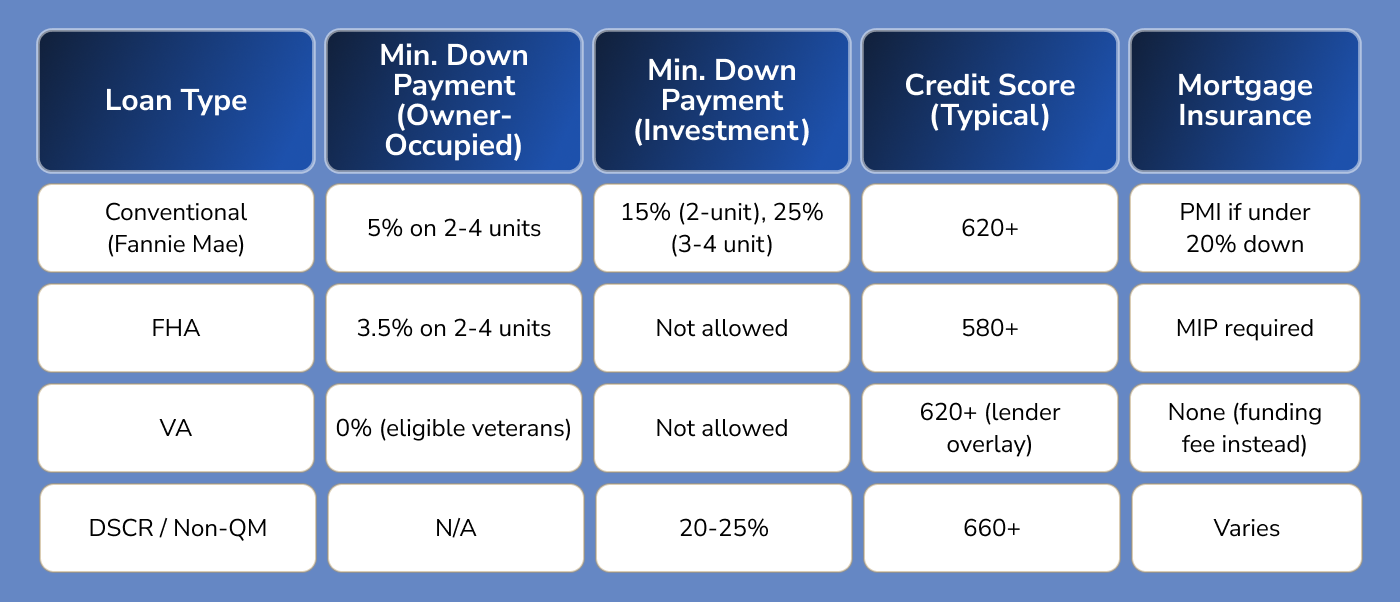
In late 2023, Fannie Mae lowered the down payment requirement for owner-occupied 2-4 unit properties to 5%. Before that change, multi family conventional loans typically required 15% to 25% down. This update made conventional financing far more accessible for first-time multi family buyers.
For investment properties, conventional financing is still available but at higher down payment thresholds: 15% for a 2-unit investment and 25% for 3-4 units.
FHA Loans for 2-4 Units
FHA allows just 3.5% down on owner-occupied 2-4 unit properties for borrowers with credit scores of 580 or higher. It is one of the most popular financing tools for first-time multi family buyers in New Hampshire because the low down payment leaves cash available for repairs, reserves, and closing costs.
FHA does require a self-sufficiency test for 3-4 unit properties (covered in detail below).
VA Loans for Veteran Buyers
If you are an eligible veteran or active-duty service member, a VA loan lets you buy a 2-4 unit property with 0% down, no mortgage insurance, and competitive rates. You must occupy one unit as your primary residence within 60 days of closing.
DSCR and Non-QM Loans
For pure investment purchases, debt service coverage ratio (DSCR) loans qualify you based on the property's rental income rather than your personal income and tax returns. These are useful for self-employed investors and those scaling a portfolio. Down payments typically run 20% to 25%.
A NextGen loan officer can walk you through which option fits your situation in about 15 minutes, since the right answer depends on your credit, cash reserves, and whether you plan to live in the property.
Down Payment Requirements for Multi Family Properties
The single biggest factor in your down payment is owner occupancy. Here is how it breaks down:
Owner-occupied 2-4 unit:
FHA: 3.5%
Conventional: 5%
VA (eligible veterans): 0%
Investment 2-4 unit:
Conventional 2-unit: 15%
Conventional 3-4 unit: 25%
DSCR / Non-QM: typically 20-25%
You will also need cash reserves on top of the down payment. For multi family loans, lenders generally require 6 months of mortgage payments (PITI) in reserves for owner-occupied 2-4 units, and often more for investment properties. Reserves can include checking, savings, and a portion of retirement accounts.
How Rental Income Helps You Qualify for a Duplex Loan in New Hampshire
Rental income from the units you do not occupy can be added to your qualifying income, which often lets you afford a larger property than you could on your salary alone. This is the financial advantage that makes a duplex loan in New Hampshire attractive to buyers who would not otherwise qualify for a comparable single family home.
Most loan programs apply a 75% rule: the lender counts 75% of the projected market rent toward your qualifying income, with the remaining 25% set aside as a vacancy and maintenance buffer.
How rental income is documented depends on whether the property has existing tenants:
Tenant-occupied units: Lender uses current lease agreements plus the appraiser's market rent analysis (Form 1007 for single units or Form 1025 for 2-4 units).
Vacant units: Lender relies on the appraiser's market rent estimate from comparable rentals.
The unit you will occupy: No rental income counted, since you live there.
For a New Hampshire duplex where you live in one unit and rent the other for $1,800 per month, the lender would typically add $1,350 per month ($1,800 x 75%) to your gross qualifying income.
FHA Self-Sufficiency Test for 3-4 Unit Properties
If you are using FHA financing on a triplex or fourplex in New Hampshire, the property must pass the self-sufficiency test. This rule does not apply to 2-unit FHA purchases.
The test works like this: the projected net rental income from all units (using 75% of market rent) must equal or exceed the full monthly mortgage payment, including principal, interest, taxes, insurance, and FHA mortgage insurance.
In plain English: the property must be able to pay for itself on rents alone.
This is the most common reason FHA buyers fail to qualify on 3-4 unit properties in New Hampshire, especially in higher-priced markets like Portsmouth or Bedford where purchase prices have outpaced market rents. If a property cannot pass the self-sufficiency test under FHA, conventional financing at 5% down is often the workaround for owner-occupied buyers.
New Hampshire Conforming Loan Limits for Multi Unit Mortgages
The Federal Housing Finance Agency (FHFA) sets baseline conforming loan limits each year, and the limits scale up for properties with more units. A 4-unit property has a substantially higher loan limit than a single family home, which gives multi family buyers more room to finance higher-priced properties under conventional terms.
Loan limits for 2-4 unit properties are roughly 28% higher (2-unit), 55% higher (3-unit), and 92% higher (4-unit) than the standard 1-unit limit in any given county. New Hampshire counties fall under the FHFA's standard baseline limits, with the exception of Rockingham and Strafford counties, which are part of the higher-cost Boston metro statistical area.
For current loan limits in your specific NH county, check the FHFA's annual conforming loan limit map or speak with a NextGen broker who can confirm what applies to the property you are looking at. Going above the conforming limit pushes you into jumbo loan territory, which typically requires higher down payments and stronger credit.
Owner-Occupied vs Investment: How It Changes Your Loan
The same property can qualify for very different terms depending on whether you intend to live there. Here is what changes:
Owner-occupied advantages:
Lower down payment (as low as 0% for VA, 3.5% for FHA, 5% for conventional)
Lower interest rates (often 0.5% to 0.875% lower than investment property rates)
Access to FHA and VA programs
Lower reserve requirements
Investment property requirements:
Higher down payments (15% to 25%)
Higher rates and fees (lender risk pricing)
Conventional or non-QM financing only (no FHA or VA)
Stricter reserve requirements (often 6+ months per financed property)
Owner-occupancy is enforced. You generally must occupy the property within 60 days of closing and live there for at least 12 months. Misrepresenting occupancy on a mortgage application is mortgage fraud, which carries serious legal consequences.
If you currently own a home and want to buy a multi family in NH as an owner-occupied purchase, lenders will look closely at the move and may require documentation explaining why the new property will be your primary residence.
Step-by-Step: How to Get a Multi Family Mortgage in NH
The mortgage process for a multi family property follows the same general path as a single family purchase, with a few extra steps tied to rental income and property analysis.
Get pre-approved. Submit income, asset, and credit documentation to a lender or broker. You will get a pre-approval letter showing your maximum loan amount based on your personal income alone, which is your starting point before adding rental income.
Identify the property type and price range. Decide whether you are pursuing 2-unit, 3-unit, or 4-unit, and confirm whether the price ranges in your target NH towns work under your loan program.
Make an offer with financing terms attached. Your offer should reference the loan program (conventional, FHA, VA) and any contingencies for inspection and appraisal.
Order the appraisal. For multi family, the appraiser uses Form 1025 (Small Residential Income Property Appraisal) and provides a market rent analysis your lender uses to add rental income to your qualification.
Underwriting reviews rental income. Your lender adds 75% of qualified market rent to your income, recalculates your debt-to-income ratio, and confirms the property meets self-sufficiency rules if applicable.
Close and take occupancy. You must move into one unit within 60 days for owner-occupied loans.
Working with a broker rather than a single bank gives you access to multiple lenders' multi family guidelines, which matters because pricing and overlays vary significantly across investors. Speak with a NextGen broker to compare options across multiple lenders before you commit to any single program.
Common Mistakes to Avoid When Financing a Multi Family Home
A few avoidable errors trip up first-time multi family buyers in New Hampshire more than anything else:
Underestimating reserves. You need 6 months of PITI in reserves on top of your down payment and closing costs. Plan for this from the start.
Skipping the self-sufficiency math on FHA 3-4 unit deals. Run the numbers before making an offer. A property that fails self-sufficiency cannot close under FHA.
Misreading projected rents. Sellers and listing agents often quote optimistic rents. The appraiser's market rent analysis is what your lender uses, not the listing.
Forgetting NH property taxes. New Hampshire has no state income tax but among the highest property tax rates in the country. Property taxes affect both your DTI and your cash flow projections. Check actual tax bills, not estimates.
Choosing the wrong loan type. FHA is not always the right answer, even with the lowest down payment. Conventional 5% down may price better when you factor in mortgage insurance and rate differences.
Treating rental income as guaranteed. Vacancies, repairs, and turnover are real costs. Build conservative assumptions into your underwriting.
How NextGen Mortgage Loans Can Help
Financing a multi family home in New Hampshire involves more moving parts than a standard purchase, and the right loan structure depends on your credit, your reserves, the property type, and whether you plan to occupy a unit. NextGen Mortgage Loans is a New Hampshire-based broker with access to multiple lenders, which means we can compare conventional, FHA, VA, and DSCR options side by side and recommend the program that fits your situation, not the one a single bank happens to offer.
Our team handles fast pre-approvals, walks you through rental income qualification, and runs the FHA self-sufficiency math before you make an offer so you do not waste time on a property that cannot close. Consultations are no-cost and no-obligation.
Get pre-approved for a multi family mortgage or run the numbers on our mortgage calculators to see what your payment looks like at different price points.
Frequently Asked Questions
Can I buy a multi family home in New Hampshire with no money down?
Yes, if you are an eligible veteran or active-duty service member using a VA loan and you plan to occupy one unit as your primary residence. VA loans allow 0% down on 2-4 unit owner-occupied properties with no mortgage insurance. For non-veteran buyers, the lowest option is FHA at 3.5% down.
How much rental income can I count to qualify for a duplex loan in New Hampshire?
Most lenders count 75% of the projected market rent from the units you will not occupy. The 25% buffer accounts for vacancy and maintenance. Documentation comes from existing leases or the appraiser's market rent analysis.
Do I have to live in the property to get a multi family mortgage?
Not necessarily, but owner-occupancy unlocks the best terms. Investment property loans require 15% to 25% down and carry higher rates. If you plan to live in one unit, you qualify for FHA, VA, and low-down-payment conventional financing.
What is the FHA self-sufficiency test?
For 3-4 unit FHA loans, the property's projected net rental income (using 75% of market rent across all units) must equal or exceed the full monthly mortgage payment. The property must theoretically be able to pay its own mortgage on rents alone. The test does not apply to 2-unit FHA purchases.
Can I use a multi family mortgage to refinance?
Yes. You can refinance an existing multi family mortgage to lower your rate, change loan terms, or pull cash out for renovations or another investment. Refinance guidelines mirror purchase guidelines on owner-occupancy and rental income.
Are interest rates higher on multi family loans?
Slightly. Owner-occupied 2-4 unit rates are typically very close to single family rates, with small loan-level price adjustments. Investment property rates run roughly 0.5% to 0.875% higher than owner-occupied rates, depending on credit score, loan-to-value, and the lender.
What is the minimum credit score for a multi family mortgage in NH?
FHA allows scores as low as 580 with 3.5% down. Conventional typically requires 620 or higher, though the best pricing starts around 740. VA underwriting follows individual lender overlays, with most NH lenders looking for 620 or higher. Your broker can match you to the lender whose guidelines best fit your credit profile.

