
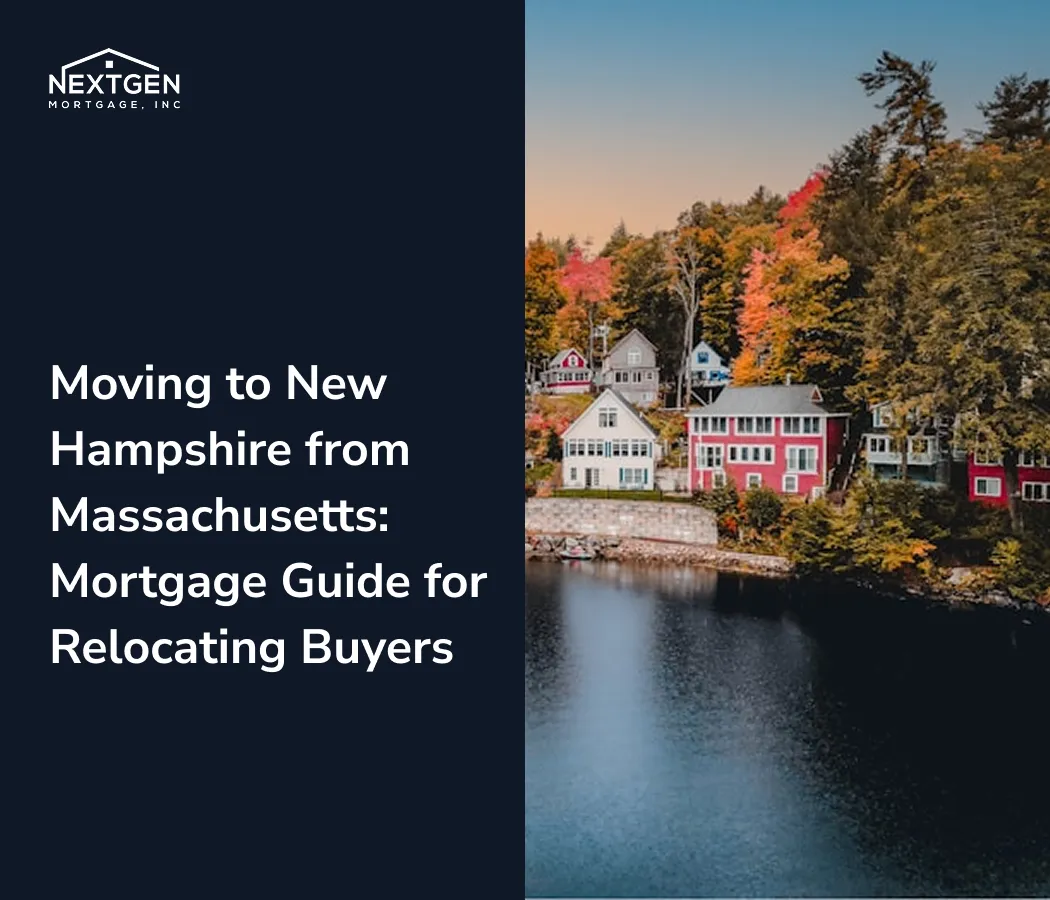
Moving to New Hampshire from Massachusetts Mortgage Guide
Financing a move from Massachusetts to New Hampshire uses the same basic mortgage process as any home purchase, but the timing between selling your MA home and closing on your NH home is where most buyers run into trouble. A handful of state level differences in property taxes, closing customs, and homestead rules also affect your numbers. Getting pre-approved early and working with a broker who understands both markets makes the transition much smoother.
Why Massachusetts Buyers Are Moving to New Hampshire
Many Massachusetts homeowners look at New Hampshire for the lack of a state income tax and no general sales tax, which can meaningfully change a household's monthly budget. Comparable homes in southern New Hampshire often cost less than similar properties in Greater Boston, stretching a buyer's purchasing power further. Towns like Nashua and Manchester sit close enough to the Massachusetts border to keep a Boston area commute realistic, which is part of what makes the move appealing rather than a full relocation.
Key Financial Differences Between Massachusetts and New Hampshire
The two states handle homeownership costs differently in ways that affect your monthly payment and your closing statement. Because rates vary town to town, treat the figures below as a general guide and confirm anything specific to your transaction with your attorney before closing.
Category | Massachusetts | New Hampshire |
|---|---|---|
State income tax | Yes, on wages and most income | None |
General sales tax | Yes | None |
Average effective property tax rate | Roughly 1.00 to 1.15 percent of assessed value statewide, varying by town | Roughly 1.50 to 1.80 percent of assessed value statewide, generally higher than MA to offset no income tax, and varies significantly by town |
Typical closing process | Attorney involved, common in most counties | Attorney involved closings are standard |
Transfer or stamp tax | Deeds excise tax of $4.56 per $1,000 of sale price (about 0.456 percent), customarily paid by the seller | Real Estate Transfer Tax of $7.50 per $1,000 charged to the buyer and another $7.50 per $1,000 charged to the seller, for a combined 1.5 percent typically split between both parties |
Homestead exemption | $125,000 automatic for any homeowner, increasing to $1,000,000 by filing a Declaration of Homestead with the Registry of Deeds | $400,000 per individual, capped at $550,000 combined for all owners of the property, effective January 1, 2026, and automatic with no filing required |
Financing the Move: Selling in MA, Buying in NH
Timing a MA sale against a NH purchase
The biggest financing challenge in a cross-state move is sequencing. Most relocating buyers fall into one of three situations: they sell first and rent temporarily, they buy first with a contingent offer tied to their MA sale, or they use bridge financing to buy before their current home closes. Each path has different implications for your down payment and your debt-to-income ratio, so it helps to run the numbers on all three before writing an offer. Understanding your DTI ratio matters here, since carrying two mortgages briefly, even on paper, can affect what you qualify for.
If you plan to use proceeds from your Massachusetts sale as your New Hampshire down payment, your lender will want to see a clear picture of your expected net proceeds, not just your home's list price. Outstanding liens, your MA closing costs, and your agent's commission all come out of that number first.
Getting pre-approved before listing the MA home
Getting pre-approved for your New Hampshire purchase before you list your Massachusetts home gives you a realistic budget and makes any offer you write in NH more competitive. It also surfaces early whether your income, credit, and existing mortgage balance support carrying both properties temporarily if your timelines overlap. Knowing how much house you can afford in New Hampshire before you sell in Massachusetts keeps the two transactions from working against each other.
One broker, two states
Because NextGen Mortgage Loans is licensed in both Massachusetts and New Hampshire, one broker can help coordinate your New Hampshire purchase financing with the timeline of your Massachusetts home sale. As an independent mortgage broker, NextGen compares programs from multiple lenders rather than offering a single bank's products. Explore our home purchase loan options in New Hampshire to find financing programs that may fit your relocation plans.
Loan programs relevant to relocating buyers
Most MA to NH relocators qualify for a conventional loan, which typically offers the most flexibility for a purchase tied to a simultaneous sale. Buyers moving into higher-priced southern New Hampshire towns sometimes need financing above conventional loan limits, in which case a jumbo loan option may apply. First-time buyers or those with lower down payments may also want to look at an FHA loan, though FHA's owner-occupancy requirements mean it generally is not used for a property you plan to keep as a rental after you relocate.
Popular Southern New Hampshire Towns for MA Relocators
Nashua sits directly across the border from northern Massachusetts and offers one of the shortest commutes back into the Merrimack Valley or Greater Boston.
Merrimack is a few minutes north of Nashua along the Everett Turnpike, appealing to buyers who want a quieter setting without adding much drive time.
Londonderry sits close to Manchester-Boston Regional Airport, which some relocators value for frequent air travel.
Salem is one of the closest NH towns to the Massachusetts border along Route 93, popular with buyers who want to keep a short commute south.
Windham has a more rural, residential character while still staying within a manageable drive of the border towns.
Derry offers a mix of village center and suburban neighborhoods, situated between Manchester and the southern border towns.
Frequently Asked Questions
Can I get pre-approved for a New Hampshire mortgage while I still own my Massachusetts home?
Yes. Lenders will factor your existing Massachusetts mortgage into your debt-to-income calculation, but owning a home in another state does not prevent pre-approval for a New Hampshire purchase. Your pre-approval amount will depend on whether you plan to sell before or after your NH purchase closes.
Do I need a different mortgage broker for a New Hampshire purchase than for my Massachusetts sale?
No. A broker licensed in both Massachusetts and New Hampshire, like NextGen Mortgage Loans, can handle financing on the New Hampshire purchase side while coordinating around your Massachusetts sale timeline. This avoids having two separate contacts working from different information.
How does a contingent offer work when selling in MA and buying in NH?
A contingent offer makes your New Hampshire purchase dependent on the successful sale of your Massachusetts home by a specified date. Sellers in competitive markets may be less willing to accept contingent offers, so discussing alternatives like bridge financing with your broker ahead of time is worthwhile.
Are property taxes higher or lower in New Hampshire compared to Massachusetts?
New Hampshire generally has higher property tax rates than Massachusetts, running roughly 1.5 to 1.8 percent of assessed value compared to roughly 1.0 to 1.15 percent in Massachusetts, since New Hampshire uses property tax revenue to offset the absence of a state income tax. The net effect on your household budget depends on your income level and the specific town's rate.
What credit score do I need to buy a home in New Hampshire?
Minimum credit score requirements vary by loan program. Conventional loans typically require a higher score than FHA loans, which can accommodate scores as low as 580 with a low down payment. Your specific rate and terms will still depend on your full credit profile, not just your score.
How long does it typically take to close on a home in New Hampshire?
A typical New Hampshire purchase closes in 30 to 45 days from an accepted offer, similar to Massachusetts timelines. Coordinating a close date with a simultaneous Massachusetts sale often requires extra communication between both sides' attorneys and lenders.
Will I need two attorneys, one in each state, to complete both transactions?
Yes. Massachusetts and New Hampshire both use attorney-involved closings, and an attorney licensed in Massachusetts cannot handle your New Hampshire closing or vice versa. Your broker can help coordinate timing between the two closings even though the attorneys themselves are separate.
Can I use gift funds for my New Hampshire down payment if my Massachusetts sale falls through?
Yes, most loan programs allow properly documented gift funds toward a down payment regardless of whether a home sale is also part of your financing plan. This can serve as a backup if your Massachusetts sale timeline shifts unexpectedly.
Ready to Coordinate Your Move?
Financing a move between two states does not have to mean managing two separate, disconnected processes. NextGen Mortgage Loans is licensed in both Massachusetts and New Hampshire, so one point of contact can walk you through your mortgage application checklist, answer the questions worth asking a mortgage broker, and help you sequence your sale and purchase with less back and forth.

