
Seller-Paid 2-1 Buydown: How It Works for Homebuyers
A seller-paid 2-1 buydown can help reduce a homebuyer's mortgage payments during the first two years of the loan by using eligible seller funds to cover part of the scheduled payment.
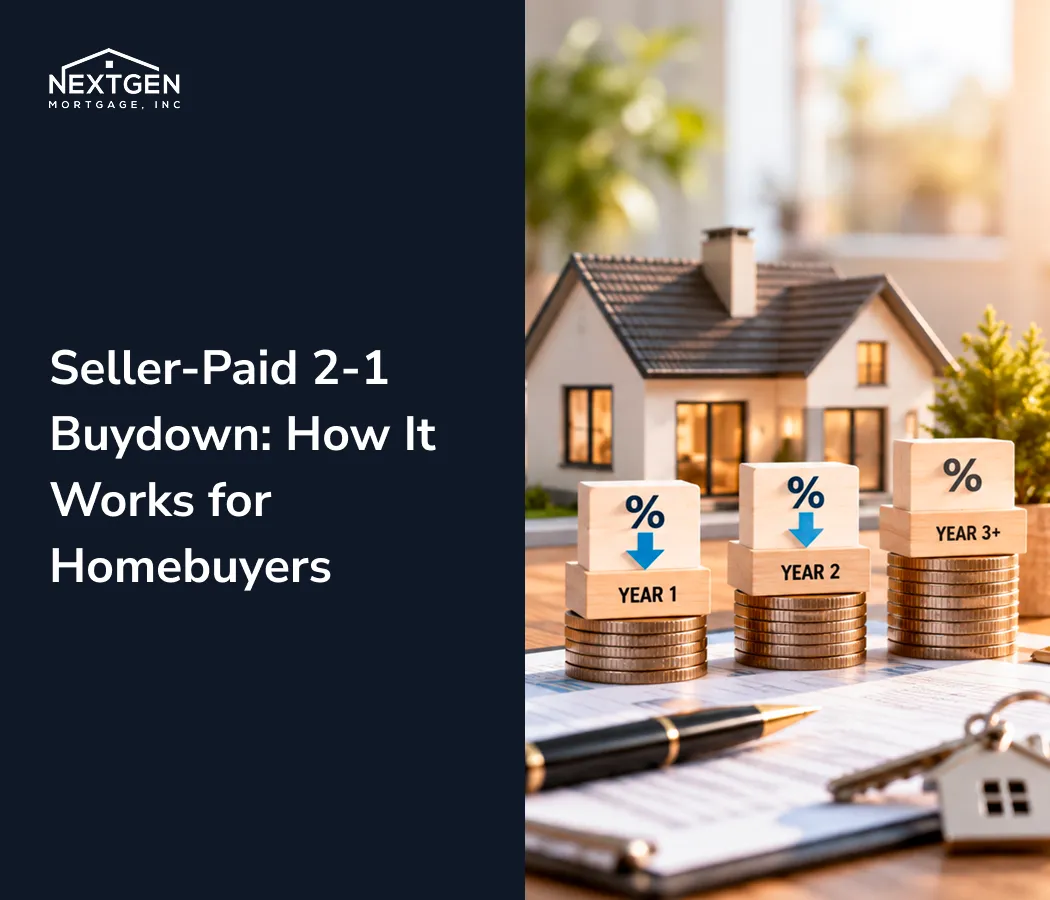
In a typical 2-1 structure, the buyer's payment during the first year is calculated as though the mortgage rate were 2 percentage points below the note rate. During the second year, the payment is calculated as though the rate were 1 percentage point lower. Beginning in Year 3, the borrower makes the full scheduled payment based on the original mortgage terms.
The seller is not permanently reducing the mortgage interest rate. Instead, eligible funds are used to subsidize the difference between the buyer's temporary payment and the full scheduled payment.
For buyers, this can make a meaningful difference during the first years of homeownership. For sellers, it can provide another way to structure an attractive offer besides simply lowering the purchase price.
If you want a broader introduction to temporary buydowns, read How a 2-1 Buydown Works. Pasted markdown
What Is a Seller-Paid 2-1 Buydown?
A seller-paid 2-1 buydown is a temporary mortgage payment subsidy funded with eligible seller contributions.
The seller provides funds as part of the home purchase transaction. Those funds are then used to cover part of the buyer's mortgage payment during the first two years.
A typical structure looks like this:
Period | Buyer's Payment Basis |
Year 1 | Payment calculated using a rate 2 percentage points below the note rate |
Year 2 | Payment calculated using a rate 1 percentage point below the note rate |
Year 3 and beyond | Full payment based on the note rate |
For example, if the mortgage has a 7.00% note rate, the buyer's principal-and-interest payment may initially be calculated as though the rate were:
Year 1: 5.00%
Year 2: 6.00%
Year 3+: 7.00%
The mortgage itself still has a 7.00% note rate. The temporary buydown funds make up the difference during the subsidized period.
How Does a Seller-Paid 2-1 Buydown Work?
A seller-funded temporary buydown is generally structured as part of the purchase transaction.
1. The Buyer and Seller Agree on the Purchase Terms
The purchase agreement may include an eligible seller contribution that can be used toward certain buyer costs, subject to the mortgage program and transaction requirements.
A temporary buydown may be one possible use of those funds.
For more background on seller contributions, see Seller Concessions in New Hampshire. Pasted markdown
2. The Cost of the 2-1 Buydown Is Calculated
The required buydown amount is based on the difference between the buyer's full scheduled mortgage payment and the reduced payments during Years 1 and 2.
The basic calculation is:
2-1 Buydown Cost = [(Full Payment - Year 1 Payment) × 12] + [(Full Payment - Year 2 Payment) × 12]
The exact amount depends on factors such as the loan amount, note rate, loan term, and mortgage program.
3. Eligible Seller Funds Are Applied to the Buydown
If the transaction and mortgage program permit it, the seller contribution can be used to fund the temporary payment subsidy.
The seller does not make the buyer's mortgage payment each month. Instead, the funds are established as part of the transaction and applied according to the temporary buydown agreement.
4. The Buyer Makes Reduced Payments During the First Two Years
During Year 1, the subsidy covers the difference between the full payment and the lower Year 1 payment.
During Year 2, it covers the smaller payment difference.
5. The Full Scheduled Payment Begins in Year 3
Once the temporary subsidy ends, the buyer is responsible for the full scheduled mortgage payment.
This payment should be understood from the beginning of the transaction. A buyer should not evaluate affordability based only on the temporarily reduced Year 1 payment.
Seller-Paid 2-1 Buydown Example
Consider a hypothetical buyer financing $400,000 with a 30-year mortgage at a 7.00% note rate.
For simplicity, this example includes principal and interest only. It does not include property taxes, homeowners insurance, mortgage insurance, HOA fees, or other housing costs.
Period | Payment Rate Used | Approx. Monthly P&I | Approx. Monthly Subsidy |
Year 1 | 5.00% | $2,147 | $514 |
Year 2 | 6.00% | $2,398 | $263 |
Year 3+ | 7.00% | $2,661 | $0 |
During Year 1:
$514 × 12 = approximately $6,167
During Year 2:
$263 × 12 = approximately $3,156
The estimated total temporary buydown cost would therefore be:
$6,167 + $3,156 = approximately $9,323
If the seller is permitted to provide enough eligible funds to cover that entire amount, the buyer could receive the reduced first-year and second-year payments without personally funding the full $9,323 subsidy.
Actual payment figures, contribution limits, and available structures will vary by mortgage and transaction.
Why Would a Seller Pay for a 2-1 Buydown?
A seller may agree to fund a temporary buydown as part of the negotiation with a buyer.
There are several reasons this strategy may be considered.
Help Reduce the Buyer's Initial Mortgage Payments
Monthly affordability can be an important concern for buyers, particularly when mortgage rates are higher than they expected.
A temporary buydown concentrates the seller's contribution into the first two years, potentially producing a noticeable reduction in the buyer's initial monthly payment.
Offer an Incentive Without Simply Cutting the Price
A seller who is willing to make a financial concession does not necessarily have to use the entire amount to reduce the purchase price.
Depending on the transaction, eligible funds may potentially be allocated toward a temporary buydown instead.
The two approaches create different financial outcomes, so buyers and sellers should compare the actual numbers.
Make the Property More Competitive
Financing incentives can also be used to differentiate a property from competing listings.
A lower first-year payment may attract buyers whose primary concern is monthly affordability rather than a relatively small change in the purchase price.
Use Available Seller Concessions Strategically
Depending on the mortgage program, eligible seller contributions may potentially be used toward several transaction costs.
A temporary buydown is one possible use.
Buyers should compare that strategy with other permitted uses before deciding how a seller contribution should be allocated.
How Much Does a Seller Need to Pay for a 2-1 Buydown?
There is no fixed dollar amount or universal percentage that a seller must pay for a 2-1 buydown.
The actual amount depends on the mortgage.
For a fully seller-funded 2-1 buydown, the eligible seller contribution generally needs to be sufficient to cover the calculated payment subsidy for Years 1 and 2, subject to applicable contribution limits and program requirements.
For example, a buydown might require:
Year 1 subsidy: $6,000
Year 2 subsidy: $3,000
Total required funding: $9,000
Another loan could require substantially more or less.
The most important variables include:
Loan amount
Mortgage note rate
Loan term
Temporary buydown structure
Mortgage program
Applicable seller-contribution limits
That is why buyers should use their actual financing scenario instead of assuming a generic buydown cost.
Is a Seller-Paid 2-1 Buydown the Same as a Seller Concession?
Not exactly.
A seller-paid 2-1 buydown may be funded through eligible seller concessions, but seller concessions are a broader category.
Depending on the mortgage program and transaction, eligible seller contributions may potentially be used toward expenses such as:
Certain closing costs
Eligible prepaid expenses
Mortgage discount points
Temporary buydown funding
Other permitted transaction costs
A temporary buydown is therefore one potential way to use seller funds.
For a more detailed explanation, read our guide to seller concessions.
Seller-Paid 2-1 Buydown vs. Price Reduction
Suppose a seller is willing to provide $10,000 of value to help complete a transaction.
There may be different ways to structure that value.
Option 1: Reduce the Purchase Price
The seller could lower the purchase price by $10,000.
This may reduce the amount the buyer needs to finance, depending on the down payment and loan structure.
However, spreading a $10,000 reduction across a long-term mortgage may result in a relatively modest monthly payment difference.
Option 2: Use Eligible Funds for a 2-1 Buydown
If permitted, seller funds could instead be used to subsidize the buyer's payments during Years 1 and 2.
Because the benefit is concentrated into a shorter period, the initial monthly payment difference may be considerably more noticeable.
Price Reduction | Seller-Paid 2-1 Buydown | |
Primary benefit | Lower purchase price | Lower initial payments |
Timing of benefit | Reflected in purchase and financing | Concentrated in first 2 years |
Changes note rate? | No | No |
Payment impact | Usually spread over time | Potentially larger initially |
Best option | Depends on buyer goals | Depends on buyer goals |
Neither option is automatically better.
A price reduction provides permanent value through a lower purchase price. A temporary buydown provides short-term payment relief.
The right choice depends on the buyer's financing, cash position, expected time in the property, and monthly budget.
Seller-Paid 2-1 Buydown vs. Closing-Cost Credit
Seller concessions may also be valuable for reducing the amount of money a buyer needs at closing.
This creates another decision.
Should eligible seller funds be used to reduce upfront costs or initial monthly payments?
Using Seller Funds for Closing Costs
This may help reduce the cash the buyer needs to complete the purchase.
For someone who wants to preserve emergency savings or maintain additional cash reserves after closing, this could be particularly valuable.
Using Seller Funds for a Temporary Buydown
This focuses the benefit on monthly cash flow.
The buyer may still bring the necessary funds to closing but benefit from lower mortgage payments during Years 1 and 2.
A buyer should compare both scenarios instead of assuming that one use of the seller credit is automatically better.
Seller-Paid 2-1 Buydown vs. Permanent Rate Buydown
A seller contribution may also potentially be compared with a permanent mortgage rate buydown.
The strategies are different.
Seller-Paid 2-1 Buydown | Permanent Rate Buydown | |
Primary benefit | Lower temporary payments | Lower long-term interest rate |
Benefit period | Years 1 and 2 | Potentially life of loan |
Does note rate change? | No | Yes |
Key consideration | Initial affordability | Long-term savings and break-even |
Upfront funding | Temporary subsidy | Discount points or rate pricing |
A permanent buydown typically involves paying mortgage discount points to obtain a lower rate.
You can learn more about mortgage points and buying down your rate. Pasted markdown
Does a Seller-Paid 2-1 Buydown Lower the Interest Rate?
No. A seller-paid 2-1 buydown does not permanently lower the mortgage's note rate.
If the mortgage has a 7.00% note rate, it remains a 7.00% mortgage during the temporary buydown period.
The Year 1 payment may be calculated as though the rate were 5.00%, and the Year 2 payment may be calculated as though the rate were 6.00%, but seller-funded buydown money covers the resulting payment difference.
This is fundamentally different from paying discount points to obtain a permanently lower mortgage rate.
What Happens After a Seller-Paid 2-1 Buydown Ends?
After the second year, the temporary subsidy ends.
The borrower then makes the full scheduled mortgage payment based on the loan's original terms.
For example:
Period | Example Payment Basis |
Year 1 | 5.00% payment calculation |
Year 2 | 6.00% payment calculation |
Year 3+ | 7.00% note-rate payment |
The change in payment should not come as a surprise.
The full scheduled payment was part of the mortgage from the beginning. The temporary subsidy simply reduced the amount the borrower was responsible for paying during the first two years.
For this reason, buyers should consider whether the Year 3 payment is affordable, not just whether the Year 1 payment fits their budget.
Borrowers can also learn more about how monthly debt obligations affect qualification in our guide to debt-to-income ratios for mortgages. Pasted markdown
Can a Seller Fund a 2-1 Buydown on Different Loan Types?
Seller contribution rules and temporary buydown requirements vary by mortgage program.
Conventional Loans
Seller-funded temporary buydowns on conventional loans must meet the applicable loan guidelines, contribution limits, and transaction requirements.
FHA Loans
FHA loans have their own requirements regarding interested-party contributions and temporary buydown arrangements.
A proposed seller-paid buydown must comply with the applicable FHA and lender requirements.
VA Loans
VA loans also have program-specific requirements governing seller contributions, concessions, and other transaction costs.
Because the rules can differ based on the mortgage and transaction, buyers should confirm the permitted contribution amount and funding structure for their specific loan. These conventional, FHA, and VA loan pages are all part of NextGen's current site structure. Pasted markdown
Benefits of a Seller-Paid 2-1 Buydown for Homebuyers
A seller-funded temporary buydown can provide several potential advantages.
Lower Initial Mortgage Payments
This is the primary benefit.
The buyer may have a lower principal-and-interest payment during the first two years compared with making the full payment from the beginning.
Preserve More Buyer Cash
When eligible seller funds cover the buydown, the buyer may not have to personally fund the entire temporary subsidy.
That may allow the buyer to retain more cash for other priorities.
Help With the Transition Into Homeownership
Buying a home often creates expenses beyond the mortgage itself.
Moving, furnishing, repairs, maintenance, utilities, and other costs can be concentrated near the beginning of homeownership.
Lower initial mortgage payments may provide additional flexibility during that period.
Provide Another Negotiation Option
A seller-funded buydown gives buyers and sellers another potential way to structure a transaction.
Instead of negotiating only around the purchase price, the parties may be able to consider how eligible seller contributions could affect the buyer's overall financing.
What Should Buyers Consider Before Accepting a Seller-Paid Buydown?
The lower initial payment can be appealing, but buyers should evaluate the entire mortgage.
Can You Afford the Full Year 3 Payment?
This is the most important question.
A buyer should be comfortable with the scheduled payment after the temporary subsidy ends.
The Year 1 payment should not be treated as the permanent mortgage payment.
Could the Seller Funds Be More Valuable Elsewhere?
A buyer may have several possible uses for eligible seller contributions.
Depending on the transaction, those funds might provide more value when applied toward:
Closing costs
Discount points
Other permitted prepaid expenses
A temporary buydown
The best use depends on the buyer's financial priorities.
Are You Assuming You Will Refinance?
Some buyers may expect to refinance before the temporary buydown expires.
That should not be treated as guaranteed.
Future mortgage rates cannot be predicted with certainty, and the ability to refinance can depend on future income, credit, equity, property value, closing costs, and lending requirements.
For more context, see When to Refinance a Mortgage in New Hampshire. Pasted markdown
Does the Transaction Meet the Loan Program's Requirements?
A seller's willingness to provide a contribution does not automatically mean the proposed use will be permitted.
The buydown must comply with the applicable mortgage program and transaction requirements.
Is a Seller-Paid 2-1 Buydown Worth It?
A seller-paid 2-1 buydown may be worth considering when eligible seller funds are available, lower initial mortgage payments are valuable to the buyer, and the full scheduled payment remains affordable after the temporary subsidy ends.
It may be particularly attractive when:
The seller is already offering an eligible contribution
Lower initial monthly payments are a priority
The buyer has sufficient cash for other closing requirements
The full Year 3 payment comfortably fits the buyer's budget
The buydown compares favorably with other permitted uses of the seller contribution
Another option may be more useful when:
The buyer primarily needs help with closing costs
Long-term rate savings are more important
A lower purchase price provides more value
The available seller contribution cannot fully support the proposed buydown
The buyer does not place much value on temporary payment relief
The best decision comes from comparing the alternatives using the same purchase price and loan assumptions.
How to Evaluate a Seller-Paid 2-1 Buydown Offer
Before deciding whether to use a seller contribution for a temporary buydown, work through the transaction step by step.
Step 1: Determine the Available Seller Contribution
Find out how much eligible seller funding is available and whether it can be used toward a temporary buydown.
Step 2: Calculate the Buydown Cost
Determine the Year 1 subsidy, Year 2 subsidy, and total amount required.
Step 3: Compare All Three Payment Levels
Review:
Year 1 payment
Year 2 payment
Year 3 and beyond payment
This gives you a much clearer picture than looking at the first-year payment alone.
Step 4: Compare Alternative Uses of the Seller Funds
Consider how the same eligible contribution could affect:
Closing costs
Mortgage discount points
Purchase structure
Temporary mortgage payments
Step 5: Consider Your Time Horizon
Think about how long you expect to keep the home and mortgage.
Short-term payment relief and long-term financing savings are different financial goals.
Step 6: Confirm the Details With Your Mortgage Professional
Loan-program requirements, seller-contribution limits, and mortgage pricing can change the calculation.
Talk to a NextGen Mortgage Professional
Frequently Asked Questions About Seller-Paid 2-1 Buydowns
Can a seller pay for a 2-1 buydown?
Yes, a seller may be able to fund a 2-1 buydown when the contribution and proposed use are permitted by the applicable mortgage program and transaction requirements.
How much does a seller-paid 2-1 buydown cost?
There is no fixed price. The cost is based on the difference between the full scheduled mortgage payment and the reduced payments during Years 1 and 2.
Does a seller-paid 2-1 buydown lower the mortgage interest rate?
No. A temporary buydown subsidizes the borrower's payments for a limited period. It does not permanently change the mortgage's note rate.
Is a seller-paid 2-1 buydown a seller concession?
Eligible seller concession funds may be used to fund a temporary buydown when permitted. Seller concessions are broader and can potentially be used toward several eligible transaction costs.
Is a seller-paid 2-1 buydown better than reducing the home price?
Not necessarily. A temporary buydown may provide a larger initial monthly payment reduction, while lowering the purchase price provides a different long-term benefit. The better option depends on the buyer's financing and priorities.
Is a seller-paid buydown better than having the seller pay closing costs?
It depends on the buyer. Someone who wants to minimize cash needed at closing may prefer closing-cost assistance, while another buyer may place more value on reducing their first two years of mortgage payments.
What happens in Year 3 of a seller-paid 2-1 buydown?
The temporary subsidy ends after Year 2. Beginning in Year 3, the borrower makes the full scheduled mortgage payment based on the underlying loan terms.
Can a seller fund a 2-1 buydown on an FHA loan?
Potentially, provided the transaction meets applicable FHA and lender requirements for seller contributions and temporary buydowns.
Can a seller fund a 2-1 buydown on a VA loan?
Potentially, subject to applicable VA guidelines, seller-contribution rules, lender requirements, and the specifics of the transaction.
See What a Seller-Paid 2-1 Buydown Could Mean for Your Mortgage
A seller-paid 2-1 buydown can turn an eligible seller contribution into temporary mortgage payment relief during the first two years of homeownership.
The strategy may be valuable for buyers who want lower initial payments, but it should be evaluated alongside other options such as closing-cost assistance, a price reduction, or a permanent rate buydown.
Most importantly, buyers should understand the full payment that begins after the temporary subsidy expires.
Use the numbers from your actual mortgage scenario to compare the options before deciding how seller funds should be used.
Talk to a NextGen Mortgage Professional
Examples are for educational purposes only and are not an offer or commitment to lend. Actual rates, mortgage payments, contribution limits, eligible funding sources, buydown requirements, and qualification standards vary by loan program and transaction.

