
Seller Concessions in New Hampshire: How Much Can Sellers Pay Toward Closing Costs?
Seller concessions are credits a home seller agrees to pay toward your closing costs at the negotiating table, and they can reduce the cash you bring to closing by thousands of dollars. In New Hampshire, where median home prices and property taxes both sit well above the national average, getting the seller to cover part of your closing costs can be the difference between buying now and waiting another year.
This guide walks through how seller concessions work, exactly how much can a seller contribute to closing costs by loan type, and how to ask for them in a New Hampshire market without losing the deal.
What Are Seller Concessions?
A seller concession is a credit the seller agrees to give the buyer at closing to cover specific costs tied to the mortgage and the transaction. The concession is written into the purchase and sale agreement and applied as a line item on the buyer's closing disclosure.
Sellers do not hand cash to buyers. The concession reduces what the buyer owes at the closing table. In practice, seller paid closing costs lower your out-of-pocket cash to close, not the purchase price or your monthly payment.
Quick answer: Seller concessions are seller-funded credits that pay part of the buyer's closing costs and prepaid expenses, capped at a percentage of the purchase price set by the loan type.
How Seller Concessions Work in a Real Estate Transaction
The process is straightforward once you know the steps:
You and your agent submit an offer that includes a request for seller concessions, usually expressed as a dollar amount or a percentage of the purchase price.
The seller accepts, counters, or rejects the request as part of the broader negotiation.
The agreed concession is written into the purchase and sale agreement.
Your lender reviews the concession to confirm it falls within the limit allowed by your loan program.
At closing, the credit appears on the buyer's side of the closing disclosure and reduces your cash to close.
The lender check matters. If you negotiate concessions above the program's cap, the excess is forfeited. It does not roll over and it does not reduce the sale price.
How Much Can a Seller Contribute to Closing Costs?
The answer depends on your loan type and, for conventional loans, your down payment. Each loan program sets its own ceiling, and lenders enforce it.
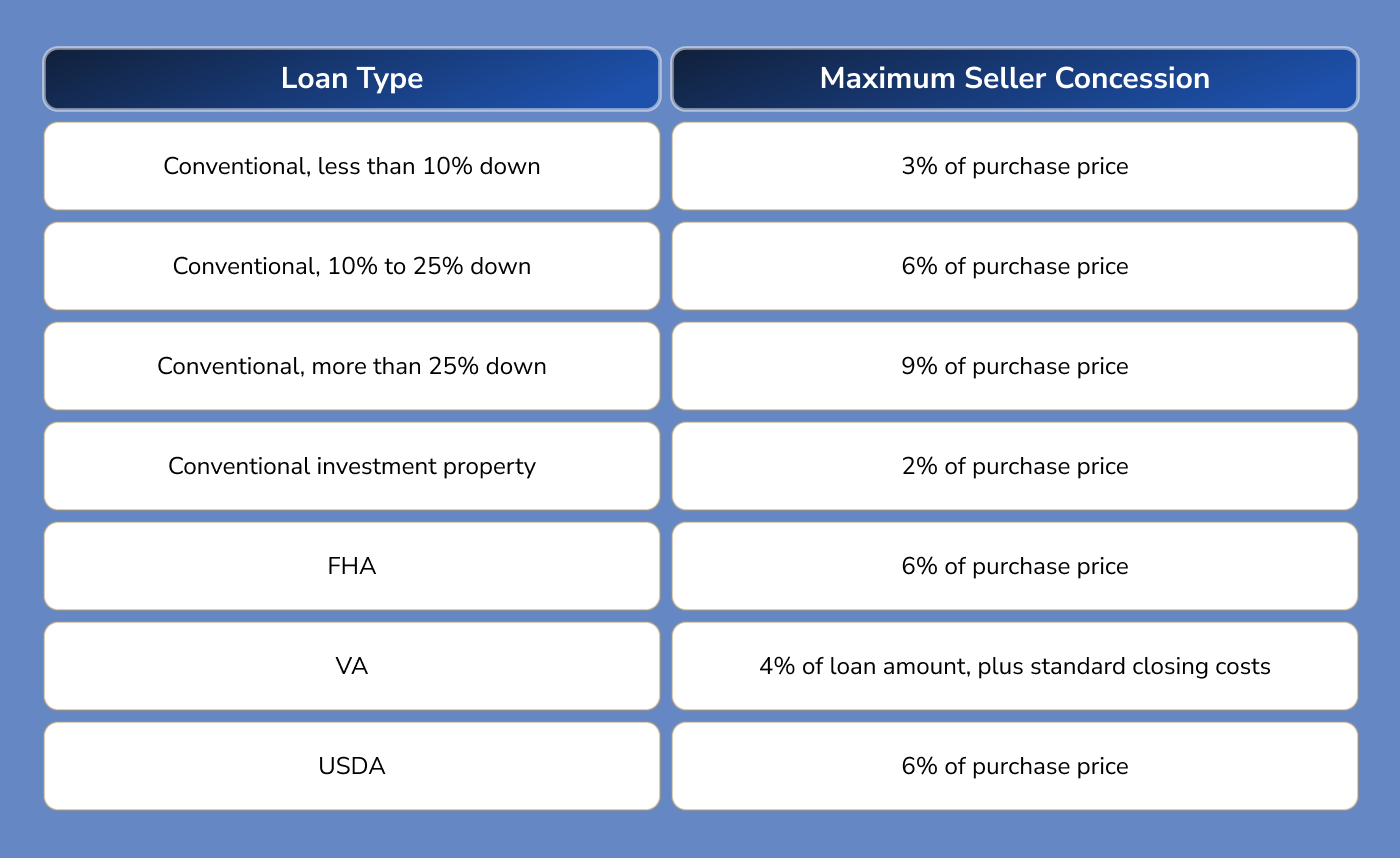
These limits come directly from Fannie Mae, Freddie Mac, HUD, the VA, and USDA program guidelines.
Seller Concessions on a Conventional Loan
For a conventional loan backed by Fannie Mae or Freddie Mac, the seller concessions conventional loan cap is tied to your down payment.
Less than 10% down: capped at 3% of the purchase price
10% to 25% down: capped at 6%
More than 25% down: capped at 9%
Second homes follow the same tiers as primary residences
Investment properties are capped at 2% regardless of down payment
A buyer putting 5% down on a $475,000 home in Manchester or Nashua would be limited to 3%, or $14,250 in concessions. A buyer putting 15% down on the same home could receive up to $28,500.
Seller Concessions on an FHA Loan
The seller concessions FHA cap is 6% of the purchase price, regardless of down payment. HUD sets this limit and it applies to all FHA-insured loans nationwide.
The 6% can cover closing costs, prepaid items, discount points, and the upfront FHA mortgage insurance premium. For first-time buyers in New Hampshire using an FHA loan, this is one of the most generous concession allowances available across loan programs.
A note on appraisals: if the agreed concession combined with the sale price suggests inflated value, the appraiser may flag it. The concession structure cannot push the deal beyond what the property supports.
Seller Concessions on a VA Loan
VA loan rules are the most generous in one specific way and stricter in another.
The seller can pay all of the buyer's normal closing costs without it counting against any concession cap.
On top of that, the seller can pay up to 4% of the loan amount in what the VA classifies as concessions.
The 4% concession bucket covers items the VA considers above and beyond standard buyer costs, such as prepaid taxes and insurance, the VA funding fee, paying off the buyer's debts, certain gifts, and discount points beyond two.
For NH veterans, this combination means a well-structured VA offer can result in close to zero cash to close.
Seller Concessions on a USDA Loan
USDA loans, available in many rural and semi-rural NH towns outside the Manchester and Nashua metro cores, allow up to 6% in seller concessions. USDA financing already permits 100% financing, and a 6% concession on top can cover most or all of a buyer's closing costs.
If you are unsure whether a property qualifies for USDA, a NextGen loan officer can pull the eligibility map and confirm in a few minutes.
What Seller Paid Closing Costs Can Cover
Seller concessions can be applied to most legitimate buyer costs at closing, including:
Loan origination and underwriting fees
Discount points to lower your interest rate
Title insurance and title search fees
Attorney fees (New Hampshire is an attorney-involved closing state)
Appraisal fees (if not already paid)
Recording fees and the buyer's portion of the NH Real Estate Transfer Tax
Prepaid property taxes and homeowners insurance
Initial escrow deposits
Upfront mortgage insurance premiums on FHA and USDA loans
The VA funding fee on VA loans
Seller concessions cannot be used for the buyer's down payment on conventional, FHA, or USDA loans. They also cannot be paid as cash to the buyer outside closing.
When to Ask for Seller Concessions in New Hampshire's Market
The right time to ask depends on local conditions. In a fast-moving Seacoast market like Portsmouth or Dover, asking for 3% in concessions on top of a list-price offer can sink your bid. In slower-moving markets or on homes that have been listed for 30 or more days, sellers are often more flexible.
Strong situations to request concessions:
The property has been listed for several weeks with limited interest
An inspection turns up issues you would rather take as a credit than have repaired
You are competing on price but need help with cash to close
The market has cooled in your county (Coos, Carroll, and parts of Cheshire and Sullivan have historically had longer days on market than Hillsborough and Rockingham)
Weaker situations:
Multiple offers on the table
Listed under three days with strong showing activity
Your offer is already under list price with otherwise weak terms
A seasoned buyer's agent and a written pre-approval from your mortgage broker tell the seller you are a serious, vetted buyer. That credibility is what earns concessions in tight markets.
How to Negotiate Seller Concessions Without Losing the Deal
Three tactics work consistently in New Hampshire:
Build the concession into a stronger offer price. If a home is listed at $450,000 and you can stretch to $460,000, offering $460,000 with a $10,000 seller credit nets the seller the same amount. Many sellers focus on the headline number more than the math underneath.
Tie the concession to inspection findings. After the inspection, requesting a closing credit instead of repairs is often easier for the seller, who would rather not coordinate contractors and timelines before moving.
Ask only for what you can use. If your total closing costs are $12,000, do not ask for $20,000. The lender will cap the concession at your actual costs, and the rest is forfeited. Your loan officer can give you an estimated closing cost figure before you write the offer.
Use our mortgage calculators to model different price-and-concession combinations and see how each one affects your monthly payment and cash to close.
Pros and Cons of Seller Concessions for Buyers
Pros
Lower cash to close, freeing money for moving costs, furniture, or reserves
Can buy down your interest rate with discount points paid by the seller
Helps stretch a tight down payment further
Particularly valuable on FHA, VA, and USDA loans where the limits are higher
Cons
Can weaken your offer in a competitive market
May push the contract price above appraised value if structured carelessly
Excess concessions over the program cap are forfeited at closing
Sellers in strong markets may move on to a cleaner offer
How NextGen Mortgage Loans Can Help
NextGen Mortgage Loans is a New Hampshire mortgage broker, which means we shop your file across multiple lenders instead of tying you to one bank's pricing. When you negotiate seller concessions, we make sure the structure works with the loan program you are using and that no dollar of the credit is wasted at the closing table.
Our team works with NH buyers across every county, from Hillsborough and Rockingham to the North Country. We can issue a pre-approval in 24 to 48 hours, walk through how seller paid closing costs would affect your specific scenario, and coach your agent on how to write the offer for the best chance of acceptance.
There is no cost to talk. Contact a NextGen loan officer or explore our loan programs to get started.
Frequently Asked Questions
Are seller concessions a good idea?
In most cases, yes, especially for first-time buyers, FHA borrowers, and VA buyers who want to minimize cash to close. They become a weaker strategy only when the market is so competitive that asking for them puts your offer behind cleaner ones.
Do seller concessions reduce the sale price?
No. Seller concessions are credits applied at closing to cover the buyer's costs. The sale price stays the same, which is what the appraiser, the tax assessor, and future comparable sales will reflect.
Can seller concessions be used for a down payment?
Generally no. Conventional, FHA, and USDA loans prohibit using seller concessions for the down payment itself. VA loans typically do not require a down payment, so the question rarely applies, though VA concession rules still cap what a seller can contribute beyond standard closing costs.
How do seller concessions affect my mortgage?
Concessions reduce your cash to close but do not change your loan amount, interest rate, or monthly payment, unless you use part of the credit to buy discount points. If you apply concessions to points, your rate and monthly payment go down.
Are seller concessions taxable for the buyer?
Seller concessions used for closing costs are not treated as taxable income to the buyer. They may, however, affect your cost basis in the home for future tax purposes. Consult a tax professional for advice specific to your situation.
What is the maximum seller concession on an FHA loan in New Hampshire?
The FHA cap is 6% of the purchase price, set by HUD, and it applies in New Hampshire the same way it applies nationwide. There is no state-specific reduction or expansion of the limit.
Can a seller refuse to pay any concessions?
Yes. Concessions are entirely negotiable. If a seller has multiple offers or a hot listing, they can decline your request, counter for a higher price, or accept a different offer with no concession ask attached.

