
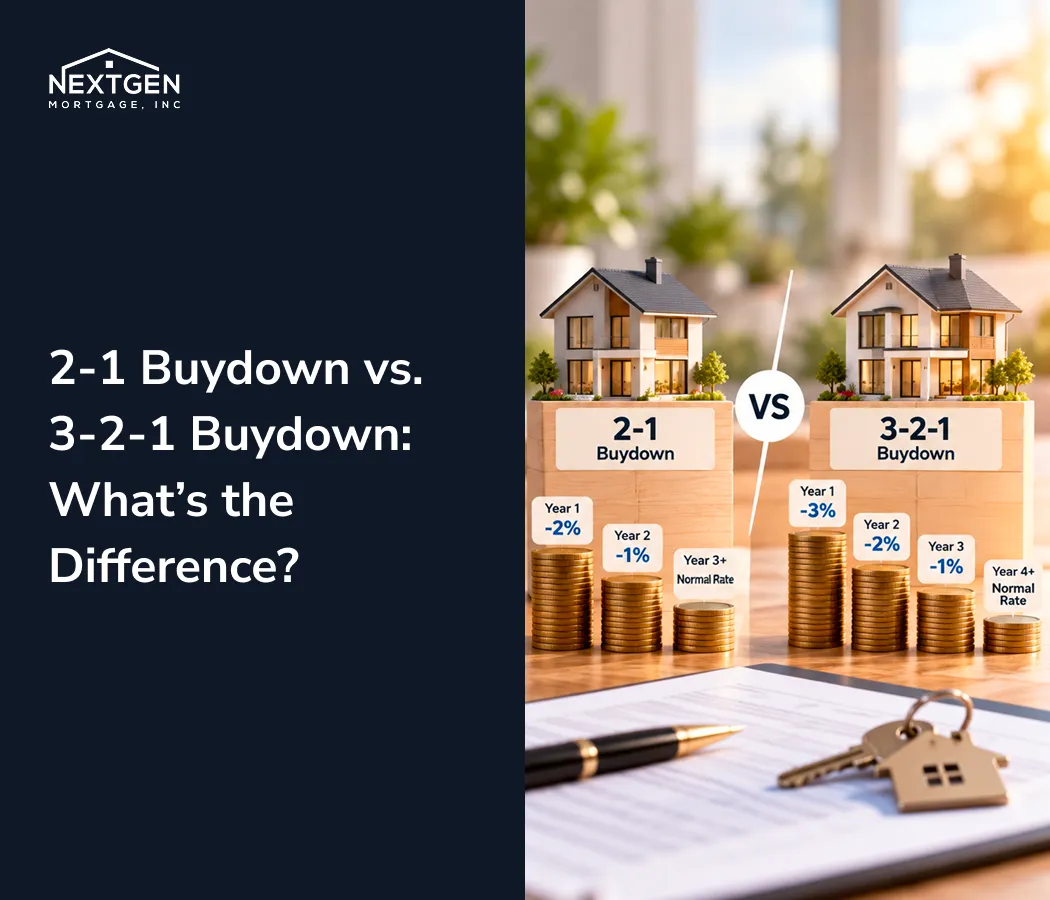
2-1 Buydown vs. 3-2-1 Buydown: What’s the Difference?
A temporary mortgage buydown can reduce a homebuyer’s payments during the first few years of a loan, but not every buydown follows the same structure.
Two common options are the 2-1 buydown and the 3-2-1 buydown.
A 2-1 buydown provides reduced payments for two years. A 3-2-1 buydown extends that temporary relief to three years and provides a larger payment reduction during the first year.
The tradeoff is cost.
Because a 3-2-1 buydown provides a deeper payment reduction for a longer period, it generally requires substantially more money to fund than a 2-1 buydown.
Neither option is automatically better. The right structure depends on the loan amount, available seller or builder contribution, full future payment, and how much value the buyer places on lower payments during the first few years.
If you are new to temporary buydowns, you can first review how a 2-1 buydown works. Pasted markdown
2-1 vs. 3-2-1 Buydown: Quick Comparison
The biggest difference between a 2-1 and 3-2-1 buydown is the length and size of the temporary payment reduction.
Feature | 2-1 Buydown | 3-2-1 Buydown |
Subsidy period | 2 years | 3 years |
Year 1 payment basis | Note rate minus 2 percentage points | Note rate minus 3 percentage points |
Year 2 payment basis | Note rate minus 1 percentage point | Note rate minus 2 percentage points |
Year 3 payment basis | Full note-rate payment | Note rate minus 1 percentage point |
Full payment begins | Year 3 | Year 4 |
First-year payment reduction | Lower | Greater |
Funding required | Generally lower | Generally higher |
Main benefit | Lower payments for 2 years | Deeper payment relief for 3 years |
The main difference is simple: a 3-2-1 buydown provides a larger and longer temporary payment reduction, but it generally costs more to fund.
How Does a 2-1 Buydown Work?
A 2-1 buydown temporarily reduces the amount the borrower pays during the first two years of the mortgage.
Suppose the loan has a 7.00% note rate.
The payment structure might look like this:
Year 1: payment calculated as though the rate were 5.00%
Year 2: payment calculated as though the rate were 6.00%
Year 3 and beyond: full payment based on the 7.00% note rate
The underlying mortgage rate does not actually change during the first two years.
Instead, funds in the temporary buydown account cover the difference between the reduced borrower payment and the full scheduled mortgage payment.
For a more detailed explanation, read How a 2-1 Buydown Works.
How Does a 3-2-1 Buydown Work?
A 3-2-1 buydown follows the same general principle, but the temporary payment reduction lasts for three years instead of two.
Using the same 7.00% note rate:
Year 1: payment calculated as though the rate were 4.00%
Year 2: payment calculated as though the rate were 5.00%
Year 3: payment calculated as though the rate were 6.00%
Year 4 and beyond: full payment based on the 7.00% note rate
Again, the mortgage itself still has a 7.00% note rate.
The temporary buydown funds simply subsidize a greater portion of the scheduled payment during the first three years.
2-1 Buydown vs. 3-2-1 Buydown Example
Consider a hypothetical buyer with the following mortgage:
Loan amount: $400,000
Loan term: 30 years
Note rate: 7.00%
For simplicity, the examples below include principal and interest only. Property taxes, homeowners insurance, mortgage insurance, HOA fees, and other costs are not included.
2-1 Buydown Example
At a 7.00% note rate, the full principal-and-interest payment would be approximately $2,661 per month.
With a 2-1 buydown:
Period | Payment Rate Used | Approx. Monthly P&I | Approx. Monthly Subsidy |
Year 1 | 5.00% | $2,147 | $514 |
Year 2 | 6.00% | $2,398 | $263 |
Year 3+ | 7.00% | $2,661 | $0 |
The estimated subsidy would be:
Year 1: about $6,167
Year 2: about $3,156
Estimated total 2-1 buydown cost: $9,323
3-2-1 Buydown Example
With a 3-2-1 buydown on the same mortgage:
Period | Payment Rate Used | Approx. Monthly P&I | Approx. Monthly Subsidy |
Year 1 | 4.00% | $1,910 | $752 |
Year 2 | 5.00% | $2,147 | $514 |
Year 3 | 6.00% | $2,398 | $263 |
Year 4+ | 7.00% | $2,661 | $0 |
The estimated subsidy would be:
Year 1: about $9,019
Year 2: about $6,167
Year 3: about $3,156
Estimated total 3-2-1 buydown cost: $18,342
In this example, the 3-2-1 buydown provides substantially more payment relief, but it also requires approximately $9,019 more funding than the 2-1 structure.
Actual results vary based on loan terms and program requirements.
Explore Mortgage Calculators Pasted markdown
Which Costs More, a 2-1 or 3-2-1 Buydown?
A 3-2-1 buydown generally costs more than a 2-1 buydown.
The reason is straightforward.
A 2-1 buydown subsidizes:
Year 1
Year 2
A 3-2-1 buydown subsidizes:
Year 1 at an even lower payment
Year 2
Year 3
The 3-2-1 structure therefore provides both a larger first-year subsidy and an additional year of assistance.
The exact difference is not fixed.
It depends on:
Loan amount
Note rate
Loan term
Monthly payment differences
Temporary buydown structure
For larger mortgages, the difference in required funding can become significant.
Which Buydown Has the Lower First-Year Payment?
A 3-2-1 buydown generally produces the lower first-year payment.
Using a 7.00% note rate:
A 2-1 buydown calculates the Year 1 payment as though the rate were 5.00%.
A 3-2-1 buydown calculates the Year 1 payment as though the rate were 4.00%.
In our $400,000 example:
2-1 Year 1 payment: approximately $2,147
3-2-1 Year 1 payment: approximately $1,910
That is a difference of roughly $237 per month during the first year.
The additional payment relief is also one reason the 3-2-1 structure requires more upfront funding.
When Does the Full Mortgage Payment Begin?
This is another major difference.
Buydown Type | Full Scheduled Payment Begins |
2-1 Buydown | Year 3 |
3-2-1 Buydown | Year 4 |
The transition to the full payment should not be treated as an unexpected rate increase.
The mortgage note rate is established from the beginning. The temporary subsidy simply reduces the amount the borrower pays during the initial years.
A buyer should therefore evaluate affordability based on the full scheduled mortgage payment, not just the first-year payment.
For more context on how monthly obligations affect mortgage qualification, read our guide to debt-to-income ratios for mortgages. Pasted markdown
Who Can Pay for a 2-1 or 3-2-1 Buydown?
Depending on the mortgage program and transaction, temporary buydown funds may come from eligible sources such as:
A home seller
A builder
A lender
Another permitted source
The exact rules depend on the mortgage program and transaction.
A seller-funded temporary buydown can be particularly relevant when the seller is already willing to provide an eligible contribution.
You can learn more about how seller contributions work in our guide to seller concessions in New Hampshire. Pasted markdown
Seller-Paid 2-1 vs. Seller-Paid 3-2-1 Buydown
When a seller is helping fund the buydown, the amount of available contribution can influence which structure is realistic.
A 2-1 buydown generally requires less money to fund.
A 3-2-1 buydown provides greater temporary payment relief but may require a much larger seller contribution.
Seller-Paid 2-1 | Seller-Paid 3-2-1 | |
Duration | 2 years | 3 years |
First-year relief | Significant | Greater |
Seller funds required | Generally lower | Generally higher |
Full payment begins | Year 3 | Year 4 |
May fit smaller concession | More likely | Less likely |
Suppose the total 2-1 subsidy is $9,300 but the same loan requires more than $18,000 for a 3-2-1 structure.
If the available seller contribution is limited, the 2-1 option may be easier to structure.
However, seller contributions must still comply with the applicable mortgage program and transaction requirements.
2-1 Buydown vs. 3-2-1 Buydown: Which Is Better?
Neither is universally better.
A 2-1 buydown may make more sense when the buyer wants meaningful temporary payment relief without requiring as large a subsidy.
A 3-2-1 buydown may be worth considering when more funding is available and the buyer places greater value on a longer transition to the full mortgage payment.
A 2-1 Buydown May Make More Sense If
The available seller or builder contribution is smaller.
Two years of reduced payments are sufficient.
The buyer wants to limit the total amount needed to fund the subsidy.
The full payment beginning in Year 3 is manageable.
Other transaction costs also need to be covered.
A 3-2-1 Buydown May Make More Sense If
A larger eligible contribution is available.
Lower payments during the first three years are especially valuable.
The buyer prefers a more gradual transition to the full payment.
The additional subsidy cost can be justified.
The transaction still meets applicable contribution limits.
The decision should be based on the actual loan numbers rather than the buydown name alone.
2-1 or 3-2-1 Buydown vs. a Permanent Rate Buydown
Temporary buydowns and permanent rate buydowns solve different problems.
2-1 or 3-2-1 Temporary Buydown | Permanent Rate Buydown | |
Main benefit | Lower initial payments | Lower long-term rate |
Rate permanently changes? | No | Yes |
Duration | 2 or 3 years | Potentially life of loan |
Funding | Temporary subsidy | Discount points or lender pricing |
Main decision factor | Short-term cash flow | Long-term savings and break-even |
With a permanent buydown, mortgage discount points are generally paid upfront to obtain a lower interest rate.
One discount point generally equals 1% of the loan amount, but one point does not automatically produce a fixed interest-rate reduction.
For more information, read Mortgage Points: How Buying Down Your Rate Works. Pasted markdown
2-1 or 3-2-1 Buydown vs. a Seller Price Reduction
If a seller is willing to offer financial assistance, there may be several possible ways to structure that value.
Strategy | Primary Buyer Benefit |
Purchase price reduction | Lower purchase price |
Closing-cost credit | Less cash needed at closing |
2-1 buydown | Lower payments for 2 years |
3-2-1 buydown | Lower payments for 3 years |
A temporary buydown can create a more noticeable short-term monthly payment difference because the benefit is concentrated into a limited number of years.
A price reduction provides a different type of benefit by lowering the amount paid for the property.
Closing-cost assistance may be more valuable to buyers whose main concern is preserving cash at closing.
There is no universal winner.
The buyer should compare the actual monthly payment, upfront cash requirements, total subsidy, and long-term financing impact of each alternative.
What Should Buyers Consider Before Choosing a Buydown?
The lower introductory payment is only one part of the decision.
Can You Afford the Full Scheduled Payment?
This should be the first question.
With a 2-1 buydown, the full payment generally begins in Year 3.
With a 3-2-1 buydown, it generally begins in Year 4.
A buyer should be comfortable with that payment even if their financial situation does not change.
Who Is Funding the Buydown?
A seller-funded buydown can look very different financially from a structure that requires the buyer to commit their own funds.
If eligible seller or builder funds are available, compare the buydown with other possible uses of that contribution.
How Much Funding Is Available?
A 3-2-1 structure may require significantly more money.
The available contribution may therefore determine which option is practical.
Could the Funds Be More Valuable Elsewhere?
Consider whether eligible funds might instead provide more value when used toward:
Closing costs
Mortgage discount points
Other permitted prepaid expenses
A different temporary buydown structure
Are You Counting on Refinancing?
Future refinancing should not be assumed.
Mortgage rates can move in either direction, and future refinancing eligibility can depend on income, credit, debt, property value, equity, closing costs, and loan-program requirements.
For more information, read When to Refinance a Mortgage in New Hampshire. Pasted markdown
Can You Use a 2-1 or 3-2-1 Buydown With Different Loan Programs?
Temporary buydown requirements can vary by mortgage program.
Conventional Loans
Temporary buydowns used with conventional loans must comply with the applicable conventional financing requirements.
FHA Loans
FHA loans have their own rules regarding interested-party contributions and temporary financing arrangements.
VA Loans
VA loans also have program-specific requirements regarding seller contributions, concessions, and temporary buydowns.
Because permitted funding sources, contribution limits, and qualification requirements can differ by loan program and transaction, borrowers should verify the proposed buydown structure for their specific mortgage. These conventional, FHA, and VA loan pages are already part of NextGen’s current site structure. Pasted markdown
How to Compare a 2-1 and 3-2-1 Buydown
Before choosing a temporary buydown, compare both structures using the same mortgage assumptions.
Step 1: Start With the Full Mortgage Payment
Calculate the principal-and-interest payment using the actual note rate.
Step 2: Calculate the 2-1 Payments
Review the estimated Year 1, Year 2, and full Year 3 payment.
Step 3: Calculate the 3-2-1 Payments
Review the estimated Year 1, Year 2, Year 3, and full Year 4 payment.
Step 4: Calculate the Total Subsidy
Compare the total amount required to fund each structure.
Step 5: Review the Available Contribution
Determine whether the seller, builder, or other permitted funding source can support either option.
Step 6: Compare Other Uses of the Funds
Consider closing costs, permanent rate reduction, and other eligible expenses.
Step 7: Review the Full Payment
The best structure is not necessarily the one with the lowest Year 1 payment.
The full future mortgage payment and total transaction economics matter too.
Talk to a NextGen Mortgage Professional
Frequently Asked Questions About 2-1 vs. 3-2-1 Buydowns
What is the difference between a 2-1 and 3-2-1 buydown?
A 2-1 buydown temporarily reduces the borrower's payment for two years. A 3-2-1 buydown provides reduced payments for three years and starts with a larger first-year reduction.
Which costs more, a 2-1 or 3-2-1 buydown?
A 3-2-1 buydown generally costs more because the subsidy is larger during Year 1 and continues for an additional year.
Which buydown has the lower first-year payment?
A 3-2-1 buydown generally provides the lower Year 1 payment because its payment calculation starts 3 percentage points below the note rate rather than 2.
When does the full payment begin with a 2-1 buydown?
The full scheduled payment generally begins in Year 3.
When does the full payment begin with a 3-2-1 buydown?
The full scheduled payment generally begins in Year 4.
Does a 3-2-1 buydown permanently lower the mortgage rate?
No. A 3-2-1 buydown temporarily subsidizes mortgage payments. It does not permanently reduce the mortgage's note rate.
Can a seller pay for a 3-2-1 buydown?
Potentially. Seller-funded temporary buydowns must comply with the mortgage program's contribution limits and other transaction requirements.
Is a 3-2-1 buydown better than a 2-1 buydown?
Not necessarily. A 3-2-1 provides greater payment relief but generally requires substantially more funding. The better option depends on the buyer's goals, available contribution, and full future payment.
Can you refinance before a temporary buydown ends?
Potentially, if the borrower qualifies for a new mortgage. However, refinancing is not guaranteed and should not be the only reason for choosing a temporary buydown.
Compare Your Temporary Buydown Options
A 2-1 buydown and a 3-2-1 buydown provide the same general benefit in different amounts.
A 2-1 buydown provides two years of temporary payment relief and generally requires less upfront funding.
A 3-2-1 buydown provides a deeper payment reduction for three years but generally requires a significantly larger subsidy.
The right choice depends on the mortgage amount, available seller or builder contribution, full future payment, and how much value the buyer places on additional short-term payment relief.
Compare the numbers using the same loan assumptions before deciding which structure fits the transaction.
Talk to a NextGen Mortgage Professional
Examples in this article are for educational purposes only and are not an offer or commitment to lend. Actual mortgage rates, payments, temporary buydown costs, permitted funding sources, contribution limits, and eligibility requirements vary by loan program and transaction.

