VA Loan Second Tier Entitlement: How to Use Your VA Benefit More Than Once
If you already have an active VA loan and want to buy another home with VA financing, VA loan second tier entitlement is what makes that possible. Also called bonus entitlement, this is the portion of your VA benefit that lets you guarantee a second loan above the basic $36,000 entitlement, even when your first VA loan is still in place.
This guide explains how second tier entitlement works, how to calculate the amount available to you, and what it means for veterans buying or relocating in New Hampshire. By the end, you will know when bonus entitlement applies, how to estimate your maximum loan amount, and how to avoid the most common mistakes when using your VA benefit a second time.
What Is VA Loan Second Tier Entitlement?
Quick answer: VA loan second tier entitlement is the additional guaranty the Department of Veterans Affairs provides on loans above $144,000, allowing eligible veterans to use their VA benefit on a second property without paying off the first loan.
Every eligible veteran starts with two layers of entitlement:
Basic entitlement: $36,000, which covers the VA's 25% guaranty on loans up to $144,000
Bonus entitlement (also called second tier or Tier 2): Additional guaranty equal to 25% of the difference between $144,000 and the FHFA conforming loan limit in your county
The bonus piece exists because the basic $36,000 figure dates back decades and no longer reflects modern home prices. Together, these two layers give veterans enough VA backing to purchase homes in line with current market values.
According to the U.S. Department of Veterans Affairs, lenders typically require a 25% combined guaranty (between your down payment and your VA entitlement) to approve a VA loan with no money down. Second tier entitlement is what makes that math work above the $144,000 threshold.
How Does Bonus Entitlement Work for a Second VA Loan?
Bonus entitlement becomes important in two main situations. The first is when you want a second VA loan while keeping your first one active. The second is when you have used most of your entitlement on a previous loan and need to know what is left.
If you have full entitlement (no active VA loan and no prior VA foreclosure), the Blue Water Navy Vietnam Veterans Act of 2019 removed VA loan limits entirely. You can borrow as much as a lender approves with zero down, and county loan limits do not cap your benefit.
If you have partial or used entitlement, the FHFA conforming loan limit becomes a ceiling on how much VA guaranty is available for your next purchase. This is where the second va loan calculation gets technical, and where working with an experienced broker matters.
The Two-Step Calculation
Here is the standard formula lenders use for veterans with partial entitlement:
Maximum guaranty available = (FHFA conforming loan limit for your county × 25%) minus entitlement already used
Maximum zero-down loan amount = Maximum guaranty available × 4
If your remaining guaranty does not cover 25% of the new loan, you can still qualify, but you will need to bring a down payment to make up the difference.
When Do You Need Second Tier Entitlement?
Veterans most commonly use bonus entitlement in these scenarios:
Permanent change of station (PCS): You bought a home with a VA loan, received orders to relocate, and want to buy at the new duty station while keeping or renting out the original property
Move-up purchase: You outgrew your first VA-financed home, want to buy a larger one, and prefer to keep the first as a rental rather than sell it
Job relocation: A civilian career move requires you to buy in a new area before selling your current home
Recovery from a prior loss: You experienced a short sale or foreclosure on a previous VA loan and only have partial entitlement remaining
In each case, the math depends on how much VA backing remains. A NextGen loan officer can pull your Certificate of Eligibility (COE) and walk through the calculation in about 15 minutes.
How to Calculate Your VA Loan Entitlement Amount
To estimate the va loan entitlement amount available for a second purchase, you need three pieces of information:
The FHFA conforming loan limit for the county where you are buying (most NH counties use the baseline limit)
The amount of entitlement currently tied up in your existing VA loan
Whether you are putting any money down
Worked Example
Say you bought a home in Hillsborough County a few years ago for $300,000 with a VA loan, which used $75,000 of entitlement (25% of $300,000). Now you are PCSing to another state and want to keep the NH home as a rental while buying a $400,000 home at your new duty station.
Total guaranty available based on conforming loan limit: 25% of the FHFA conforming limit
Subtract $75,000 already in use
The remainder is your available bonus entitlement
Multiply by 4 to get your zero-down ceiling
If the resulting zero-down ceiling falls short of $400,000, you can still proceed, but the gap between 25% of $400,000 and your remaining guaranty must be covered with a down payment. Your lender calculates this for you, and most veterans are surprised by how little (if anything) they need to bring to closing.
For a quick personalized estimate, our team can run your numbers in real time. You can also start with our mortgage calculators to model different purchase prices.
VA Loan Second Tier Entitlement in New Hampshire
New Hampshire is a strong state for veterans using VA benefits. Every NH county currently uses the standard FHFA baseline conforming loan limit (no high-cost designation), which keeps the rules consistent statewide. According to the FHFA, the baseline conforming loan limit is updated each November and applies to all NH counties for the following calendar year.
A few NH-specific considerations matter when planning a second VA loan:
Property taxes: New Hampshire has no income tax but relatively high property taxes, which factor into your debt-to-income ratio. Towns like Claremont, Berlin, and Pittsfield carry higher effective tax rates than coastal towns like Rye or Hampton.
Manchester VA Medical Center: Veterans relocating to be closer to VA healthcare often buy in Hillsborough or Rockingham County, both of which use the standard conforming limit.
Out-of-state buyers: Many veterans relocating from Massachusetts to NH for affordability reasons keep their MA home as a rental and use bonus entitlement on the NH purchase.
Rural areas: If you are buying in northern NH (Coos, Carroll, or Grafton County), you may also qualify for USDA loans, which we can compare side by side with your VA option.
For a deeper look at how VA loans work locally, see our overview of VA loans in New Hampshire.
How to Restore Your Full VA Entitlement
If you would rather use your full entitlement on the next purchase (and skip the bonus entitlement math), you have two paths to restore it:
Sell the existing VA-financed home and pay off the loan. Once the loan is satisfied, you can request a one-time entitlement restoration through the VA.
Have a qualified veteran assume your existing VA loan with substitution of entitlement. This transfers the entitlement obligation to the assuming veteran, freeing yours.
Restoration is requested through VA Form 26-1880 or by working with your lender to submit the COE update. Processing typically takes a few weeks. If timing matters (for example, you have an offer accepted on a new home), let your loan officer know early so they can coordinate with the VA.
VA Bonus Entitlement vs. Other Loan Options
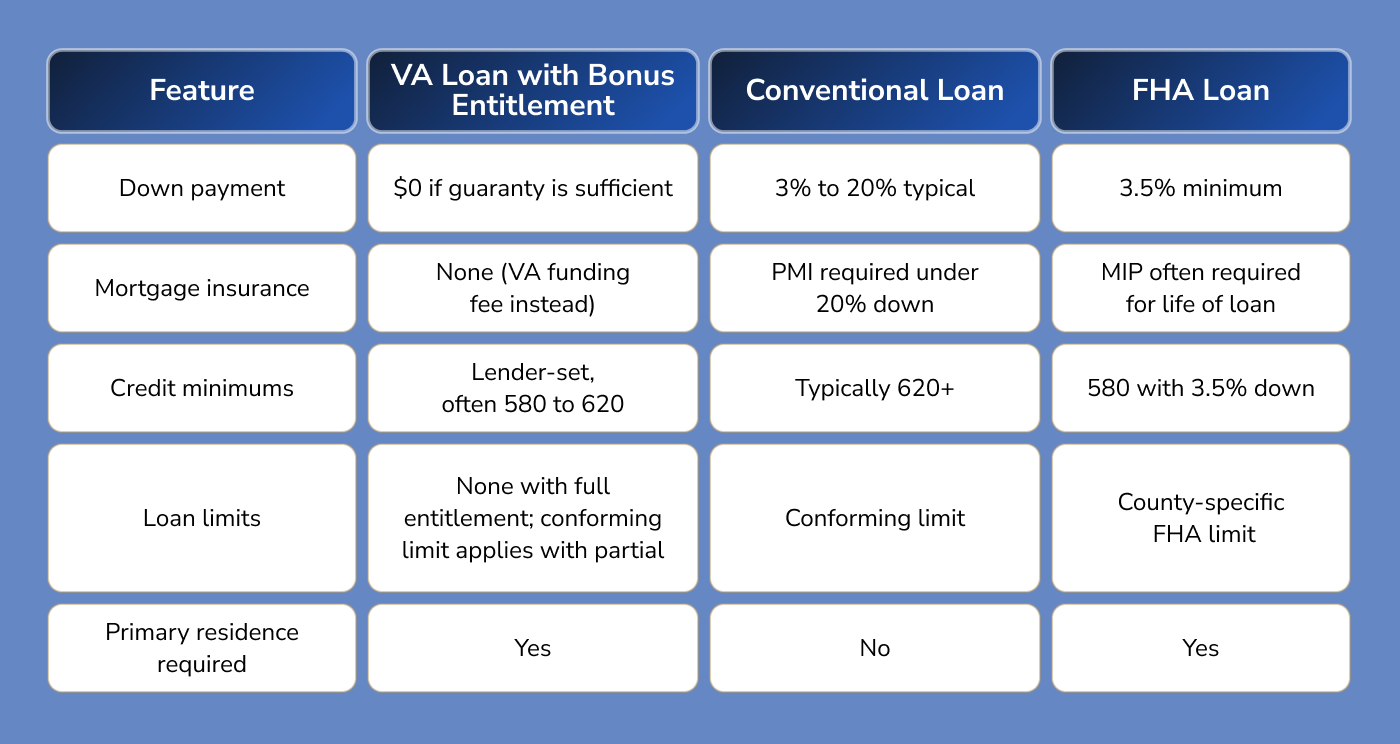
The biggest advantage of using bonus entitlement is the ability to keep your zero-down or low-down benefit on a second purchase, something no other loan program offers. Speak with a NextGen broker to compare your VA option against conventional and FHA scenarios across multiple lenders.
How NextGen Mortgage Loans Can Help
Second tier entitlement calculations are one of the trickier parts of VA lending, and the wrong answer can cost you a deal or a down payment you did not need to make. NextGen Mortgage Loans is a New Hampshire mortgage broker, which means we shop your loan across multiple VA-approved lenders to find the best rate and terms for your specific situation. We pull your Certificate of Eligibility, run the second va loan calculation, and tell you exactly how much you can borrow with zero down before you start house hunting.
Whether you are PCSing into NH, moving up to a larger home, or recovering from a prior VA loss, our team handles the entitlement math and the lender comparisons so you can focus on the move. Get a no-cost VA pre-approval by reaching out at contact NextGen, or run your numbers with our VA loan calculator.
Frequently Asked Questions
Can I have two VA loans at the same time?
Yes. As long as you have enough remaining entitlement (or bring a down payment to cover the gap) and the second home will be your primary residence, you can hold two VA loans simultaneously. This is the most common use case for bonus entitlement.
Do I have to sell my first home to use my VA benefit again?
No, you do not have to sell. If you have sufficient bonus entitlement remaining, you can keep the first home (often as a rental) and use second tier entitlement on the new purchase. This is especially useful for veterans on PCS orders.
How much entitlement do I have left after my first VA loan?
Your remaining entitlement equals the total guaranty available in your county (25% of the FHFA conforming limit) minus 25% of your original VA loan amount. Your Certificate of Eligibility shows the exact figure, and your lender can pull it for you in minutes.
Does bonus entitlement always require a down payment?
Not always. If your remaining bonus entitlement covers 25% of the new loan amount, you can still buy with zero down. If the new loan exceeds what your remaining guaranty supports, you contribute a down payment for the difference, not the full 25%.
Can I restore my full VA entitlement?
Yes, in two ways. You can sell the home, pay off the existing VA loan, and request a one-time restoration. Or, a qualifying veteran can assume your current VA loan with substitution of entitlement, transferring the obligation to them and freeing yours.
Are NH conforming loan limits different from other states?
All New Hampshire counties use the standard FHFA baseline conforming loan limit, with no high-cost adjustments. The FHFA updates this figure annually each November. Always confirm the current year's limit with your loan officer before running calculations.
What if I had a foreclosure on a previous VA loan?
You may have lost a portion of your entitlement, but you can often still use what remains for a new VA loan. The exact amount depends on the loan size and how the VA settled the claim. A NextGen loan officer can pull your COE and tell you what is available.

