How Many Times Can You Use a VA Loan?
You can use a VA loan as many times as you want. The VA home loan benefit is a lifetime benefit with no cap on the number of times you can use it, as long as you have enough entitlement available and meet eligibility requirements each time. That means a New Hampshire veteran who bought a starter home in Manchester ten years ago can use a VA loan again to buy a larger home in Bedford, often with no down payment.
This guide breaks down exactly how reusing your VA loan benefit works, when you can hold two VA loans at once, how entitlement restoration works, and what changes when you use the benefit a second or third time. If you're a NH veteran or active-duty service member thinking about your next home, this is the guidance you need before you start shopping.
Quick Answer: How VA Loan Reuse Works
Key takeaway: There is no limit on how many times you can use a VA loan. What matters is your entitlement, which is the amount the VA guarantees on your behalf. You can reuse the benefit by either restoring entitlement after selling and paying off a VA loan, or by tapping unused bonus entitlement to hold two VA loans at once.
Here is the short version:
First-time use: You typically have full entitlement. With full entitlement, you can borrow above the conforming loan limit with no down payment, subject to lender approval.
Subsequent use after sale: Sell the home and pay off the VA loan, then request entitlement restoration to buy again with full benefits.
Two VA loans at once: Possible using bonus or second-tier entitlement, often with a partial down payment depending on your loan amount and county loan limit.
Funding fee changes: Subsequent uses carry a higher VA funding fee than first-time use, unless you're exempt.
Understanding VA Loan Entitlement
Entitlement is the foundation of VA loan reuse. The Department of Veterans Affairs does not lend money directly. Instead, the VA guarantees a portion of your loan to the lender, which is why VA loans require no private mortgage insurance and often no down payment.
There are two types of entitlement to know.
Basic Entitlement
Basic entitlement is $36,000. This is the original guaranty amount Congress set decades ago. On its own, basic entitlement covers only small loans, so for any modern home purchase, the VA also extends what is called bonus or secondary entitlement.
Bonus (Secondary) Entitlement
Bonus entitlement covers the gap between $36,000 and 25% of the FHFA-published conforming loan limit for your county. For most New Hampshire counties, that conforming loan limit follows the standard national figure published each year by the Federal Housing Finance Agency. Higher-cost counties around the country have higher limits, but NH counties generally do not.
If you have full entitlement, meaning you have either never used a VA loan or have fully restored your entitlement, you have no county loan limit cap on a no-down-payment VA loan. The Blue Water Navy Vietnam Veterans Act of 2019 removed loan limits for veterans with full entitlement starting in 2020.
Can I Have Two VA Loans at Once?
Yes. Holding two VA loans at the same time is possible and more common than many veterans realize. This typically happens in three scenarios:
PCS or job relocation: You're transferred to a new duty station or take a new job and want to keep your current VA-financed home as a rental.
Move-up purchase: You're upgrading to a larger home and prefer to keep the original property rather than sell.
Out-of-state move to NH: You're relocating from another state, want to keep your home there, and buy in New Hampshire as your new primary residence.
To pull this off, you use your remaining entitlement, which is what's left after the VA's existing guaranty on your first loan. Your remaining entitlement, combined with the county loan limit where you're buying, determines how much you can borrow without a down payment.
In most cases, a second VA loan with remaining entitlement will require some down payment, though it's often far less than a conventional 20% down. A NextGen loan officer can run the entitlement math for your specific situation and tell you exactly how much you'd need to bring to closing.
Important: You must intend to occupy the new home as your primary residence within 60 days of closing in most cases. The VA does not finance investment properties.
How VA Loan Entitlement Restoration Works
VA loan entitlement restoration is the most common way veterans reuse the benefit. Once restored, you have full entitlement again as if you'd never used the program.
There are three primary paths to restoration.
Sell the Property and Pay Off the Loan
This is the standard restoration path. When you sell your VA-financed home and the loan is paid off in full, you can request that the VA restore your entitlement. After restoration, you can use a VA loan again with full benefits.
One-Time Restoration Without Selling
You can restore your entitlement once without selling the home if the VA loan has been paid off through refinancing into a non-VA loan or paid down with other funds. This one-time-only restoration is useful for veterans who refinanced into a conventional loan years ago and now want to reuse their VA benefit.
Substitution of Entitlement
If another eligible veteran assumes your VA loan, your entitlement can be restored through substitution. The assuming veteran's entitlement replaces yours, freeing up your benefit for future use. VA loan assumptions are less common today but still possible.
To request restoration, you'll need to submit VA Form 26-1880 (Request for Certificate of Eligibility) along with documentation showing the prior loan was paid off. Most lenders, including NextGen, can pull your updated COE through the VA's online portal in minutes.
How the VA Funding Fee Changes for Subsequent Use
The VA funding fee is one of the few real cost differences between first and subsequent VA loan use. It's a one-time fee that funds the VA loan program and replaces the mortgage insurance you'd pay on most other loan types.
Per the U.S. Department of Veterans Affairs, current funding fee rates for purchase loans (regular military) are structured as follows:
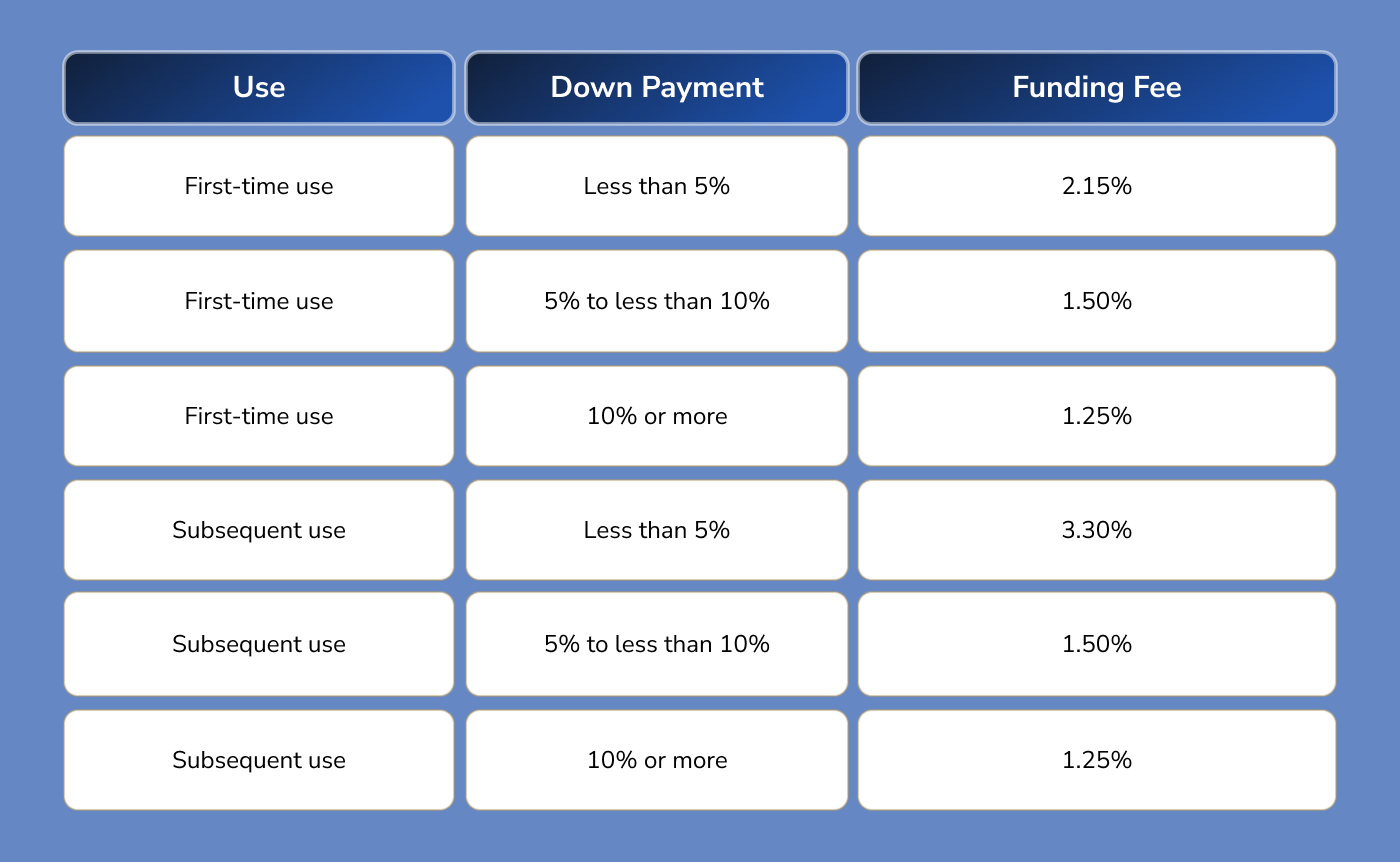
Source: U.S. Department of Veterans Affairs. Verify current rates at VA.gov before applying, as the schedule is set by Congress and can change.
A few notes:
Exempt veterans: Veterans with a service-connected disability rating, surviving spouses receiving Dependency and Indemnity Compensation, and Purple Heart recipients on active duty are exempt from the funding fee on any number of uses.
Financed into the loan: The fee can be rolled into the loan amount, so it doesn't have to be paid upfront.
Reservist and National Guard rates: Slightly different from regular military rates. The VA publishes both schedules.
The takeaway: subsequent uses with no down payment carry a meaningfully higher funding fee than first-time use. Putting at least 5% down levels the fee between first and subsequent uses, which is a planning consideration if you're reusing the benefit and have some savings.
VA Loan Reuse Considerations Specific to New Hampshire
New Hampshire has a meaningful veteran population, particularly around Portsmouth, the Seacoast, and communities tied to Pease Air National Guard Base. VA loan reuse plays out a little differently here than in higher-cost states.
A few NH-specific points to keep in mind:
County loan limits: All NH counties currently follow the standard FHFA conforming loan limit. None are designated high-cost. This matters for veterans with remaining (not full) entitlement, because the county limit caps how much you can borrow with no down payment.
Property tax context: NH has no income tax but high property taxes. When you reuse a VA loan and move up, your monthly housing cost includes property tax that varies significantly by town. Get a tax estimate for the specific town before locking in a price range. Consult a tax professional for advice specific to your situation.
NHHFA pairing: The New Hampshire Housing Finance Authority offers down payment assistance and competitive first-mortgage programs. Some can stack with or complement a VA loan in specific scenarios. Ask your broker whether NHHFA fits your situation.
Out-of-state buyers: Many NH home purchases come from MA buyers relocating north. If you used a VA loan in MA and want to buy in NH while keeping the MA home, the second-tier entitlement math applies.
Common Scenarios for Reusing Your VA Loan Benefit
Here are the situations where NH veterans most often end up reusing the VA loan benefit:
Selling and buying up. Sell the starter home, pay off the VA loan, restore entitlement, buy a larger home with a fresh VA loan.
PCS to or from NH. Keep the current VA-financed home as a rental, use second-tier entitlement to buy at the new duty station.
Refinanced years ago, reusing now. You refinanced into conventional after rates dropped, then later want to reuse VA. One-time restoration applies.
Surviving spouse using benefits. An eligible surviving spouse can use the VA loan benefit and reuse it under the same rules.
Cash-out or rate refinance. A VA Interest Rate Reduction Refinance Loan (IRRRL) or VA cash-out refinance is a form of reuse but works under separate rules.
Each of these has distinct entitlement implications. Speak with a NextGen broker to map yours to the right product.
How NextGen Mortgage Loans Can Help
Reusing a VA loan benefit gets technical fast. Bonus entitlement, county loan limits, funding fee tiers, occupancy rules, and restoration paperwork can either save you tens of thousands of dollars or trip you up at closing. As a New Hampshire mortgage broker, NextGen Mortgage Loans works with multiple VA-approved lenders, which means we can shop your scenario across rate sheets and pair you with the lender best suited to your entitlement situation.
A NextGen loan officer can pull your updated Certificate of Eligibility, calculate your remaining entitlement, model what your monthly payment looks like at different price points, and walk you through whether selling or holding your current home makes more financial sense. There is no cost to consult, and pre-approvals are typically issued within 24 to 48 hours.
Ready to find out how much VA loan benefit you have left? Contact a NextGen broker or use our mortgage calculators to start running the numbers.
Frequently Asked Questions
Is there a lifetime limit on how many VA loans you can have?
No. The VA loan benefit is a lifetime benefit with no cap on the number of times you can use it. You can reuse it as many times as you have entitlement available, whether by restoring entitlement after a sale or by using bonus entitlement to hold multiple VA loans at once.
Can I have two VA loans at once?
Yes. Holding two VA loans at the same time is possible using your remaining or second-tier entitlement. You'll need to intend to occupy the new home as your primary residence, and depending on the loan amount and county limit, you may need a partial down payment on the second loan.
How do I restore my VA loan entitlement?
The most common way is to sell your VA-financed home and pay off the loan in full, then request restoration through the VA. You can also restore entitlement once without selling if you've paid off the loan through refinancing or other funds. Submit VA Form 26-1880 to update your Certificate of Eligibility.
Does the VA funding fee go up when I reuse my VA loan?
Yes, in most cases. Per the VA, subsequent-use funding fees are higher than first-time-use fees when you put less than 5% down. With 5% or more down, the funding fee is the same regardless of whether it's your first or subsequent use. Veterans exempt from the funding fee remain exempt on any number of uses.
Can I use a VA loan to buy a vacation home or rental property?
No. VA loans are for primary residences only. You must certify your intent to occupy the home as your primary residence, generally within 60 days of closing. You can later convert a former primary residence into a rental, which is how some veterans end up with two VA-financed properties at once.
Do NH county loan limits apply to my second VA loan?
It depends on your entitlement. If you have full entitlement (no active VA loans and no prior foreclosures), there is no county loan limit cap on a no-down-payment VA loan. If you have remaining entitlement, the FHFA-published conforming loan limit for your NH county determines how much you can borrow with no down payment.
How do I find out how much VA entitlement I have left?
Pull your Certificate of Eligibility through the VA's eBenefits portal or through a VA-approved lender. Your COE shows your basic entitlement and any bonus entitlement currently in use.

