
Cash-Out Refinance Calculator
Use this free cash-out refinance calculator to see how much equity you can turn into cash, what your new mortgage payment will look like, and when the refinance pays for itself.
On a typical conventional cash-out refinance, lenders let you borrow up to 80% of your home's value. That means if your home is worth $500,000 and you owe $300,000, you could potentially pull out up to $100,000 in cash, minus closing costs. VA borrowers may access up to 100% of their home's value.
Estimate Your Cash-Out Refinance
Turn your home equity into cash. See your new payment and what happens to your total monthly bills.
Add up the minimum monthly payments on the credit cards, auto loans, or personal loans you plan to pay off with the cash. Leave at 0 if you are not consolidating debt.
Estimates only. Payments shown are principal and interest only — taxes, insurance, and mortgage insurance are not included. Paying off shorter-term debt with a mortgage secures that debt against your home and spreads it over the life of the loan, which can increase the total interest paid over time. Actual cash-out depends on appraisal, credit approval, DTI, and program guidelines. Rates shown are for illustration and do not constitute an offer. NextGen Mortgage Loans NMLS #1621958.
How a Cash-Out Refinance Works
A cash-out refinance replaces your existing mortgage with a new, larger loan. You pocket the difference between the two loan amounts in cash at closing. The cash can be used for any purpose: home improvements, debt consolidation, tuition, investment property down payment, or an emergency reserve.
Three variables control how much cash you can access:
Your home's current value (determined by appraisal)
Your current mortgage balance (the payoff amount on your existing loan)
The maximum loan-to-value ratio allowed by your loan type
The formula looks like this:
Maximum Cash-Out = (Home Value × Max LTV) − Current Mortgage Balance − Closing Costs
If your home is worth $500,000 with a $300,000 balance on a conventional loan (80% LTV cap), your math is:
$500,000 × 0.80 = $400,000 (new maximum loan amount)
$400,000 − $300,000 = $100,000 (gross cash before costs)
$100,000 − ~$12,000 closing costs = ~$88,000 cash in hand
The calculator above does this math automatically and factors in your chosen loan type, new interest rate, and whether you want to roll closing costs into the loan.
Maximum Cash-Out by Loan Type
Not every loan lets you access the same amount of equity. Here is what to expect in 2026:
Conventional Cash-Out Refinance
Max LTV: 80% for single-family primary residences
Credit score minimum: 620 (most lenders want 660+)
DTI limit: 43% (up to 50% with compensating factors)
Seasoning: Typically 6 months of ownership
FHA Cash-Out Refinance
Max LTV: 80%
Credit score minimum: 580 (some lenders require 620)
DTI limit: 43% to 50%
Seasoning: 12 months of on-time payments
Note: Mortgage insurance (MIP) required regardless of equity
VA Cash-Out Refinance
Max LTV: Up to 100% for eligible veterans
Credit score minimum: Set by lender, often 580 to 620
DTI limit: Flexible, often 41% guideline
Seasoning: 210 days and six consecutive on-time payments
Note: VA funding fee applies unless exempt
Want to know which program fits your income and credit profile? Talk to Expert or see our full breakdown on our Refinance Loans page.
What Your New Monthly Payment Will Look Like
A cash-out refinance changes your monthly payment in three ways at once:
Higher principal means a higher monthly payment at the same rate
A new interest rate can push your payment up or down
A new loan term resets your amortization clock
The calculator shows your old payment next to your new payment so you can see the delta clearly. It also breaks out principal and interest separately from the cash-out portion, so you can see exactly what the cash is costing you per month.
$100,000 Cash-Out at 2026 Rates
Based on a $400,000 home with a $250,000 current balance at 4.25%, refinanced into a new 30-year loan at 6.75% to access $100,000 in cash.
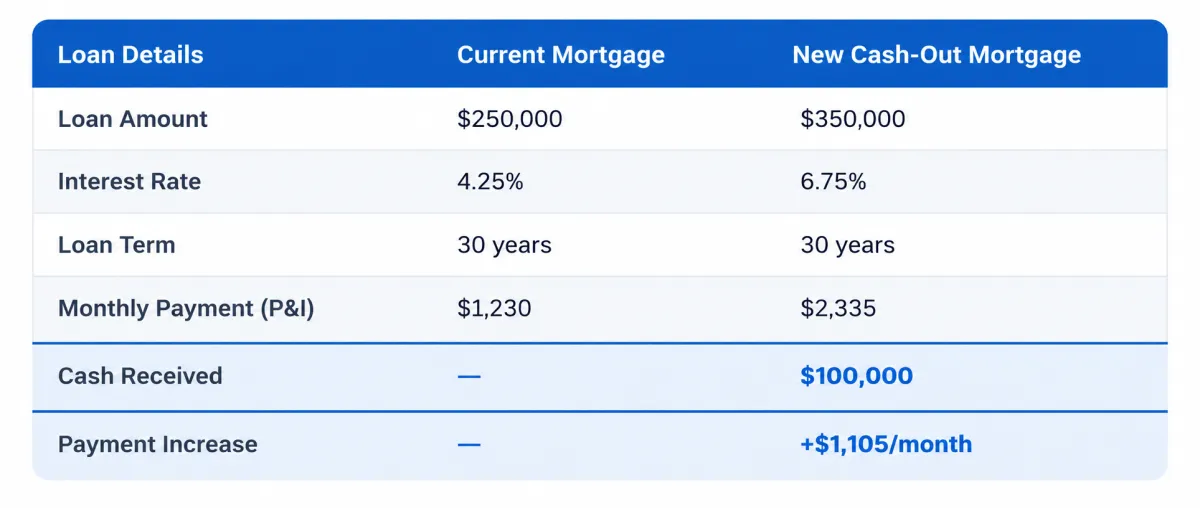
Estimates only. Principal and interest only, excluding taxes, insurance, and closing costs financed into the loan. Actual payment depends on final rate, credit profile, and loan program. Not a loan offer or Loan Estimate.
The question is whether $1,105 more per month is worth the $100,000 lump sum. That depends on what the cash accomplishes: if it pays off $100,000 in credit card debt at 22%, you save roughly $1,800/month in interest alone. If it funds a discretionary purchase, the math rarely works.
Closing Costs on a Cash-Out Refinance
Closing costs typically run 2% to 5% of the new loan amount. On a $400,000 loan that is $8,000 to $20,000. Common line items:
Loan origination fee (0% to 1% of loan)
Appraisal fee ($500 to $750)
Title search and insurance ($500 to $2,000)
Recording fees and transfer taxes (varies by state)
Credit report fee ($50 to $100)
Underwriting fee ($300 to $900)
Prepaid property tax and insurance escrows
You have two choices: pay closing costs in cash at the table, or roll them into the new loan balance. Rolling them in preserves your cash but reduces the net cash-out you walk away with and increases your monthly payment slightly. The calculator handles both options.
Break-Even Point: When the Refinance Pays for Itself
The break-even point tells you how long you need to stay in the home for the refinance to make financial sense on a rate basis. The formula:
Break-Even Months = Total Closing Costs ÷ Monthly Interest Savings
If your closing costs are $10,000 and you save $250 per month on interest (ignoring the cash-out portion), your break-even is 40 months, or about 3 years and 4 months. If you plan to sell before then, the refinance costs you money even if the rate is lower.
For pure cash-out refinances where your rate goes up, the break-even concept shifts: you are trading higher lifetime interest for liquidity today. The right question is whether the cash generates a better return than the interest cost.
When a Cash-Out Refinance Makes Sense
A cash-out refinance usually makes sense when:
You are consolidating high-interest debt. Credit cards at 20%+ APR beat out mortgage rates at 7% every time, especially if the interest is tax-deductible for home improvement uses.
You are funding a value-adding home improvement. Kitchens, bathrooms, and primary suite additions typically return 60% to 80% of cost at resale. The IRS may also allow you to deduct mortgage interest if the funds are used to improve the home.
You need emergency liquidity. Medical bills, a job transition, or tuition gap funding are common reasons.
Your rate is dropping anyway. If current rates are at least 0.75 to 1 point below your existing rate, the refinance pays off faster.
A cash-out refinance usually does not make sense when:
You plan to sell within 2 to 3 years
Your new rate will be significantly higher and the cash funds non-essential consumption
You have less than 20% equity after the cash-out (triggers PMI on conventional loans)
Your credit score has dropped since your original mortgage
What You'll Need to Apply
To move from calculator estimate to real numbers, you'll need:
Two most recent pay stubs
Two years of W-2s or 1099s (tax returns if self-employed)
Two months of bank statements
Current mortgage statement
Homeowner's insurance declarations page
Photo ID
At NextGen Mortgage Loans, the typical timeline from application to closing on a cash-out refinance is 14 to 21 days. We move faster than most banks because we review your actual income documents, not just credit bureau summaries.
Want a Lower Rate? Talk to an Expert.
A lower interest rate means every extra payment goes further.
NextGen Mortgage can help you refinance or find the best loan for your situation.
Client Testimonials
Don't just take our word for it. Hear from the families we've helped
secure their dream homes.

Frequently Asked Question
How much cash can I get from a cash-out refinance?
Most conventional and FHA cash-out refinances let you borrow up to 80% of your home's appraised value. VA borrowers may access up to 100%. The cash you receive equals the new loan amount minus your current mortgage payoff minus closing costs. On a $500,000 home with a $300,000 mortgage, a conventional borrower could typically access around $88,000 to $92,000 in net cash.
Do I need an appraisal for a cash-out refinance?
Yes. Nearly all cash-out refinances require a full appraisal to establish current market value. Appraisal waivers are rare for cash-out transactions because the lender needs to verify equity. Appraisal cost is typically $500 to $750 and is paid at or before closing.
What credit score do I need for a cash-out refinance?
Conventional cash-out refinances generally require a 620 credit score minimum, though most lenders look for 660 or higher. FHA cash-out allows scores as low as 580. VA lenders often accept 580 to 620. Higher scores unlock better rates.
How long do I have to wait to do a cash-out refinance?
Seasoning requirements vary by program. Conventional loans usually require 6 months of ownership. FHA cash-out requires 12 months of on-time payments. VA cash-out requires 210 days plus six consecutive on-time payments. Always verify current guidelines with your lender.
Is cash-out refinance interest tax deductible?
Mortgage interest on a cash-out refinance is only tax deductible when the funds are used to buy, build, or substantially improve the home that secures the loan. Using the cash for debt consolidation, tuition, or other purposes generally makes the interest non-deductible. Consult a tax professional for your situation.
How does a cash-out refinance affect my monthly payment?
Your monthly payment will almost always increase on a cash-out refinance because your principal balance is larger. The size of the increase depends on your new rate, term, and cash-out amount. The calculator above shows your current and new payment side by side.
Can I do a cash-out refinance with bad credit?
FHA and VA loans offer the most flexibility for borrowers with credit issues. FHA allows scores down to 580 with 80% LTV. If your credit is below 580, focus on improving it before applying. Pay down revolving balances, dispute errors on your credit report, and avoid new credit applications for 90 days before you apply.
MLO License Info: NMLS #1621958, NH Broker license #1621958MBRR, and MA Broker license #MB1621958, ME Broker License #1621958, FL Broker License #MBR4542, RI Broker License #20265029LB
Company
Services
Contact
MLO License Info: NMLS #1621958, NH Broker license #1621958MBRR, and MA Broker license #MB1621958, ME Broker License #1621958, FL Broker License #MBR4542, RI Broker License #20265029LB
Company
Services
Contact
