

DSCR Mortgage Loan Calculator
Estimate the debt service coverage ratio for an investment property mortgage using expected rental income and monthly property expenses.
This calculator is intended solely for DSCR mortgage financing secured by investment real estate. It is not a personal loan calculator and does not offer unsecured consumer loans. Estimates are for informational purposes only and do not constitute a loan approval, rate quote, or commitment to lend.
Calculate Your DSCR in Seconds
Enter your property and loan details to estimate your DSCR, monthly payment, and see how your deal compares with common lender requirements.
Your DSCR appears here once you calculate.
Check your DSCR loan options
Unlock your full payment breakdown, monthly cash flow, and see which of our 30+ lending partners fit this deal.
No tax returns · No credit check · No obligation
No tax returns · No credit check · No obligation
You're all set,
A loan specialist is reviewing this deal and will reach out shortly with your options. Run more scenarios anytime — we'll keep them on file.
Something went wrong on our end. Call +1 (877) 411-0123 and we'll walk the numbers with you.
MLO License Info: NMLS #1621958, NH Broker license #1621958MBRR, and MA Broker license #MB1621958
How do you calculate DSCR?
Divide the property's qualifying monthly rental income by the monthly housing payment
used by the applicable DSCR program.
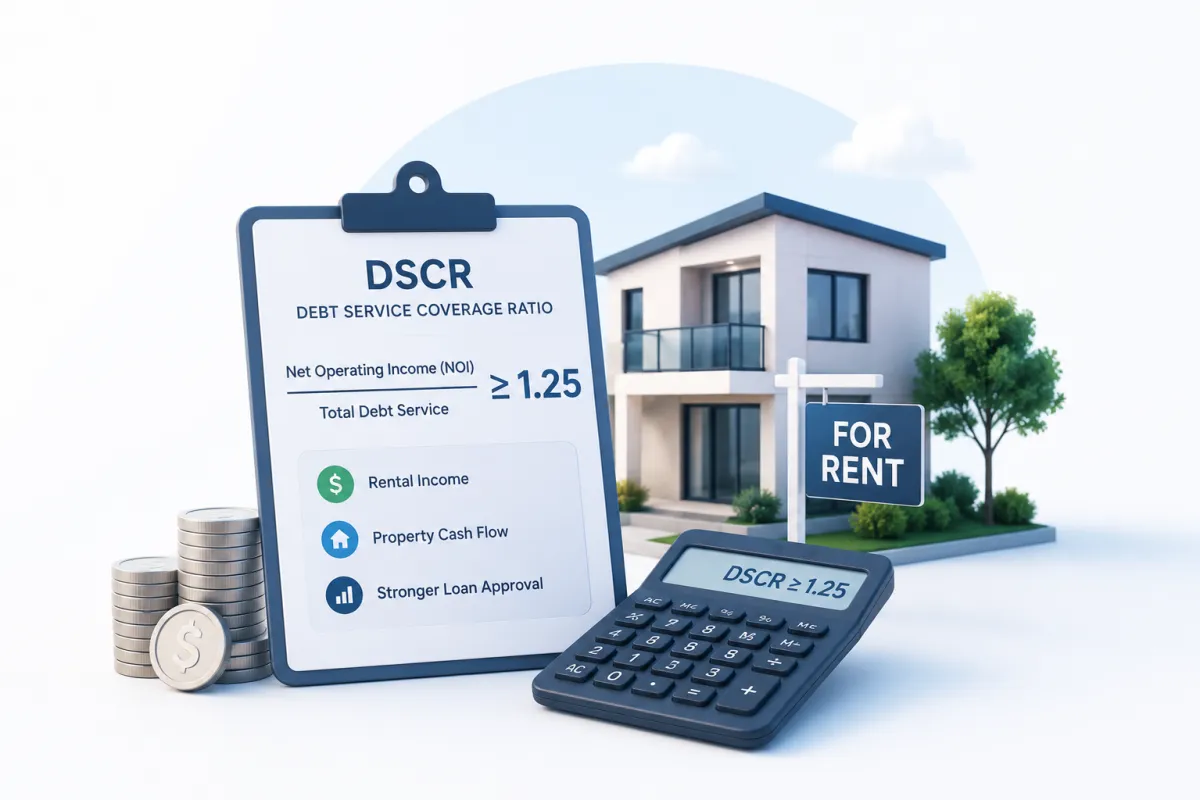
DSCR = Monthly rental income ÷ Monthly housing payment
$3,000 ÷ $2,500 = 1.20
The housing payment normally includes principal, interest, taxes, insurance and HOA dues. Which rent figure
counts as qualifying income, and exactly which expenses are included, varies between lending partners.
What is DSCR?
DSCR, or debt service coverage ratio, measures how well a property's rental income supports its housing payment. For rental property financing, the ratio helps lenders evaluate the property's cash flow rather than relying only on the borrower's personal income.
That is the core difference between DSCR financing and traditional financing. Conventional underwriting looks first at the borrower's tax returns, W-2s and debt-to-income ratio. DSCR underwriting looks first at whether the property pays for itself.
What does your DSCR mean?
A DSCR above 1.00 means the rental income used in the calculation exceeds the corresponding housing payment. Many DSCR lending programs target approximately 1.00 or higher, while stronger ratios can provide access to more financing options. Exact requirements vary by lending partner.
Below 1.00
Rental income is below the calculated housing payment.
Some specialty or no-ratio programs may still be available depending on the lending partner and scenario.
1.00 – 1.24
Rental income meets or modestly exceeds the calculated housing payment.
This may fall within the range considered by many DSCR programs.
1.25 and above
Rental income provides stronger coverage of the calculated housing payment.
A higher DSCR may provide access to more financing options depending on the lender, credit, leverage and property.
What if my DSCR is below 1.00?
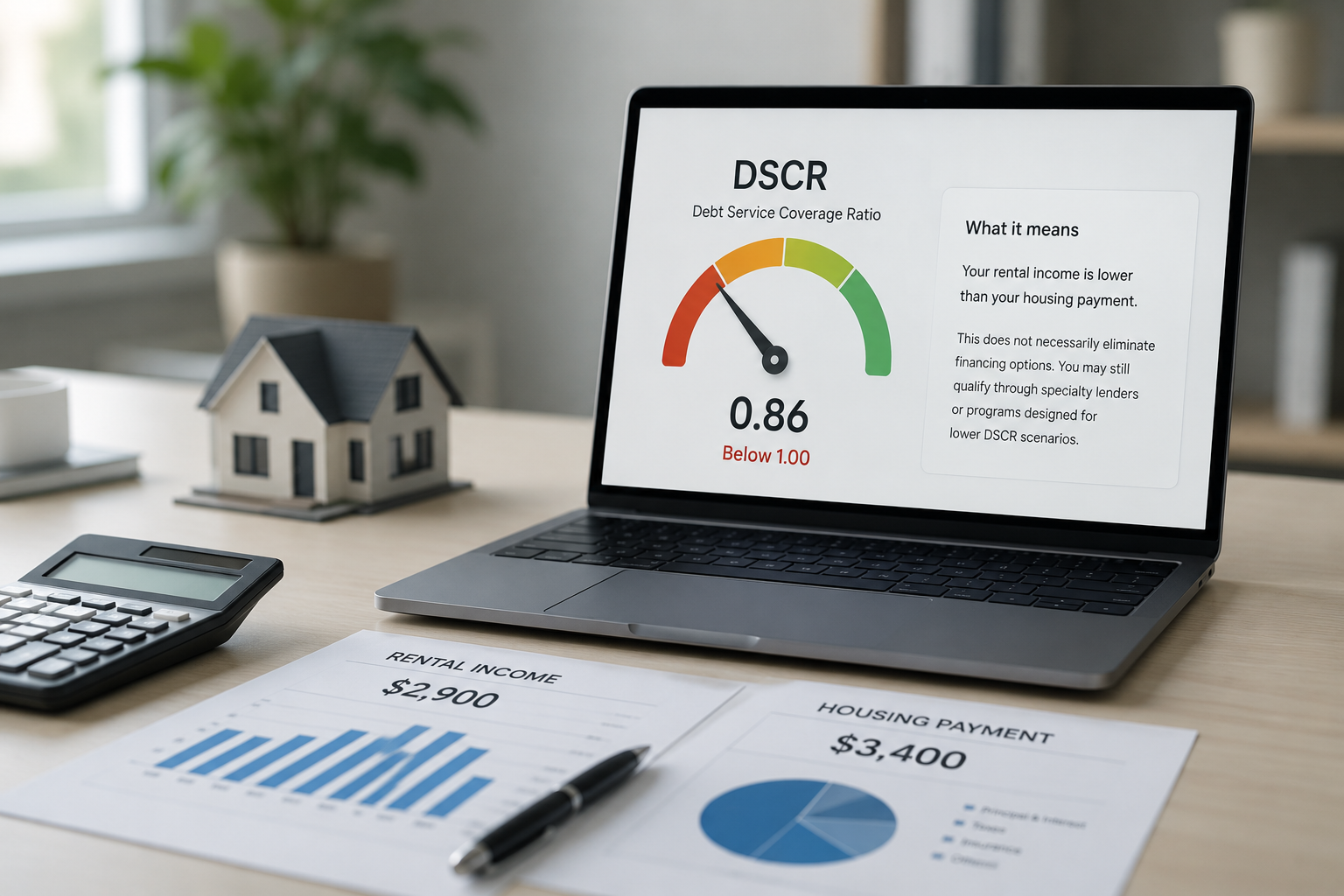
A DSCR below 1.00 means the rental income entered into the calculator is lower than the calculated housing payment. That does not necessarily eliminate every financing option. Specialty lenders may offer lower-DSCR or no-ratio programs depending on credit, down payment, property and other factors.
A property showing a 0.86 ratio is not automatically ineligible. It is a scenario that needs to be matched to the right program rather than measured against a single guideline.
What else affects DSCR loan options?
Cash flow is one of three factors that work together. Credit, down payment and DSCR are considered
as a whole rather than in isolation.
Credit
Programs may be available around 620+ FICO, while stronger credit can potentially improve available pricing and options.
Down payment and LTV
Some DSCR programs may offer financing up to approximately 85% LTV, while greater equity can improve available financing options.
DSCR
Stronger rental cash flow may improve the number or structure of available programs.
Exact lender requirements vary, and no individual metric guarantees approval.
DSCR programs can vary significantly
Depending on the lending partner and borrower scenario, available programs may include:
- No personal income verification
- No traditional tax-return qualification
- LLC or eligible entity ownership
- Interest-only structures
- Cash-out refinance
- Short-term rentals
- Foreign-national programs
- Specialty no-ratio options
This is why comparing programs through a mortgage broker can matter.
Why calculate DSCR with a mortgage broker?
A calculator provides one estimated ratio. It does not tell you which lender guidelines may fit your scenario.
| One calculator result | NextGen broker review |
|---|---|
| One estimated DSCR | Review of the complete scenario |
| Does not evaluate lender guidelines | Compare multiple lending partners |
| Cannot account for specialty options | Evaluate available specialty programs |
| No pricing comparison | Compare available structures and pricing |
| No underwriting context | Identify potential lender fit |
Want to know which DSCR programs may fit?
NextGen Mortgage is a mortgage broker with access to 30+ lending partners. We can compare your property scenario against multiple DSCR program guidelines.

Share your property details and we’ll help identify potential DSCR loan options.
DSCR calculator questions
What is a DSCR calculator?
A DSCR calculator divides a rental property's monthly income by its monthly housing payment to estimate the debt service coverage ratio. It gives investors a quick read on whether the property's cash flow covers the payment before they speak with a lender.
How do I calculate DSCR for a rental property?
Divide the qualifying monthly rental income by the monthly housing payment. For example, $3,000 of rent divided by a $2,500 housing payment equals a 1.20 DSCR. The housing payment normally includes principal, interest, taxes, insurance and HOA dues.
What does a 1.0 DSCR mean?
A 1.00 DSCR means the rental income used in the calculation is equal to the corresponding housing payment. The property breaks even on paper. Many DSCR programs treat 1.00 as a commonly relevant threshold, although requirements vary between lending partners
What does a 1.25 DSCR mean?
A 1.25 DSCR means the rental income used in the calculation equals 125% of the corresponding housing payment. For example, $2,500 of monthly rent divided by a $2,000 monthly housing payment equals 1.25. Stronger coverage can widen the range of programs and structures available.
Can I get a DSCR loan below 1.0?
Possibly. A ratio below 1.00 does not automatically remove every option. Some lending partners may offer programs for lower-DSCR or no-ratio scenarios, typically weighing credit, down payment and property type more heavily.
What is a no-ratio DSCR loan?
A no-ratio program is an investor loan that does not require the property to hit a specific coverage ratio. Availability, pricing and leverage vary by lending partner and scenario. Explore no-ratio DSCR options.
Does credit score affect a DSCR loan?
Yes. Programs may be available around 620+ FICO, and stronger credit can potentially improve available pricing, leverage and program options. Credit is considered alongside down payment and cash flow rather than on its own.
Does down payment affect DSCR qualification?
Yes. A larger down payment lowers the loan amount, which lowers the housing payment and raises the DSCR. Some DSCR programs may offer financing up to approximately 85% LTV, while greater equity can improve available financing options.
Is Airbnb rental income used for DSCR?
Some lending partners consider short-term rental income, often using a market rent estimate or documented platform history. Methodology differs meaningfully between programs, so short-term rental scenarios are worth comparing across several lenders.
Can I calculate DSCR before buying a property?
Yes, and it is one of the most useful ways to screen deals. Use the estimated purchase price, expected rent and an estimated payment to see whether the numbers work before making an offer.
Is this calculator the same calculation every lender uses?
No. Lending partners differ in which rent figure counts as qualifying income and which expenses are included in the payment used for the ratio. Treat this result as an estimate rather than a lender's own calculation.
Does the DSCR calculator mean I qualify for a loan?
No. The calculator provides an estimate for educational and planning purposes. Actual qualifying rental income, housing expenses, DSCR calculation methodology and program eligibility vary by lending partner and loan scenario.
MLO License Info: NMLS #1621958, NH Broker license #1621958MBRR, and MA Broker license #MB1621958, ME Broker License #1621958, FL Broker License #MBR4542, RI Broker License #20265029LB
Company
Services
Contact
MLO License Info: NMLS #1621958, NH Broker license #1621958MBRR, and MA Broker license #MB1621958, ME Broker License #1621958, FL Broker License #MBR4542, RI Broker License #20265029LB
Company
Services
Contact
