VA Loan vs FHA Loan: Which Mortgage Is Right for You?
If you qualify for a VA loan, it is almost always the better option in any va loan vs fha comparison because it requires zero down payment, charges no monthly mortgage insurance, and typically comes with lower interest rates. FHA loans are designed for buyers who do not have military eligibility but need a lower-barrier path to homeownership, often with credit scores below 620 or limited savings.
This guide breaks down the va loan vs fha decision in plain English, including down payment rules, mortgage insurance costs, credit requirements, and how the two loans work for New Hampshire buyers in 2026.
What Is a VA Loan?
A VA loan is a mortgage backed by the U.S. Department of Veterans Affairs and offered through private lenders. It is available to eligible active-duty service members, veterans, certain National Guard and Reserve members, and qualifying surviving spouses.
The VA itself does not lend money. It guarantees a portion of the loan, which lets approved lenders offer favorable terms with less risk. Key benefits include:
No down payment required for most borrowers with full entitlement
No monthly mortgage insurance (a major cost advantage over FHA)
Competitive interest rates, often lower than conventional and FHA rates
Limited closing costs that the VA caps and restricts
No prepayment penalties if you pay off early
To use a VA loan, you need a Certificate of Eligibility (COE) from the VA, which a lender or broker can pull on your behalf.
What Is an FHA Loan?
An FHA loan is a government-insured mortgage backed by the Federal Housing Administration, a division of the U.S. Department of Housing and Urban Development (HUD). FHA loans are open to any qualified borrower, not just veterans, and they exist to help buyers with lower credit scores or smaller down payments become homeowners.
Key features of FHA loans:
3.5% down payment if your FICO score is 580 or higher
10% down payment if your FICO score is between 500 and 579
Upfront mortgage insurance premium (MIP) of 1.75% of the loan amount
Annual MIP paid monthly, which varies by loan term and amount
More flexible debt-to-income (DTI) limits than conventional loans
Loan limits set by HUD that vary by county
FHA loans are a popular choice for first-time homebuyers, especially in higher-cost markets where saving for a 20% down payment is unrealistic.
Difference Between VA and FHA Loan: Side-by-Side
Here is the difference between va and fha loan at a glance:
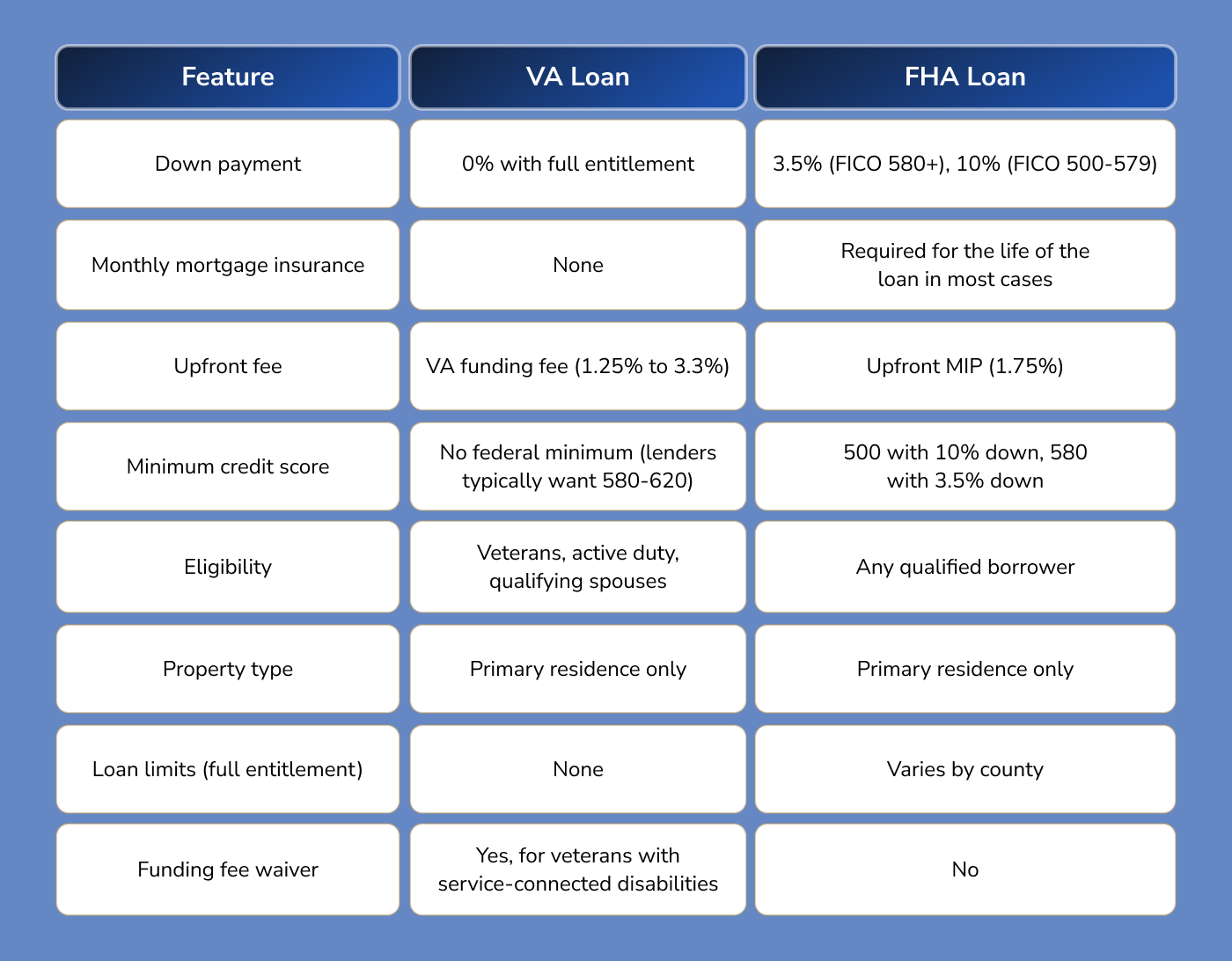
The bottom line: if you qualify for both, the VA loan saves you tens of thousands of dollars over the life of the loan in most cases. The funding fee can be rolled into the loan, and disabled veterans are exempt from it entirely.
Down Payment: A Major Difference Between VA and FHA Loans
Down payment is where the va loan vs fha comparison swings most dramatically.
A VA loan with full entitlement requires no down payment. On a $400,000 home, that is $0 out of pocket toward the purchase price. You still need funds for closing costs and reserves, but the VA caps which costs you can pay.
An FHA loan requires at least 3.5% down with a credit score of 580 or higher. On the same $400,000 home, that is $14,000 minimum at closing. If your credit score is between 500 and 579, you would need 10% down, or $40,000.
For New Hampshire buyers facing rising home prices, this difference can make or break affordability. The New Hampshire Housing Finance Authority (NHHFA) tracks median home prices statewide, and in many counties they have climbed well above the national median in recent years.
If you are eligible for VA but tight on savings, talk to a NextGen loan officer about layering down payment assistance with an FHA loan or maximizing your VA entitlement instead.
Mortgage Insurance: VA Funding Fee vs FHA MIP
This is where the long-term cost story plays out.
VA funding fee
The VA charges a one-time funding fee to keep the program running for future veterans. The fee depends on:
Whether this is your first or subsequent VA loan
Your down payment amount (yes, you can put money down on a VA loan)
Your service category, though the VA has equalized regular military and Guard/Reserve rates in recent years
The funding fee generally ranges from 1.25% to 3.3% of the loan amount and can be financed into the loan rather than paid at closing. According to the VA, veterans receiving compensation for a service-connected disability are exempt from the funding fee entirely, as are surviving spouses receiving Dependency and Indemnity Compensation (DIC).
There is no monthly mortgage insurance on a VA loan. Once the funding fee is paid (or financed), you are done.
FHA mortgage insurance premium (MIP)
FHA loans require two layers of mortgage insurance:
Upfront MIP: 1.75% of the loan amount, paid at closing or rolled into the loan
Annual MIP: paid monthly as part of your mortgage payment, varying by loan term and loan-to-value (LTV)
The catch: if you put less than 10% down on an FHA loan, MIP stays for the life of the loan. To remove it, you typically have to refinance into a conventional mortgage once you have enough equity.
Over a 30-year mortgage, this can add up to tens of thousands of dollars in extra cost compared to a VA loan with no monthly insurance.
Credit Score, DTI, and Income Requirements
Both VA and FHA loans are more flexible than conventional mortgages on credit and income, but they differ in detail.
Credit score
VA loans have no federally mandated minimum credit score. Most lenders set their own floor between 580 and 620.
FHA loans allow 580 for 3.5% down and 500 for 10% down at the federal level. Many lenders apply overlays and require 600 or 620 in practice.
A NextGen broker can shop your loan across multiple lenders to find one whose credit overlays match your profile, which is one of the biggest advantages of working with a broker rather than a single bank.
Debt-to-income ratio (DTI)
VA loans technically have no hard DTI cap, but most lenders prefer DTI under 41%. Higher ratios may be approved with strong residual income.
FHA loans generally allow DTI up to 43%, with exceptions up to 50% or higher for borrowers with compensating factors (large reserves, long employment history, strong credit).
Income and employment
Both programs require stable, documented income. Self-employed borrowers can qualify for either, but FHA tends to be more accommodating to non-traditional income profiles, while VA underwriting focuses heavily on residual income, the cash left over after major monthly obligations.
VA and FHA Loan Limits in New Hampshire
Loan limits matter when you are buying near the high end of your price range.
VA loan limits: Veterans with full entitlement have no VA loan limit. You can borrow as much as a lender will approve based on your income and credit. If you have partial entitlement (you used some on a previous loan that has not been restored), VA loan limits do apply and are tied to FHFA conforming limits.
FHA loan limits: Set annually by HUD and vary by county. In most New Hampshire counties, the FHA limit matches the national floor set by HUD. Rockingham and Strafford counties, which are part of the greater Boston metropolitan area, have higher limits that reflect the regional housing market.
For the current loan limit in your specific NH county, contact a NextGen loan officer for a quick look-up. Limits reset every year in early January.
FHA vs VA Loan for Veterans: Which Should You Choose?
For veterans and eligible service members weighing fha vs va loan for veterans, the answer is almost always the same: take the VA loan if you qualify.
Here is why:
No down payment vs. 3.5% minimum
No monthly mortgage insurance vs. MIP for the life of the loan in most cases
Typically lower interest rates
Funding fee waived for disabled veterans
More flexible underwriting on residual income
There are narrow situations where an FHA loan might still make sense for a veteran:
You have already used your full VA entitlement and do not want to deal with partial-entitlement loan limits
You are buying a multi-unit property where FHA self-sufficiency rules align better with your goals
The seller is unwilling to pay items the VA does not allow the buyer to pay
You need a property type that does not meet VA Minimum Property Requirements (MPRs)
For most eligible veterans in New Hampshire, the VA loan wins. If you are weighing whether the va or fha loan better fits your situation, a 15-minute call with a NextGen broker can usually settle the question.
Closing Costs and Seller Concessions
Both loan types let the seller contribute to closing costs, but the rules differ.
VA loans:
Seller can pay up to 4% of the loan amount toward concessions (prepaids, funding fee, debts paid off for qualification)
Plus standard buyer closing costs with no specific cap (typically 3% to 5% of the loan)
The VA limits certain "non-allowable" costs that the buyer cannot pay, like attorney fees for the lender
FHA loans:
Seller can pay up to 6% of the sales price toward closing costs and prepaids
More flexibility on what the buyer can pay
In a competitive NH market like Manchester, Concord, or the Seacoast, seller concessions are increasingly negotiable, and a strong broker can structure offers to maximize them.
When an FHA Loan Makes More Sense
FHA loans are not just a fallback for veterans. For non-veteran buyers, they often beat conventional loans on:
Credit flexibility: 580 FICO with 3.5% down is hard to beat for buyers rebuilding credit
Higher DTI tolerance: Up to 50%+ with compensating factors
Gift funds and down payment assistance: FHA pairs well with NHHFA programs and other DPA
Non-occupant co-borrowers: Allowed for added flexibility, often used for parent-child purchases
For first-time buyers in New Hampshire who do not qualify for VA, an FHA loan combined with a first-time homebuyer program can dramatically lower the upfront cost of buying.
How NextGen Mortgage Loans Can Help
Choosing between a VA loan and an FHA loan is rarely a snap decision. It depends on your eligibility, credit, savings, target home, and long-term plans.
As a New Hampshire mortgage broker, NextGen Mortgage Loans works with multiple lenders rather than a single bank. That means we can compare VA and FHA programs across the market to find the lowest rate and the right credit overlays for your situation. We handle the COE pull, run the numbers on funding fee vs. MIP scenarios, and pre-approve you fast so you can write strong offers.
A no-cost consultation takes about 15 minutes. Bring your last two pay stubs, your DD-214 (if applicable), and your goals.
Get pre-approved with NextGen Mortgage Loans or run the numbers first using our mortgage calculators.
Frequently Asked Questions
Can I have both a VA loan and an FHA loan at the same time?
Yes, in some circumstances. You can hold a VA loan on one primary residence and obtain an FHA loan on a new primary residence if you are relocating, growing your family, or in another HUD-approved scenario. You typically cannot use either program for investment property, since both require owner occupancy.
Is it harder to close on a VA loan than an FHA loan?
Not significantly, though VA appraisals tend to be stricter due to the VA's Minimum Property Requirements (MPRs). Sellers used to FHA contracts may need a refresher on VA-specific rules, like non-allowable closing costs. An experienced NH broker can guide both sides through it smoothly.
Do VA loans have lower interest rates than FHA loans?
In most cases, yes. VA loans typically come with lower rates than FHA and conventional loans because the VA guarantee reduces lender risk. Actual rates depend on credit, loan amount, market conditions, and lender. Always compare offers from multiple lenders, or work with a broker who does that automatically.
Can I refinance an FHA loan into a VA loan later?
Yes, if you qualify for VA. Many veterans start with an FHA loan (often before establishing eligibility or while waiting on a COE) and refinance into a VA loan once eligible. This eliminates monthly MIP and often lowers the rate.
What credit score do I need for a VA or FHA loan in New Hampshire?
There is no federal credit minimum for VA loans, though most NH lenders look for 580 to 620. FHA loans federally allow 500 with 10% down or 580 with 3.5% down, but lender overlays often push this to 600 or 620. A broker can match your score to the right lender.
Are VA and FHA loans only for first-time homebuyers?
No. Both programs are open to repeat buyers as well. VA loans require restored entitlement or partial entitlement for repeat use. FHA loans require the property to be your primary residence but do not require first-time-buyer status.
Can I use a VA or FHA loan to buy a multi-family home in NH?
Yes for both, with conditions. Both allow up to 4-unit properties as long as you live in one unit as your primary residence. FHA requires the property to pass a "self-sufficiency test" for 3-4 unit purchases, where projected rental income must cover the mortgage payment. VA does not have that test but requires you to demonstrate sufficient income and reserves.

