
VA IRRRL Streamline Refinance: A Complete Guide for NH Veterans
A VA IRRRL is a streamlined refinance program that lets eligible veterans replace an existing VA loan with a new VA loan at a lower interest rate, usually without a new appraisal, income verification, or credit underwriting. If you already have a VA mortgage on a New Hampshire home and rates have dropped since you closed, the VA Interest Rate Reduction Refinance Loan is one of the fastest, lowest-cost ways to reduce your monthly payment.
This guide walks through how the VA streamline refinance works, who qualifies, what it costs, and what NH veterans should know before starting the process.
What Is a VA IRRRL?
A VA IRRRL (Interest Rate Reduction Refinance Loan), also called a VA streamline refinance, is a refinance program from the U.S. Department of Veterans Affairs designed exclusively for homeowners who already have a VA-backed mortgage. The goal is simple: lower your interest rate, reduce your monthly payment, or move from an adjustable-rate mortgage to a fixed-rate loan.
Unlike a traditional refinance, the IRRRL skips most of the friction. According to the VA, an IRRRL typically does not require a new home appraisal, a new Certificate of Eligibility, or full income and asset documentation. That makes it one of the fastest refinance products available to homeowners in any loan category.
Quick answer: A VA IRRRL is a no-appraisal, low-documentation refinance available only to existing VA loan holders who want a lower rate or a more stable loan structure.
How the VA Streamline Refinance Works
The IRRRL works by replacing your current VA loan with a new VA loan that has better terms. The new loan pays off the old one, and you continue making payments on the new mortgage at the lower rate.
The VA does not lend money directly. Instead, the VA guarantees a portion of the loan, and a private lender funds it. You can use your original lender or shop with a different one. In many cases, switching lenders gets you a better rate, which is one reason working with a broker who compares offers across multiple lenders often beats going back to the bank that issued your original VA loan.
There are two qualifying scenarios for an IRRRL:
You are refinancing from a higher fixed rate to a lower fixed rate.
You are refinancing from an adjustable-rate mortgage (ARM) to a fixed-rate loan, even if the new rate is higher than your current ARM rate.
The VA calls this the "Net Tangible Benefit" requirement. The refinance must produce a real financial advantage, not just a sideways move.
VA IRRRL Requirements: Who Qualifies
The IRRRL has a shorter checklist than most refinances, but the rules are strict. You must meet all of the following to be eligible.
You Already Have a VA Loan
The IRRRL is only available to refinance an existing VA-backed mortgage. If your current mortgage is conventional, FHA, or USDA, you are not eligible for an IRRRL even if you are a qualified veteran. (You may still be eligible for a VA cash-out refinance, which has different rules.)
You Meet the 210-Day Seasoning Rule
Per VA guidelines, you must wait at least 210 days from the date of your first mortgage payment on your current VA loan before you can close on an IRRRL. You also must have made at least six consecutive monthly payments. This rule was added to protect veterans from predatory "loan churning" by unscrupulous lenders.
You Certify Prior Occupancy
For your original VA loan, the home had to be your primary residence at some point. With an IRRRL, you only need to certify that you previously occupied the property. This makes the IRRRL useful for veterans who bought a home with a VA loan, then moved (for example, due to a PCS or job change) and now rent the home out.
You Pass the Net Tangible Benefit Test
The new loan must demonstrably benefit you. In practice, this usually means a meaningfully lower interest rate, a switch from ARM to fixed, or a reduction in loan term that saves long-term interest.
Your Lender Approves You
The VA itself does not set a minimum credit score or debt-to-income ratio for IRRRLs. However, individual lenders do. Most lenders look for a credit score of 580 to 640 or higher, plus a clean recent mortgage payment history. A NextGen loan officer can walk you through where you stand in 15 minutes and tell you which lenders are most flexible right now.
Benefits of a VA Interest Rate Reduction Refinance Loan
The IRRRL is one of the most veteran-friendly refinance products on the market. The advantages stack quickly.
No appraisal required in most cases. This saves $500 to $800 and removes the risk of your home appraising too low to refinance.
No income or employment verification typically required. Self-employed veterans, retirees, and those between jobs can still qualify.
Reduced documentation. Most lenders need only your existing loan information, a credit pull, and basic identity verification.
Lower funding fee. The IRRRL funding fee is just 0.5% of the loan amount, far below the 2.15% to 3.3% charged on most VA purchase and cash-out loans.
Closing costs can be rolled into the loan. You can refinance with little or no money out of pocket.
No private mortgage insurance. VA loans never require PMI, regardless of equity.
Faster closings. Many IRRRLs close in 30 days or less because there is no appraisal contingency.
For NH veterans who closed their original VA loan when rates were high, an IRRRL can produce monthly savings of $150 to $400 or more depending on loan size and rate spread.
VA IRRRL Costs and Funding Fee
While the IRRRL is cheaper than most refinances, it is not free. Here is what to expect.
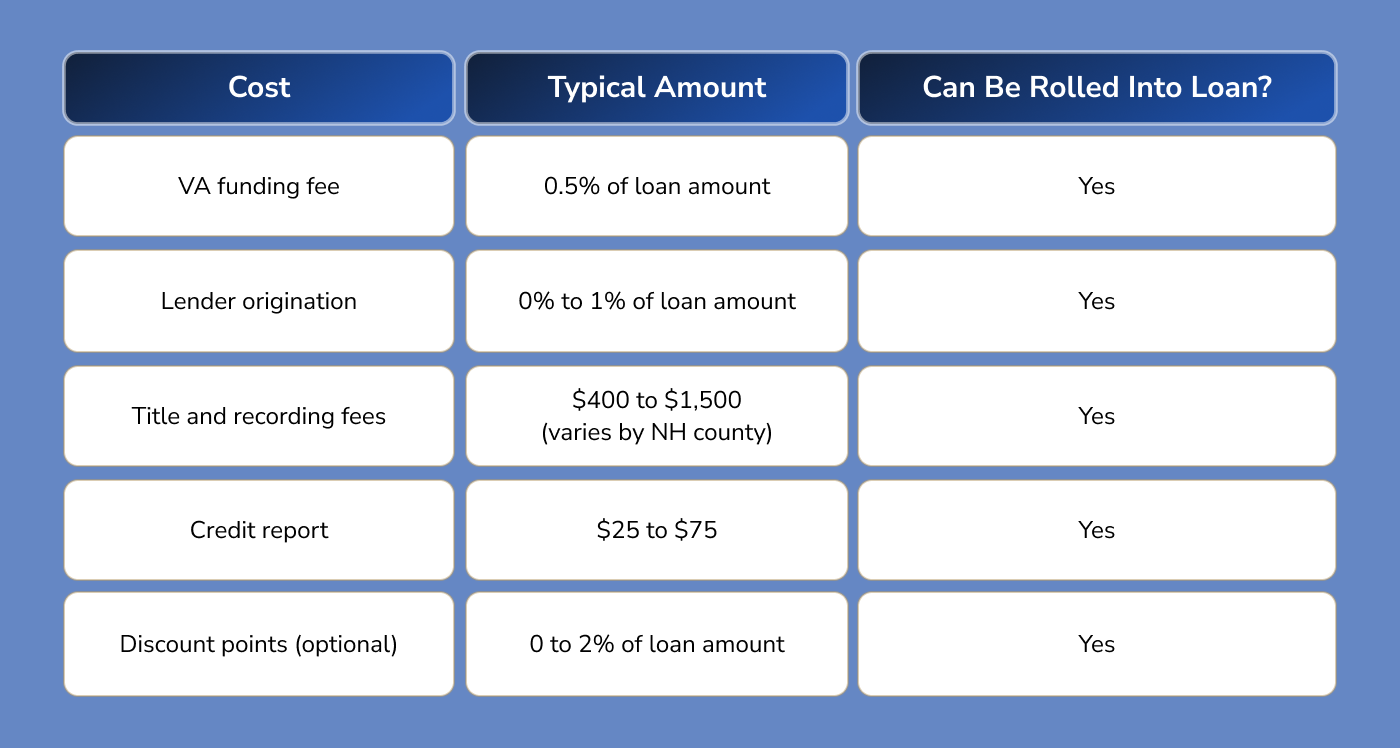
The VA funding fee helps keep the VA loan program self-sustaining. Veterans who receive compensation for a service-connected disability, surviving spouses receiving Dependency and Indemnity Compensation (DIC), and Purple Heart recipients are exempt from the funding fee under VA rules. If you are exempt on your current VA loan, you remain exempt on the IRRRL.
You can use a mortgage refinance calculator to compare your current payment against an estimated IRRRL payment and see how long it will take to break even on closing costs.
VA IRRRL vs. VA Cash-Out Refinance
Both products refinance a VA loan, but they serve different purposes.
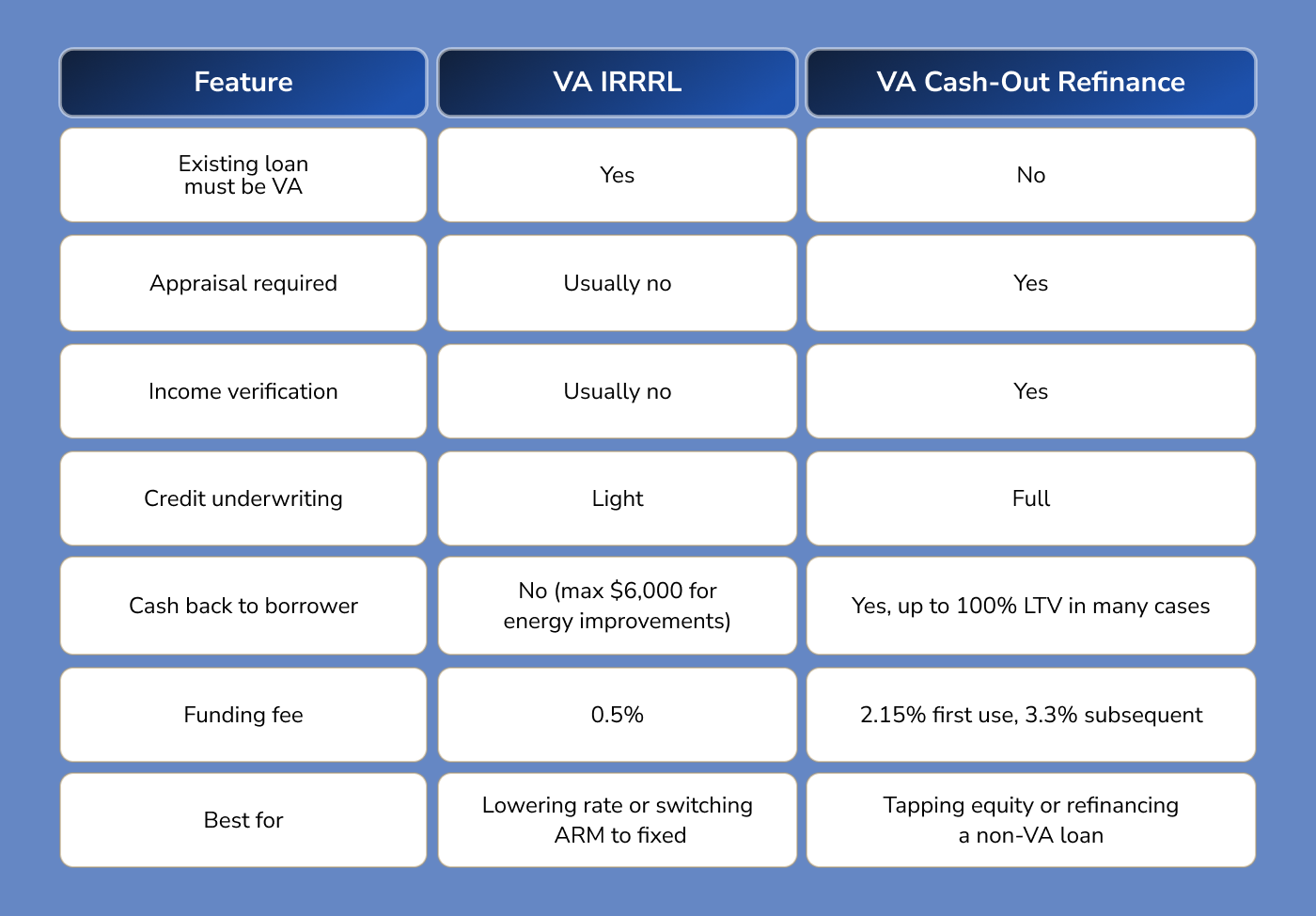
If your only goal is a lower rate or a more predictable payment, the IRRRL almost always wins on speed and cost. If you need cash for renovations, debt consolidation, or college tuition, the VA cash-out refinance is the appropriate tool. To explore both, see our VA loan options page.
The VA IRRRL Process Step by Step
Most IRRRLs follow this timeline.
Initial consultation and rate quote. You share your current loan details, your lender pulls a soft credit estimate, and you receive a quote with the new rate, payment, and closing costs.
Application. You complete a short application. Because the IRRRL skips most documentation, this step is quick.
Loan estimate. Within three business days, the lender provides a written Loan Estimate as required by the CFPB. Review it carefully and compare it against any other quotes.
Processing. The lender pulls a full credit report, verifies your existing VA loan information, and orders title work. No appraisal is ordered in most cases.
Underwriting. An underwriter confirms eligibility, the Net Tangible Benefit test, and final approval. This often takes a few days for IRRRLs versus weeks for purchase loans.
Closing disclosure. You receive the final terms at least three business days before closing.
Closing. You sign the new loan documents. After a federally required three-day rescission period for refinances on a primary residence, your old VA loan is paid off and the new loan takes over.
Most NH IRRRL closings wrap up in 30 to 45 days, though motivated borrowers and lenders can move faster when paperwork is in order.
Common Mistakes to Avoid With a VA Streamline Refinance
Even on a streamlined product, missteps cost real money.
Refinancing too early. If you have not hit the 210-day mark or made six payments, your application will be denied.
Only checking with your current lender. Brokers can compare IRRRL pricing across multiple wholesale lenders, which often produces a lower rate than going back to the bank that wrote your original loan.
Rolling too many costs into the loan. Adding $5,000 of closing costs to your principal can erase years of monthly savings if you sell or move soon. Calculate your break-even point.
Buying down the rate without a plan. Discount points only pay off if you stay in the home long enough. NH veterans planning a future PCS or relocation may not break even.
Ignoring the term reset. Refinancing a 25-year loan into a new 30-year loan lowers your payment but extends your repayment timeline. Consider a 20- or 15-year IRRRL if you want to stay on schedule.
A NextGen broker can model these scenarios side by side so you can see the long-term impact, not just the next monthly payment.
VA IRRRL for New Hampshire Veterans
New Hampshire is home to thousands of veterans across Rockingham, Hillsborough, Merrimack, Strafford, and the North Country. A few NH-specific points are worth understanding before you refinance.
NH property tax escrow matters. New Hampshire has some of the highest property taxes in the country. When you refinance, your escrow account is recalculated, and you may receive a refund from your old escrow account a few weeks after closing. Plan for that timing rather than assuming the funds are immediately available at the closing table.
County loan limits rarely affect IRRRLs. Because the IRRRL refinances an existing VA loan, the loan amount is generally capped at the payoff balance plus allowable closing costs and the funding fee. The 2026 conforming loan limits set by the FHFA still apply as a ceiling for veterans without full entitlement, but most NH veterans refinancing a single-family home will not bump into them.
NHHFA programs are separate. The New Hampshire Housing Finance Authority offers several first-time homebuyer programs, but the IRRRL operates outside of those. If you used an NHHFA program with a VA loan, talk to your broker about how a refinance affects any second mortgage or down payment assistance lien.
Coastal and lakefront homes. For homes in Rockingham County or around Lake Winnipesaukee, no-appraisal IRRRLs can be especially valuable since waterfront appraisals can be unpredictable.
How NextGen Mortgage Loans Can Help
NextGen Mortgage Loans is a New Hampshire-based mortgage broker, which means we shop your VA IRRRL across multiple wholesale lenders rather than locking you into one bank's pricing. That competition usually translates into a lower rate, lower fees, or both.
Our loan officers work with NH veterans every week, including active-duty service members at Pease, retirees, surviving spouses, and veterans who have moved out of state but still own NH property. We will tell you straight whether an IRRRL makes sense for your situation, calculate your break-even point in real numbers, and pull together a no-cost rate comparison so you can see your options before committing.
Ready to see what your new payment could look like? Contact a NextGen loan officer for a free VA IRRRL consultation, or run the numbers yourself with our mortgage calculators.
Frequently Asked Questions
How soon after closing on a VA loan can I do an IRRRL?
You must wait at least 210 days from the date of your first mortgage payment, and you must have made at least six consecutive monthly payments on your current VA loan. Both conditions are set by the VA and apply to every lender.
Do I need a new Certificate of Eligibility for an IRRRL?
In most cases, no. The VA confirms eligibility electronically using the existing VA loan information. Your lender handles this verification as part of the application.
Can I get cash back from a VA IRRRL?
Generally no. The IRRRL is not a cash-out product. The one exception is up to $6,000 in eligible energy efficiency improvements completed within 90 days before closing. If you need to pull equity for other purposes, a VA cash-out refinance is the right tool.
Can I refinance an investment property with an IRRRL?
Yes, but only if the home was your primary residence at some point under the original VA loan. You will sign a certification of prior occupancy at closing. This makes the IRRRL one of the few refinance products that allows a no-appraisal refinance on a former primary residence that is now a rental.
Will an IRRRL hurt my credit score?
The application triggers a hard credit pull, which can temporarily drop your score by a few points. The longer-term impact depends on how you manage payments after closing. Most borrowers see no meaningful change beyond the short-term inquiry effect.
Does the IRRRL funding fee apply to disabled veterans?
Veterans receiving VA compensation for a service-connected disability, surviving spouses receiving DIC, and Purple Heart recipients are exempt from the VA funding fee, including on an IRRRL. If you were exempt on your original VA loan, you remain exempt on the streamline refinance.
Should I pay points to lower my IRRRL rate?
It depends on how long you plan to keep the home. Discount points pay off only if you hold the loan past the break-even point, often three to seven years depending on the math. If you might sell or PCS within a few years, paying points usually does not make sense. Consult a tax professional for advice specific to your situation, since points may be deductible.

