
Should I Buy a House Now or Wait? A 2026 Guide for New Hampshire Buyers
The short answer: for most financially ready buyers in New Hampshire, waiting will not save you money in 2026. Home prices are still climbing, inventory remains historically tight, and mortgage rates are not expected to drop sharply this year. The right question is not whether to time the market. It is whether your finances and timeline are ready.
This guide walks through what is actually happening in the NH housing market right now, what the data says about waiting for mortgage rates to drop, the real cost of delaying a purchase, and how to decide based on your situation rather than headlines.
The short answer: should I buy a house now or wait?
If you have stable income, a healthy emergency fund, manageable debt, and you plan to stay in the home for at least 5 to 7 years, buying now is usually the stronger move. Waiting tends to backfire when prices keep rising and rates stay range-bound, which is what most major forecasters are projecting through 2026.
Buy now if:
Your income is stable and your debt is under control
You have funds for the down payment, closing costs, and 3 to 6 months of reserves
You plan to stay in the home long enough to absorb closing costs, typically 5 plus years
You can afford the monthly payment at current rates without stretching your budget
Wait if:
Your job or income is uncertain
You have high-interest debt squeezing your debt-to-income ratio
You are still building your emergency fund or down payment
You may need to relocate within 2 to 3 years
The market is not the variable that should drive this decision. Your readiness is.
What is actually happening in the New Hampshire housing market in 2026
Prices in NH are still rising, just more slowly than in recent years. According to the New Hampshire Association of Realtors, the median single-family home price in the first quarter of 2026 was $530,000, up 3.9 percent from the same period in 2025. Inventory is improving but still well below balanced-market levels.
Key NH data points heading into mid-2026:
Statewide median single-family price: around $530,000 (NHAR)
Months of supply: roughly 1.4 to 1.8 months versus the 5 to 6 months considered balanced
Days on market: averaging in the mid-40s, up from the low 30s in 2024
Rockingham County recorded the highest county median price (around $660,000), Merrimack County around $482,450, and Coos County remained the most affordable at roughly $240,000
The takeaway: NH is still a sellers' market, but it is the softest sellers' market we have seen in several years. More homes are coming online, with new listings up 7.4 percent for single-family homes year-over-year, and inventory is up 13.2 percent for single-family homes. Days on market have lengthened, and the share of homes selling above asking has come down. That gives buyers more leverage than they had in 2022 or 2023, even with rates higher than they were then.
For a deeper look at what your monthly payment would look like in your target town, our mortgage calculators let you model price, rate, taxes, and insurance side by side.
Should I wait for mortgage rates to drop before buying a house?
Probably not by enough to make waiting worth it. Most forecasts point to rates fluctuating in a band rather than falling meaningfully.
As of the week ending April 30, 2026, Freddie Mac's Primary Mortgage Market Survey put the average 30-year fixed rate at 6.30 percent, with the 15-year fixed at 5.64 percent. Rates began the year just above 6 percent, dipped to 5.98 percent in late February (the lowest in three and a half years), and climbed back through April. Many economists expect rates to continue fluctuating within the 6 to 6.5 percent range through the year, with no credible forecast pinning down a specific endpoint.
A few things drive that view:
Inflation remains above the Federal Reserve's 2 percent target
The 10-year Treasury yield, which mortgage rates track, has been volatile but elevated
The Fed has signaled cautious, gradual easing rather than aggressive cuts
What that means for you: planning a purchase around the assumption that 30-year rates will return to 5 percent or below in the next 12 months is a bet, not a plan. Buyers who wait often face a difficult trade-off. Rates may come down half a point, but home prices in NH are forecast to rise 2 to 4 percent over the same period, which can wipe out the savings.
The hidden cost of waiting in the NH market
Most buyers focus only on the rate. The full picture includes price appreciation, lost equity, and rent paid in the meantime.
Consider a $500,000 home in NH at today's rates versus the same home a year from now if prices rise 3 percent and rates fall half a point.
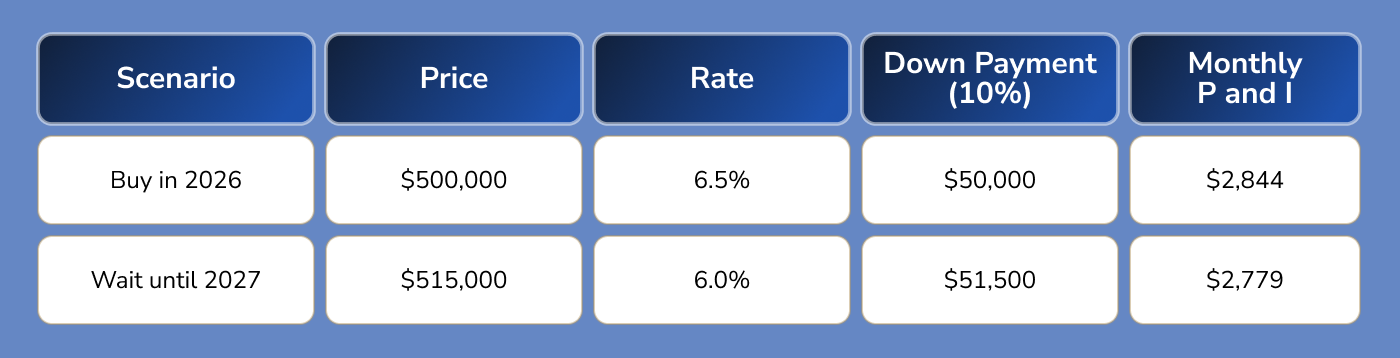
The "wait" scenario saves roughly $65 per month on principal and interest, but in that year you paid another 12 months of rent (often $2,500 plus in southern NH), built no equity, and now need a larger down payment to hit the same percentage. The math rarely favors waiting unless rates drop more than a full point and prices stay flat, which is not the consensus forecast.
Speak with a NextGen broker to compare options across multiple lenders if you want to run these numbers against your actual budget rather than a generic example.
When buying a house now makes sense
Buying makes sense in 2026 when the fundamentals on your side of the equation are strong, regardless of where the market sits.
Green lights:
Stable employment for at least 2 years in the same field
Credit score above 680 (above 740 unlocks the best pricing)
Debt-to-income ratio under 43 percent, ideally under 36 percent
Emergency fund covering 3 to 6 months of essential expenses, separate from your down payment
Clear time horizon of 5 plus years in the home
Rent that is approaching or exceeding what your mortgage payment would be
If you check most of those boxes, the cost of waiting usually outweighs the benefit. Refinancing later is straightforward if rates drop. Recovering missed appreciation is not. There is a saying in the industry: you marry the house, you date the rate. It oversimplifies, but the underlying logic holds. Locking in your home and your purchase price matters more long term than locking in the rate, because rates can be refinanced.
If you are ready to move forward, get pre-approved so you know your real budget before you start touring.
When waiting to buy a house makes sense
Waiting is the right call in some situations, and a good broker will tell you so.
Yellow or red flags:
Job loss or industry instability in the past 12 months
Recent move to a new state or new line of work without 2 years of consistent history
Credit score below 620, or recent late payments, collections, or charge-offs
DTI above 50 percent, often driven by student loans, auto loans, or credit cards
Less than 5 percent saved for down payment with no nearby completion date
A likely move in 2 to 3 years (job rotation, military assignment, family plans)
If any of these apply, focus the next 6 to 18 months on fixing the underlying issue, not on watching rates. Pay down high-interest debt first, build savings, and use that time to clean up your credit profile. The improvement in your loan terms when you finally do buy can outweigh anything the broader market gives you.
How to position yourself if you decide to wait
If your situation calls for waiting, use that time deliberately. Most buyers waste 6 to 12 months "watching the market" and arrive at their next attempt no better prepared. Do the opposite.
A productive 12-month plan:
Pull your credit reports from all three bureaus and dispute errors immediately
Pay down revolving debt to under 30 percent of available credit, ideally under 10 percent
Avoid new credit accounts and large purchases until after closing
Keep employment stable in the same line of work
Automate savings for down payment and closing costs into a separate account
Get a soft pre-qualification at least 6 months out so a NextGen loan officer can flag any issues with enough runway to fix them
Track NH inventory and pricing in your target towns so you recognize a real opportunity when it shows up
A NextGen loan officer can walk you through this checklist in 15 minutes and lay out exactly what to clean up before applying.
NH-specific factors to weigh
A few New Hampshire realities can shift the calculation in either direction.
County loan limits
For 2026, the FHFA conforming loan limit for one-unit properties in most NH counties is $806,500. Rockingham and Strafford counties carry higher limits because they are part of the Boston-area high-cost MSA. If your target purchase is above the conforming limit in your county, you may need a jumbo loan, which carries different qualification standards. A broker can show you how the same purchase price prices out across different loan programs.
Property taxes
NH has no state income tax, but property taxes are among the highest in the country and vary widely by town. A home in Hanover, Portsmouth, or Bedford may carry materially higher taxes than a comparably priced home an hour north. Always price the home with full PITI (principal, interest, taxes, and insurance), not just principal and interest. Consult a tax professional for advice specific to your situation.
NHHFA programs
The New Hampshire Housing Finance Authority offers down payment assistance and below-market-rate first mortgages for eligible buyers, particularly first-time homebuyers and those buying in targeted areas. These programs change annually and have income limits, so check current eligibility before assuming you do or do not qualify. Our team works with NHHFA loans regularly and can quickly tell you whether you fit current guidelines.
Out-of-state buyers
If you are relocating from Massachusetts, the cost-of-living differential can make NH feel more affordable on paper, but adjust for property tax and heating costs in your monthly budget. Also confirm any employment-related residency requirements with your employer if you are remote or hybrid.
How NextGen Mortgage Loans can help
NextGen Mortgage Loans is a New Hampshire-licensed mortgage broker, which means we are not tied to a single bank's pricing or product set. We compare rates and programs across multiple lenders and bring you the strongest option for your specific scenario, whether that is a conventional, FHA, VA, USDA, or jumbo loan.
We work with first-time NH buyers, move-up buyers, veterans, self-employed borrowers, and out-of-state buyers relocating to the Granite State. Initial consultations are no-cost and no-obligation. We will run the numbers on your target price range, walk you through pre-approval, and give you an honest read on whether buying now or waiting fits your situation better.
Ready to find out where you stand? Contact a NextGen loan officer or run the numbers in our mortgage calculators before you talk to a real estate agent.
Frequently asked questions
Is it a good time to buy a house in 2026?
For financially ready buyers in NH, yes. Prices are still rising, inventory is improving but still tight, and rates are forecast to stay in the low to mid 6 percent range. Waiting rarely pays off unless your personal finances need more time, in which case use the time to strengthen your credit, savings, and DTI.
Will mortgage rates go down in 2026?
Probably not significantly. Most major forecasters, including Fannie Mae, the Mortgage Bankers Association, and NAR, expect 30-year fixed rates to fluctuate in the 6 percent range through 2026. Small dips are possible if inflation cools, but a return to sub-5 percent rates is not the consensus view.
Should I wait for the housing market to crash?
Most economists do not expect a NH housing crash. Inventory remains far below pre-pandemic levels, lending standards are far stricter than they were in 2008, and homeowner equity is high. A modest price softening is possible in some segments, but a 20 to 30 percent crash is not what current data supports.
How much do I need to put down to buy a house in NH?
It depends on the loan type. Conventional loans can go as low as 3 percent down for qualified first-time buyers, FHA loans require 3.5 percent, USDA and VA loans can be zero down for eligible borrowers, and jumbo loans typically require 10 to 20 percent. Speak with a NextGen broker to see what you qualify for.
Is it cheaper to rent or buy in New Hampshire right now?
In many NH towns, the monthly cost of renting and the monthly cost of owning are close, but only owning builds equity. Run both numbers using your actual rent versus a mortgage payment that includes taxes, insurance, and maintenance, and compare the 5-year total cost. Our calculators can help you model this.
Can I buy a house with bad credit?
Possibly, depending on the score and what is on the report. FHA loans accept scores as low as 580 with 3.5 percent down, and some lenders go lower with larger down payments. If your credit is in the 500s or you have recent derogatory marks, work with a broker first to understand what to fix before applying.
How long does pre-approval take with NextGen?
For most borrowers, a NextGen pre-approval can be issued within 24 to 48 hours once we have your income, asset, and credit documents. Self-employed borrowers and complex files can take longer, which is another reason to start the conversation early rather than wait until you have an offer to make.

