
How to Get a Self Employed Mortgage in New Hampshire
Yes, you can get a self employed mortgage in New Hampshire, even if your tax returns show modest net income. Lenders look at self-employed borrowers differently than W-2 employees, and the right loan program can mean the difference between an approval and a denial. This guide walks you through what NH lenders actually require, which programs fit business owners best, and how to position your application for the strongest possible outcome.
If you run an LLC, freelance, contract, or own a small business in New Hampshire, the path to homeownership is open. It just requires more paperwork and smarter preparation than a traditional salaried borrower would face.
Why a Self Employed Mortgage Is Different
Lenders treat self-employment income as variable rather than predictable. A W-2 employee shows a paystub and a verification of employment. You show two years of tax returns, schedules, and often a year-to-date profit and loss statement.
The bigger issue is how income gets calculated. Lenders use your net business income (after legitimate write-offs), not gross revenue. The deduction strategy that saved you on taxes last April can shrink your qualifying income on a mortgage application.
Here is the trade-off: aggressive write-offs lower your taxable income but also lower the income a lender can use to approve your loan. Conservative write-offs preserve qualifying income but raise your tax bill. Most self-employed borrowers in NH benefit from planning two to three years ahead of a home purchase.
Quick answer
A self employed mortgage is a home loan issued to a borrower whose primary income comes from self-employment, business ownership, contract work, or freelance income. Lenders verify that income through tax returns, bank statements, or profit and loss statements rather than W-2 paystubs.
How to Get a Mortgage When Self Employed: The Documentation You Need
Plan to provide more documentation than a traditional borrower. Most NH lenders ask for the following on a conventional, FHA, or VA loan:
Two years of personal federal tax returns, all schedules included
Two years of business tax returns (if filed separately, like an S-corp or partnership)
Year-to-date profit and loss statement, signed and dated
Two months of personal and business bank statements
Business license or proof the business has been active for at least two years
A signed letter explaining significant income variations year over year
Evidence of continuing business stability (active contracts, ongoing client work)
Some lenders also pull a CPA letter confirming your business is operating and that pulling income for a down payment will not damage the business. This is most common with self-employed borrowers using business funds for closing.
Self Employed Home Loan Requirements at a Glance
Requirements vary by loan type, but the baseline NH lenders look for typically includes:
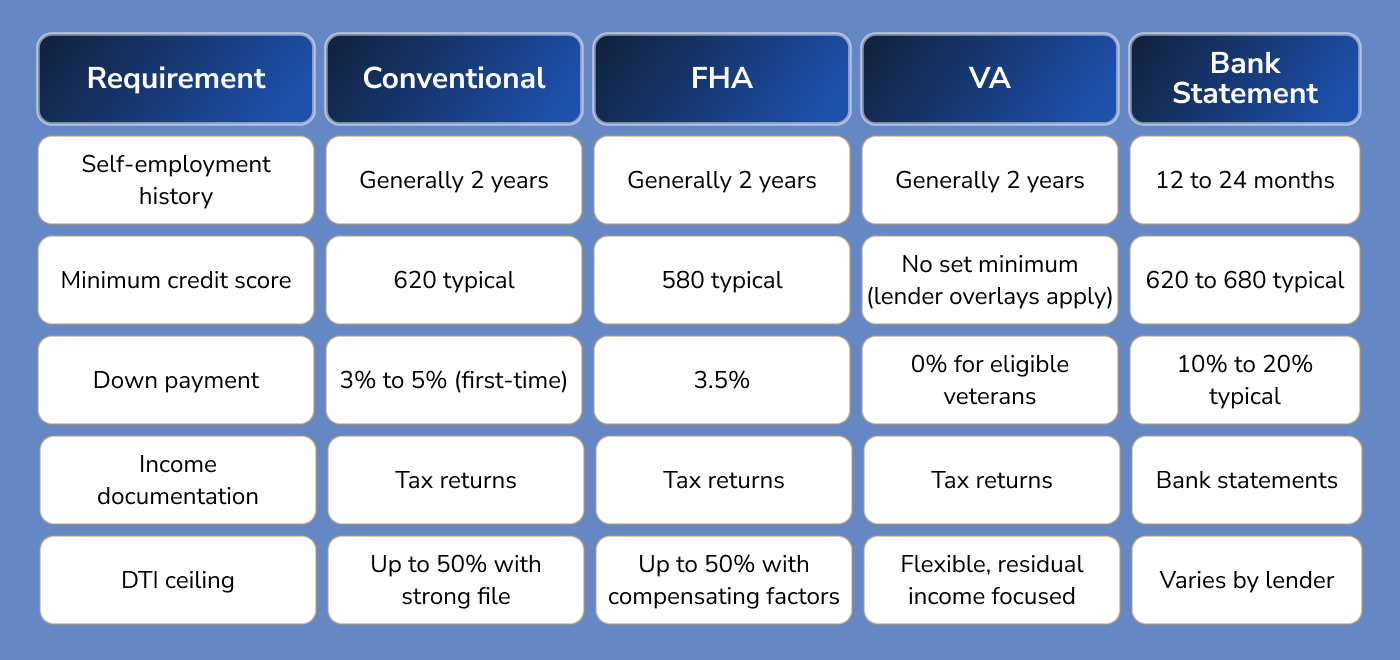
These are general guidelines. Individual approvals depend on credit, reserves, the property, and overall file strength. A NextGen loan officer can review your specific situation and tell you which path looks strongest in 15 minutes.
The 2 Years Self Employed Mortgage Rule (and the Exceptions)
Most loan programs require a 2 year self employed mortgage history. Fannie Mae, Freddie Mac, FHA, and VA generally want to see two consecutive years of self-employment income, supported by tax returns.
There are exceptions worth knowing about:
One year may work if you have a prior W-2 history in the same line of work and the self-employment is a continuation of that career. Fannie Mae's Selling Guide allows this under specific conditions.
Bank statement loans can approve borrowers with as little as 12 months of self-employment, since they derive income from deposits rather than tax returns.
Profit and loss only loans exist through some non-QM lenders and skip tax returns entirely, though rates and down payment requirements run higher.
Asset-based loans ignore income entirely and qualify you on liquid assets, which can work for retired business owners or borrowers with significant savings.
If you have not yet hit the two year mark, do not assume you cannot buy. The bank statement and non-QM space has grown significantly, and a broker with access to multiple lenders can shop your file across programs that traditional banks do not offer.
Mortgage for Business Owners: Which Loan Type Fits Best
The right loan depends on your tax returns, your credit, and how much down payment you have. Here is a practical breakdown.
Conventional loans
Best when your tax returns show solid net income and your credit is 680 or higher. You get the most competitive rates and the lowest mortgage insurance once you pass 20% equity. Conventional loans follow Fannie Mae and Freddie Mac guidelines, which means strict income calculation but predictable underwriting. You can review the full menu on our loan programs page.
FHA loans
Useful when your credit is in the 580 to 660 range or your debt-to-income ratio is tight. FHA allows higher DTIs with compensating factors and accepts lower credit scores. The trade-off is mortgage insurance for the life of the loan in most cases.
VA loans
If you served, this is almost always the strongest path. No down payment, no monthly mortgage insurance, and flexible underwriting that often handles self-employment well. VA still requires 2 years of business history in most cases. Take a look at our VA loan calculator to see how the numbers compare.
Bank statement loans
Designed specifically for self-employed borrowers whose tax returns understate true cash flow. The lender uses 12 to 24 months of personal or business bank statements and calculates income from deposits, often after applying an expense factor. Rates run higher than conventional, but for the borrower with $400,000 in deposits and $80,000 on Schedule C, the math often works out in favor of the bank statement product.
P&L only and asset-based loans
The least documentation-heavy options, used for borrowers with strong assets or simple verifiable income through a CPA-prepared P&L. Down payment requirements typically start at 20% and rates sit higher than QM loans.
How NH Lenders Calculate Your Self-Employment Income
This is where most self-employed borrowers get surprised. Lenders use a specific formula, not just "what you made."
For a sole proprietor (Schedule C):
Start with net profit on Schedule C
Add back depreciation
Add back business use of home expenses
Add back depletion (if applicable)
Subtract any non-recurring income
Average across two years (or use the most recent year if it is lower and trending down)
For an S-corporation or partnership, lenders look at K-1 distributions, W-2 wages from the business, and ordinary business income, often with similar add-backs from the business return.
The key insight: lenders average. If 2024 was a strong year and 2025 was weaker, they typically use the average. If 2025 was weaker and trending downward, some lenders use the most recent year only, which works against you. Plan accordingly.
New Hampshire Specifics: Loan Limits, Programs, and Property Tax Context
NH has unique features worth understanding before you apply.
Conforming loan limits. The Federal Housing Finance Agency sets annual conforming loan limits, which most NH counties follow at the baseline figure. Rockingham, Strafford, and Hillsborough counties sit close to Boston metro pricing, so jumbo loans are more common in southern NH than in the northern parts of the state. Check the current FHFA limits before assuming a property fits within conforming territory.
NHHFA programs. New Hampshire Housing offers down payment assistance and below-market-rate options for qualifying buyers, including some self-employed borrowers. Income limits and purchase price caps apply by county. NHHFA loans pair with conventional or FHA financing and can reduce the cash required at closing. Buyers using NHHFA support often appear on our first-time homebuyer guidance page.
Property tax weight. New Hampshire has no income or sales tax, but property taxes are among the highest in the country. Towns like Claremont, Berlin, and parts of the seacoast carry high effective rates that materially affect your DTI. When a lender calculates your housing payment, they include property taxes, and NH's higher rates can push your DTI above program limits even with a strong income. Run the numbers on a mortgage payment calculator before you fall in love with a property.
Rural areas and USDA. Much of central and northern NH qualifies for USDA Rural Development loans, which offer 0% down for eligible borrowers, including self-employed buyers. Check the USDA eligibility map for the exact property address.
Tips to Strengthen Your Self Employed Mortgage Application
Small adjustments in the year or two before you apply can move the needle significantly.
Keep business and personal banking separate. Lenders need clean documentation. Mixed accounts create headaches and slow the file.
Plan tax strategy with a mortgage in mind. Talk to your CPA about which write-offs to take in the year before you apply. Some deductions, like depreciation, get added back on the loan side. Others, like Section 179 equipment expense, often do not. Consult a tax professional for advice specific to your situation.
Build reserves. Most self-employed borrowers benefit from showing 6 to 12 months of mortgage payment in liquid reserves. This compensates for income variability in the underwriter's eyes.
Hold credit card balances under 30% of the limit. Utilization affects credit scores quickly, and self-employed borrowers often run business expenses on personal cards. Pay down before applying.
Avoid major purchases or new credit accounts in the 60 to 90 days before and during your loan process.
Get pre-approved early. A real pre-approval, not a casual pre-qualification, tells you exactly what you can buy and surfaces problems while you still have time to fix them.
How NextGen Mortgage Loans Can Help
Self-employed borrowers benefit most from working with a broker rather than a single bank. As an independent NH mortgage broker, NextGen Mortgage Loans shops your file across multiple lenders, including conventional, FHA, VA, USDA, and bank statement programs. That access matters: one bank might decline a file that another lender approves cleanly, and you only see the difference when someone is actively comparing across the market.
We help business owners across New Hampshire structure their applications, navigate income calculations, and choose the loan type that fits their tax situation. Consultations are free and there is no obligation to proceed.
Contact a NextGen loan officer today to start your pre-approval, or run the numbers on our mortgage calculator suite before you reach out.
Frequently Asked Questions
Can I get a mortgage if I have only been self-employed for one year?
Sometimes. Conventional and FHA loans typically require two years of self-employment history, but Fannie Mae allows one year if you have prior W-2 experience in the same line of work. Bank statement loans can also approve at 12 months. Speak with a broker to find out which programs will consider your specific timeline.
Do lenders use my gross income or net income?
Lenders use your net income after business expenses, not gross revenue. They typically average two years of tax returns and add back certain non-cash deductions like depreciation. This is why aggressive write-offs can hurt your qualifying income even when your business is profitable.
What credit score do I need for a self employed mortgage?
Minimums vary by loan type. Conventional loans typically require 620, FHA accepts down to 580 (and lower with bigger down payments), and VA has no set minimum but most lenders apply overlays around 600 to 620. Bank statement loans usually want 620 to 680.
Can I use bank statements instead of tax returns?
Yes, through non-QM bank statement loan programs. The lender reviews 12 to 24 months of personal or business bank statements and calculates income from deposits. These loans carry higher rates and usually require 10% to 20% down, but they often work well for borrowers with strong cash flow but heavy write-offs.
Will my business debt count against my DTI?
It depends. If a business loan is in your personal name, it generally counts against your debt-to-income ratio. If the loan is in the business name and you can document that the business has paid it for at least 12 months from business accounts, lenders often exclude it. Bring all business loan documentation to your loan officer early.
How much down payment do I need as a self-employed buyer in NH?
The same as any other borrower for the same loan type. Conventional first-time buyers can put down as little as 3%, FHA requires 3.5%, VA and USDA can go to 0% for eligible borrowers, and bank statement loans typically require 10% to 20%. Down payment assistance through NHHFA may reduce the cash needed at closing.
Should I pay off business debt before applying for a mortgage?
Not always. Paying down high-utilization revolving debt usually helps your credit score and DTI. Paying off a low-balance installment loan close to the end of its term may not move the needle and could drain reserves. Talk to a broker before making large debt moves in the 90 days before applying.

