Renting vs Buying in New Hampshire: How to Decide in 2026
If you plan to stay in your home at least five years and you can comfortably afford the down payment, closing costs, and monthly carrying cost (including NH's high property taxes), buying usually beats renting in New Hampshire over time. If you might move within two or three years or your budget is stretched thin, renting often wins. The right answer depends on your timeline, savings, credit, and the specific town you are considering.
This guide breaks down renting vs buying in New Hampshire using real cost factors, including property taxes that are among the highest in the country, NHHFA down payment programs, and the math that determines your break-even point.
Quick Answer: Should You Rent or Buy in New Hampshire?
Buy if you have stable income, plan to stay 5+ years, can put 3% to 20% down, and your total monthly housing cost (PITI) fits within roughly 28% to 35% of your gross income.
Rent if you expect to move within 2 to 3 years, lack savings for a down payment plus closing costs and reserves, are still building credit, or are unsure where in NH you want to settle.
The decision is not just about monthly payment. Property taxes, maintenance, opportunity cost on your down payment, and how long you stay all change the answer.
The Real Cost of Renting in New Hampshire
Rent has climbed sharply across NH since 2020. According to the U.S. Census Bureau's American Community Survey, median gross rent in New Hampshire runs higher than the national median, and tracking data from sources like Zillow and Apartment List shows continued upward pressure in markets like Manchester, Nashua, Portsmouth, and the Seacoast.
When budgeting to rent in NH, plan for:
Monthly rent
Renters insurance (typically $15 to $30 per month)
Utilities not included in rent (heat is a major cost in NH winters)
Security deposit (often one month's rent)
Annual rent increases at lease renewal
Rent is predictable month to month, but it is not predictable year to year. NH does not have statewide rent control, so renewals can move with the market. Over a 5-year horizon, rent increases of 3% to 6% per year are common, which compounds into a meaningfully higher cost in year five than year one.
The Real Cost of Buying in New Hampshire
When you buy a home in New Hampshire, your monthly cost is typically called PITI: principal, interest, taxes, and insurance. In NH, the "T" matters more than in most states.
NH consistently ranks among the top states for property tax burden. According to the Tax Foundation, New Hampshire's effective property tax rate is one of the highest in the nation. With no state income tax and no general sales tax, the state funds public services (especially K-12 education) largely through local property taxes.
That has two implications for buyers:
Your monthly mortgage payment will include a meaningful escrow for property taxes.
Property taxes vary significantly by town. Two homes with identical sale prices can have monthly payments that differ by hundreds of dollars depending on the local mil rate.
Beyond PITI, plan for:
Down payment: 3% to 20% of purchase price (FHA from 3.5%, Conventional from 3%, VA and USDA from 0%)
Closing costs: typically 2% to 5% of the loan amount
Homeowners insurance: varies by location and coverage
Private mortgage insurance (PMI): if you put less than 20% down on a conventional loan
Maintenance reserve: a common rule of thumb is 1% of home value per year
HOA fees: if applicable (more common in condos and some new developments)
A NextGen loan officer can run the full numbers for a specific NH town and price point in about 15 minutes.
Side-by-Side: NH Rent vs Mortgage Comparison
Here is a simplified framework. Actual numbers depend on your situation.
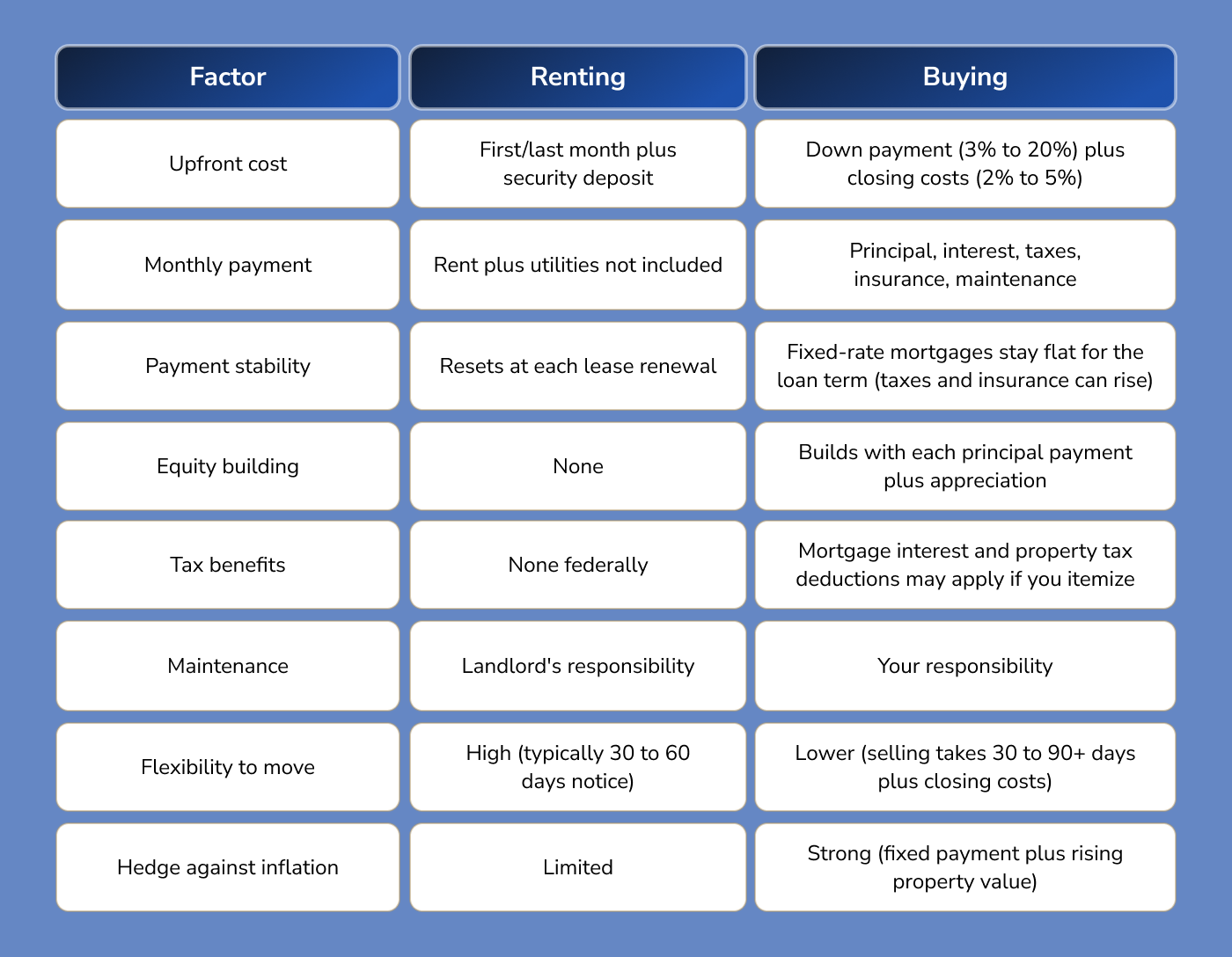
Consult a tax professional for advice specific to your situation regarding mortgage interest and property tax deductions.
Is It Cheaper to Rent or Buy in NH?
The honest answer: it depends on three variables.
1. How Long You Plan to Stay
The longer you stay, the more buying tilts in your favor. Closing costs (2% to 5% of the loan) and selling costs (5% to 6% in agent commissions plus other fees) take time to recoup. The widely cited "5-year rule" exists for this reason. If you sell after 18 months, you almost certainly lose money compared to renting.
2. The Local Market
In some NH towns, the monthly cost of buying is close to or below the monthly cost of renting a comparable property. In others (especially the Seacoast and parts of southern NH near the Massachusetts border), buying carries a premium. Comparing the two requires running numbers for the specific town and property type.
3. The Mortgage You Qualify For
Your rate, loan type, and down payment shape the math. A buyer with a 760 credit score putting 20% down on a conventional loan has a very different monthly cost than a buyer with a 660 score putting 3.5% down on FHA, even at the same purchase price. Use a mortgage calculator to model your specific scenario.
Hidden Costs of Homeownership in New Hampshire
These are the costs first-time NH buyers most often underestimate.
Property taxes that re-bill twice a year. Most NH towns bill in July and December. Your escrow handles this, but you should understand the schedule.
Heating costs. NH winters are long. Many older NH homes still run on oil or propane. Budget realistically; a single fill-up can run $600 to $1,200 or more depending on tank size and current fuel prices.
Septic and well systems. Many homes outside town centers in NH are on septic and well rather than municipal services. Septic pumping (every 3 to 5 years), well testing, and possible filtration add ongoing costs.
Snow and ice management. Plowing contracts, roof rakes, ice dam prevention, and salt add up across a NH winter.
Older home maintenance. Much of NH's housing stock predates 1980. Plan for roof, heating system, and electrical updates over time.
Town-specific assessments. Some NH towns carry betterment assessments or special district fees. Always review the property tax card before making an offer.
When Renting Makes More Sense in NH
You expect a job change or relocation in the next 1 to 3 years
You are still building emergency savings (3 to 6 months of expenses)
Your credit profile needs 6 to 12 more months of seasoning to qualify for a competitive rate
You are unsure which NH town fits your lifestyle and commute
You want to avoid maintenance responsibility at this stage of life
Local rent is meaningfully below the cost of buying a comparable home
There is no shame in renting longer. Buying before you are financially ready is a far more expensive mistake than renting an extra year.
When Buying Makes More Sense in NH
You have stable income and plan to stay 5+ years
You have funds for a down payment, closing costs, and 2 to 6 months of reserves
Your debt-to-income ratio (DTI) supports a mortgage payment within affordability guidelines
You want predictable housing costs that do not reset every 12 months
You want to build equity and benefit from any home appreciation
You qualify for a program (VA, USDA, NHHFA) that improves the math meaningfully
If you are an NH veteran or active-duty service member, VA loan benefits (no down payment, no PMI, competitive rates) often shift the rent vs buy math significantly in favor of buying.
NH-Specific Programs That Change the Math
The New Hampshire Housing Finance Authority (NHHFA) offers programs that can lower the upfront cost of buying for qualifying borrowers.
NHHFA's Home Flex Plus and Home Preferred Plus programs offer down payment assistance to eligible NH homebuyers. The exact amount, income limits, and terms change periodically, so check current details on the NHHFA website or with a participating lender.
Federal programs also reshape the calculation:
FHA loans: 3.5% down, more flexible credit requirements
VA loans: 0% down for eligible veterans and service members
USDA loans: 0% down for eligible rural NH areas (much of NH outside the Manchester, Nashua, and Seacoast corridors qualifies)
Conventional 97: 3% down for first-time buyers
Each program has eligibility rules, and the right one depends on your income, credit, location, and goals. A NextGen broker can compare loan programs across multiple lenders and identify which option makes buying most affordable for you.
How NextGen Mortgage Loans Can Help
NextGen Mortgage Loans is a New Hampshire-licensed mortgage broker, which means we shop your loan across multiple lenders rather than offering you a single bank's products. That structure typically results in better rates and more flexibility, especially for first-time buyers, self-employed borrowers, and veterans.
If you are weighing renting vs buying in New Hampshire, a free 15-minute call with a NextGen loan officer can give you:
A clear picture of what you can comfortably afford
A real pre-approval (not just a pre-qualification)
A side-by-side comparison of FHA, conventional, VA, USDA, and NHHFA options
Guidance on which NH towns fit your budget once property taxes are factored in
Contact a NextGen loan officer today to find out what your numbers actually look like. There is no cost to talk and no obligation to move forward.
Frequently Asked Questions
Is it cheaper to rent or buy in NH right now?
It depends on the town, your loan terms, and how long you plan to stay. In many NH markets, monthly rent and a monthly mortgage on a comparable home are within a few hundred dollars of each other. Once you factor in equity buildup, tax treatment, and rent increases over time, buying often comes out ahead after 5 years, but only if you can comfortably cover the upfront and ongoing costs.
How much do I need to put down to buy a house in New Hampshire?
As little as 0% with a VA or USDA loan if you qualify, 3% with a Conventional 97 loan, or 3.5% with an FHA loan. Putting 20% down avoids private mortgage insurance (PMI) on conventional loans but is not required. NHHFA also offers down payment assistance programs for eligible NH buyers.
Why are property taxes so high in NH?
New Hampshire has no state income tax and no general sales tax, so most public services (especially K-12 education) are funded through local property taxes. According to the Tax Foundation, NH's effective property tax rate is among the highest in the nation. Rates vary significantly by town, so the same purchase price can produce very different monthly payments depending on location.
What credit score do I need to buy a home in NH?
Most loan programs accept scores starting around 580 (FHA) or 620 (Conventional and most VA lenders), though better rates typically begin around 680 to 740. If your score is below those thresholds, a few months of focused credit work can meaningfully lower your rate and monthly payment.
How long should I plan to stay in a home for buying to make sense in NH?
The general rule of thumb is at least 5 years. Closing costs and selling costs (agent commissions, transfer taxes, title work) take time to recoup through equity and appreciation. If you might move within 2 to 3 years, renting usually costs less overall.
Are there first-time homebuyer programs in New Hampshire?
Yes. The NH Housing Finance Authority (NHHFA) runs programs like Home Flex Plus and Home Preferred Plus that offer down payment assistance to eligible buyers. Federal programs (FHA, VA, USDA, Conventional 97) are also available to first-time buyers in NH. A mortgage broker can help you identify which combination produces the lowest cost for your situation.
Should I wait for rates to drop before buying in NH?
Timing the rate market is difficult, and home prices can move while you wait. A more useful question is whether you can afford the home you want at today's rates. If yes, you can always refinance later if rates fall. If no, renting longer while you save is a reasonable plan. A NextGen loan officer can help you model both scenarios so you can make the call based on numbers, not headlines.

