Non QM Loans in New Hampshire: How They Work
META DESCRIPTION: Non QM loans help self-employed, investor, and non-traditional borrowers in New Hampshire qualify for a mortgage. Learn requirements, costs, and how to apply.
URL SLUG: /post/non-qm-loans-new-hampshire
PRIMARY KEYWORD: non qm loans (KD: 11, SV: 2.4K)
Non QM Loans in New Hampshire: How They Work
A non QM loan is a residential mortgage that does not meet the Consumer Financial Protection Bureau's Qualified Mortgage rules, but still follows federal lending laws. For New Hampshire borrowers who are self-employed, real estate investors, retirees, or recovering from a credit event, non QM loans (also called non qualified mortgages) often unlock financing that traditional bank programs deny.
This guide breaks down how non QM loans work, who qualifies, what documentation you'll need, and how alternative mortgage programs compare to conventional and government-backed options. By the end, you'll know whether a non QM lender fits your purchase or refinance in NH.
What Is a Non QM Loan?
Quick answer: A non QM loan is a residential mortgage that falls outside the CFPB's Qualified Mortgage rule, usually because the borrower's income, employment structure, or debt profile does not fit standard conventional underwriting.
After the 2008 housing crisis, the Dodd-Frank Act created the Qualified Mortgage rule to protect borrowers from risky loan features. According to the Consumer Financial Protection Bureau, a QM loan must meet specific criteria around documentation, loan structure, and pricing. Loans that fall outside these criteria are classified as non-QM.
That does not mean non-QM is unregulated. Non QM lenders are still required to verify a borrower's ability to repay under federal rules. The difference is in how income is documented and how flexibly a borrower's profile is evaluated.
In practice, a non qualified mortgage uses alternative documentation, such as 12 to 24 months of bank statements, profit and loss statements, asset balances, or rental income, in place of W-2s and tax returns.
Who Needs a Non Qualified Mortgage in New Hampshire?
Non QM loans serve borrowers whose financial picture is strong but unconventional. In NH, that often includes:
Self-employed business owners and 1099 contractors whose tax returns show heavy write-offs that mask actual cash flow
Real estate investors purchasing rentals in markets like Manchester, Nashua, Portsmouth, Concord, and the Lakes Region
Retirees with substantial assets but limited W-2 income
High-earning professionals (physicians, attorneys, consultants) with complex compensation structures
Borrowers with a recent credit event such as a bankruptcy, short sale, or foreclosure who are outside conventional waiting periods
Foreign nationals purchasing second homes or investment properties in the Seacoast or White Mountains
W-2 borrowers with high DTI who exceed conventional debt limits but have strong reserves
New Hampshire has a meaningful share of small business owners and self-employed workers, and the state's real estate investor activity (especially in southern NH commuter markets and Seacoast rental properties) means non QM demand is steady year over year.
If you've been told you don't fit a conventional or FHA box, you are not out of options. A self-employed mortgage review with a NextGen broker can identify which alternative mortgage programs you may qualify for.
Types of Non QM Loans
Most non QM lenders offer several loan structures. The right one depends on how you earn income and what kind of property you're financing.
Non QM Loan Type
Best For
Income Documentation
Typical Down Payment
Bank statement loan
Self-employed borrowers
12 to 24 months of personal or business bank statements
10% to 20%
DSCR loan
Real estate investors
Property's rental income vs. debt service
20% to 25%
Asset depletion loan
Retirees, high-net-worth borrowers
Liquid assets converted to qualifying income
20% to 30%
1099-only loan
Independent contractors
1 to 2 years of 1099s
10% to 20%
Profit and loss loan
Business owners with CPA-prepared P&L
CPA-prepared P&L statement
15% to 25%
Recent credit event loan
Borrowers post-bankruptcy or foreclosure
Standard docs, shorter waiting periods
15% to 30%
Jumbo non-QM
High-balance loans above conforming limits
Flexible, varies by program
10% to 25%
ITIN loan
Borrowers without an SSN
Standard income docs with ITIN
15% to 25%
Foreign national loan
Non-US citizens buying US property
Foreign income, foreign assets accepted
25% to 40%
Each program has its own credit score floor, reserve requirement, and pricing. We can compare offerings from multiple non QM lenders to find the best fit for your file.
Non QM Loan Requirements
Non QM loan requirements vary more than conventional or FHA loan rules because each lender sets its own overlays. That said, most programs share a common baseline.
Credit Score
Most non QM lenders require a minimum credit score of 620 to 680, although some programs go lower. Stronger credit generally unlocks lower rates and smaller down payments.
Down Payment
Plan for 10% to 25% down on a primary residence and 20% to 30% on an investment property. Borrowers with recent credit events or foreign national status often need more.
Reserves
Non QM lenders typically require 3 to 12 months of mortgage payments held in liquid reserves after closing. Investor and jumbo loan programs usually sit on the higher end of that range.
Debt-to-Income Ratio
Conventional QM loans typically cap DTI at 45% to 50%. Non QM programs often allow 50% or higher when other compensating factors are strong. DSCR loans skip personal DTI entirely and focus on the property's cash flow.
Property Types
Most non QM programs allow primary residences, second homes, and investment properties, including single-family, condos, 2-to-4 unit multifamily, and in some cases short-term rentals.
Documentation
This is where non QM shines. Instead of pay stubs and tax returns, you can qualify with:
Bank statements (personal or business)
1099 forms
CPA-prepared profit and loss statements
Asset statements (retirement and brokerage accounts)
Rental income from the subject property
Foreign asset and income documentation
A NextGen loan officer can walk you through which documentation path makes the most sense for your situation in about 15 minutes.
Pros and Cons of Non QM Loans
Pros
Flexible income documentation for self-employed and 1099 borrowers
Higher DTI tolerance than QM rules typically allow
Shorter waiting periods after a bankruptcy, foreclosure, or short sale
DSCR options that qualify investors based on property cash flow
Loan amounts that often exceed conforming and FHA limits
Solutions for foreign nationals and ITIN borrowers
Cons
Interest rates are usually higher than conventional, FHA, or VA loans
Larger down payments are common, especially for investment properties
Reserve requirements tend to be stricter
Fewer lenders offer non QM, which makes broker access valuable
Some programs carry prepayment penalties (especially DSCR investor loans)
The trade-off is straightforward. You gain qualification flexibility in exchange for slightly higher costs. For many NH borrowers, that trade is well worth making, particularly when the alternative is no financing at all.
How Non QM Loans Compare to Conventional and Government Loans
Most NH buyers should still start with conventional, FHA, USDA, or VA financing if they qualify, because those programs typically offer lower rates and lower costs. Non QM is the right fit when one or more of those doors is closed.
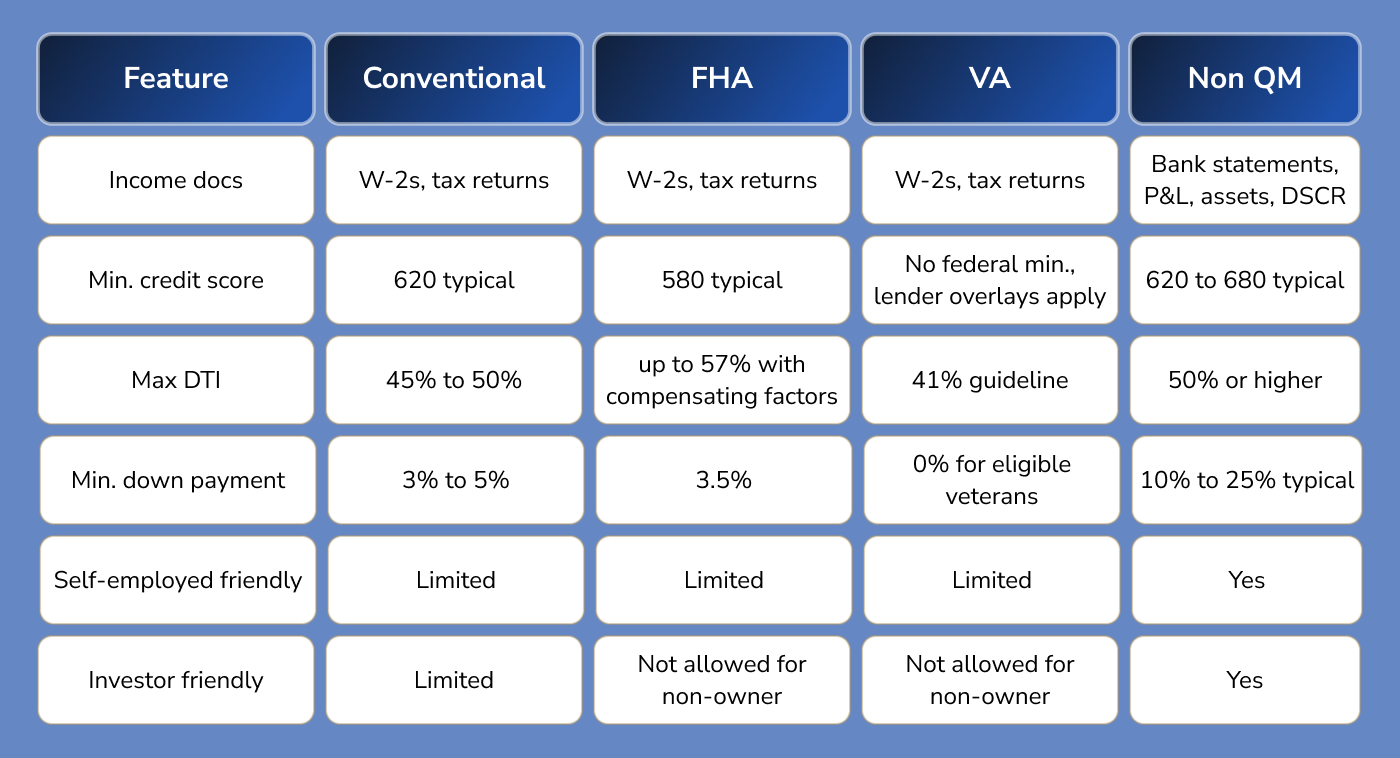
If you are a veteran in NH, a VA loan is almost always the better starting point. If you are a first-time buyer with limited down payment, an FHA loan may serve you well. Non QM enters the conversation when conventional rules don't accommodate your income or credit profile.
How to Apply for a Non QM Loan in New Hampshire
The application process mirrors a conventional mortgage, with a different documentation path.
Speak with a broker. Share your income structure, credit history, down payment, and target property. A broker can quickly identify which non QM lenders fit your profile.
Gather alternative documentation. Depending on the program, this could be 12 to 24 months of bank statements, recent 1099s, a CPA-prepared P&L, or asset statements.
Receive a pre-approval. A non QM pre-approval reviews credit, assets, and your alternative income docs.
Make an offer. With a pre-approval in hand, you can shop NH homes with confidence.
Submit the full application. Once you're under contract, the lender orders an appraisal and runs final underwriting.
Close. Non QM closings often take 21 to 35 days, similar to conventional timelines, although unique programs (foreign national, complex DSCR) can take slightly longer.
Working with a broker matters more on non QM than on conventional. Because each non QM lender writes its own rules, the right placement can mean a significantly better rate, lower down payment, or smoother underwriting. Speak with a NextGen broker to compare options across multiple non QM lenders.
How NextGen Mortgage Loans Can Help
NextGen Mortgage Loans is a New Hampshire licensed mortgage broker with access to multiple non QM lenders, conventional investors, and government loan programs. That broker model matters here, because non QM pricing and guidelines vary widely between lenders. We shop your file across our network so you don't end up paying more than you should or getting denied by the wrong fit.
Whether you're a self-employed Manchester homeowner refinancing, a Seacoast investor adding a rental, or a relocating professional whose tax returns understate your real income, we'll review your scenario at no cost and outline your options in plain English. Get pre-approved today, or estimate your payment to see what your numbers look like before you start shopping.
Frequently Asked Questions About Non QM Loans
Are non QM loans legal?
Yes. Non QM loans are fully legal and federally regulated. They are required to meet the CFPB's Ability-to-Repay rule, which means lenders must verify the borrower's capacity to repay the loan. The "non" in non-QM only refers to the Qualified Mortgage rule, not to legality.
What credit score do I need for a non QM loan?
Most non QM lenders look for a minimum credit score of 620 to 680, though some programs accept lower scores with larger down payments and reserves. Higher scores generally lead to better pricing and lower required down payments.
Are non QM loan rates higher than conventional rates?
In most cases, yes. Non QM rates typically run higher than comparable conventional, FHA, or VA rates because the lender takes on more flexibility risk. The exact spread varies by program, credit score, and down payment, so it's worth comparing offers across multiple non QM lenders.
Can I refinance from a non QM loan to a conventional loan later?
Often, yes. Many borrowers use a non QM loan as a bridge while they wait for a credit event waiting period to clear, season their self-employment income, or rebuild credit. Once you meet conventional guidelines, you can refinance into a lower-rate product if it makes financial sense.
Do non QM loans require private mortgage insurance?
Most non QM programs do not charge traditional PMI, because they typically require down payments of 10% or more. The cost of that flexibility is usually built into the rate or fees rather than a separate monthly PMI charge.
Can I use a non QM loan for a primary residence in New Hampshire?
Yes. Non QM programs are available for primary homes, second homes, and investment properties throughout New Hampshire, including single-family homes, condos, and small multifamily properties up to four units.
How long does it take to close a non QM loan?
Most non QM purchases close in 21 to 35 days, similar to conventional timelines. More complex programs, such as foreign national loans or jumbo non-QM with multiple properties, may take longer because of additional underwriting steps.

