
VA Loan Occupancy Requirements: What NH Veterans Need to Know
VA loan occupancy requirements mandate that you move into the home as your primary residence within 60 days of closing and continue to live there for the foreseeable future. The VA loan program exists to help veterans, active-duty servicemembers, and eligible surviving spouses buy a home to live in, not an investment property or vacation getaway. If you're a New Hampshire veteran weighing a VA loan, understanding these rules upfront protects your benefits, keeps you compliant with federal lending guidelines, and helps you plan around real-life situations like PCS orders, deployments, or future moves.
This guide breaks down what occupancy actually means under VA rules, how long you need to stay, the exceptions that apply to military families, and when you can legally rent out a VA-financed home.
What Are VA Loan Occupancy Requirements?
Quick answer: A VA loan occupancy requirement is the rule that the borrower must use the financed property as their primary residence, generally moving in within 60 days of closing.
The U.S. Department of Veterans Affairs guarantees VA loans on the condition that the home will be the borrower's primary residence. This is the foundation of the program and the reason VA loans offer benefits like no down payment, no private mortgage insurance, and competitive rates.
In practical terms, the occupancy rule has three pieces:
Move-in window: You must occupy the home within a reasonable time after closing, typically defined as 60 days.
Primary residence: The home must be where you actually live, not a second home, vacation property, or rental.
Continued occupancy: You're expected to keep the home as your primary residence for a sustained period, generally interpreted as at least 12 months unless an exception applies.
These rules apply to every VA purchase loan, including loans used to buy a single-family home, a condo on the VA-approved list, or a multi-unit property of up to four units.
How Long Do You Have to Live in a VA Loan Home?
Quick answer: In most cases, you must live in the home for at least 12 months before considering converting it to a rental or moving out without a qualifying exception.
The 60-day move-in expectation comes from VA Pamphlet 26-7, the lender's handbook used by underwriters. The 12-month continued occupancy expectation is the industry-standard interpretation that most VA lenders apply when evaluating loans.
There is some flexibility built in. The VA recognizes that life and military service do not always cooperate with strict timelines. If you cannot move in within 60 days, you may still satisfy the requirement by occupying the home within 12 months of closing, provided you can show:
A specific future date by which you'll move in
A particular event that will allow occupancy by that date (such as a retirement date, end of deployment, or completion of repairs)
Anything beyond 12 months is typically considered unreasonable by the VA and would require a strong justification approved by the lender.
The VA Loan Primary Residence Rule Explained
The VA loan primary residence rule is the legal certification you sign at closing stating that you intend to occupy the home as your principal dwelling. You sign this on the VA Loan Occupancy Certification, and it becomes part of the loan file.
A primary residence is the home where you:
Spend the majority of your time
Receive mail and use as your address for tax purposes
Register your vehicle
Vote from
List on your driver's license
You can only have one primary residence at a time. This is why you generally cannot use a VA loan to buy a second home or vacation property in another state, even if you plan to use it occasionally.
For New Hampshire buyers relocating from Massachusetts, a common scenario, the home must become your actual NH residence after closing. You cannot keep your MA home as your primary residence and use a VA loan to buy a NH property as a weekend home.
VA Loan Occupancy Exceptions
VA loan occupancy exceptions exist because military life is unpredictable. The VA recognizes several situations where the standard 60-day move-in rule bends or where a family member can satisfy occupancy on the borrower's behalf.
Spouse occupancy
If you are an active-duty servicemember and unable to personally occupy the home due to your duty station, your spouse can satisfy the occupancy requirement on your behalf. This is one of the most commonly used exceptions and is fully recognized by the VA. The spouse moves in within the standard timeframe, and the borrower is considered compliant.
Dependent child occupancy
In limited cases, a dependent child can satisfy occupancy through an attorney-in-fact arrangement, typically when a single-parent servicemember is deployed. This is harder to use and requires careful legal documentation, so it should be reviewed with a qualified VA loan officer and an attorney.
Deployment and PCS orders
Active-duty servicemembers who receive permanent change of station (PCS) orders or are deployed after closing can apply the spouse occupancy rule above. If there's no spouse, the VA will evaluate the situation case by case, and the lender may accept a delayed occupancy plan.
Retirement within 12 months
If you're retiring from active service within 12 months of closing, the VA permits delayed occupancy until your retirement date, provided you submit a copy of your retirement application and intent to occupy.
Property repairs delaying move-in
If the home requires repairs that prevent immediate occupancy, the VA may permit a delayed move-in tied to a documented completion date.
Refinances of a previously occupied home
For VA Interest Rate Reduction Refinance Loans (IRRRLs), the rule is different. You only need to certify that you previously occupied the home, not that you currently occupy it. This makes IRRRLs useful for veterans who have moved but still own the original VA-financed home.
Can You Rent a VA Loan Home?
Quick answer: You cannot buy a home with a VA loan intending to rent it out, but you may rent it out later after you've satisfied the occupancy requirement and your circumstances have legitimately changed.
This is one of the most misunderstood parts of the program. The VA does not permanently prohibit renting a VA-financed home. It prohibits buying with the intent to rent.
Renting after you've occupied
Once you've genuinely lived in the home as your primary residence and your situation changes (new job, PCS orders, growing family, retirement to a different region), you can typically convert the home into a rental. There is no formal "release" you need from the VA. You are simply expected to have honored the original occupancy commitment in good faith.
Common scenarios where this works cleanly:
You bought a home in Manchester, lived there for two years, then received PCS orders to another state.
You bought a starter home in Nashua, occupied it for several years, then moved up to a larger home and rented out the first one.
You retired from service, lived in the home for the required period, then relocated and decided to keep the original home as a rental.
Multi-unit properties (two to four units)
VA loans allow you to buy properties with up to four units. You must occupy one of the units as your primary residence, but the other units can be rented from day one. This is one of the most powerful and underused features of the VA program. In New Hampshire markets like Manchester, Nashua, Dover, and Portsmouth, two- to four-unit properties can be a legitimate path to building equity and rental income while still satisfying VA occupancy rules.
A NextGen loan officer can walk you through the math on a multi-unit purchase, including how the lender will count rental income toward your qualification.
VA Occupancy for Refinances: IRRRL and Cash-Out
Occupancy rules shift depending on which type of VA refinance you're using.
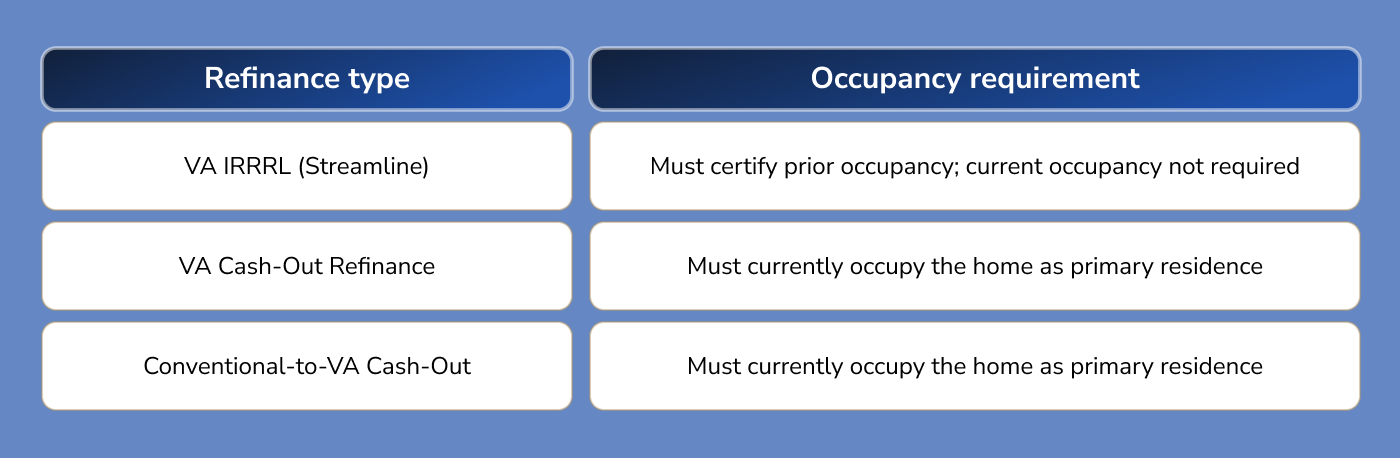
The IRRRL flexibility is intentional. It allows a veteran who moved due to military or job reasons, and now rents out the original VA-financed home, to still benefit from a lower rate without losing the VA guarantee. If you're considering a refinance and want to compare it against current options, our mortgage calculators are a useful starting point before you talk to a loan officer.
What Happens If You Violate VA Occupancy Rules?
Misrepresenting your intent to occupy is mortgage fraud. It is a serious federal offense with real consequences.
If a lender or the VA determines that a borrower never intended to occupy the home, the borrower can face:
Loan acceleration: The full balance becoming due immediately
Loss of VA loan benefits: Including future eligibility
Civil and criminal penalties: Under federal mortgage fraud statutes
Damaged credit: From foreclosure if the loan cannot be repaid
The Consumer Financial Protection Bureau (CFPB) treats occupancy misrepresentation as a clear-cut form of mortgage fraud, and lenders are required to report suspected cases.
The good news is that most occupancy issues are not fraud. They are life changes after the fact, and those are generally fine as long as the original intent was honest. If your situation changes after closing, document it and talk to your lender. There is almost always a legitimate path forward.
VA Occupancy Considerations for New Hampshire Buyers
New Hampshire is home to a meaningful veteran population, with proximity to Pease Air National Guard Base in Newington, the Portsmouth Naval Shipyard area, and the VA Medical Center in Manchester. VA loan use is common across Rockingham, Hillsborough, Strafford, and Merrimack counties.
A few NH-specific points worth knowing:
Loan limits: For veterans with full VA entitlement, there is no county-level loan limit on a VA loan, which matters in higher-priced southern NH markets.
Property taxes: New Hampshire has no income tax but high property taxes. When you run the numbers on whether you can comfortably keep a home and satisfy occupancy, factor in property tax escrow carefully.
Multi-unit opportunities: Older mill cities and commuter towns often have legitimate two- to four-unit inventory that fits the VA owner-occupied multi-unit strategy.
Cross-border buyers: If you're moving from Massachusetts and using a VA loan in NH, your NH property must become your actual primary residence after closing.
For a deeper look at how VA loan payments work in our market, take a look at our VA loan calculator and run a scenario before you begin house hunting.
How NextGen Mortgage Loans Can Help
VA loans look simple from the outside and become detailed quickly once you start working through occupancy timelines, exception documentation, and lender-specific overlays. As a New Hampshire mortgage broker, NextGen Mortgage Loans works with multiple lenders and can compare VA loan options across them to find the rate, fee structure, and underwriting approach that fits your situation. That broker access is meaningful when you're a veteran with a non-standard situation, such as pending PCS orders, a delayed move-in, or a multi-unit purchase.
Whether you're a first-time VA buyer in Manchester, a relocating servicemember coming to the Seacoast, or a veteran refinancing a home you no longer occupy, we'll walk through your options without pressure and at no cost. Contact a NextGen loan officer to start a no-obligation review of your VA loan options.
Frequently Asked Questions
How long do you have to live in a VA loan home before renting it out?
In most cases, you should live in the home for at least 12 months as your primary residence before converting it to a rental. The VA does not publish a hard 12-month rule, but lenders use this benchmark to evaluate whether your original occupancy intent was genuine.
Can my spouse satisfy the VA occupancy requirement if I'm deployed?
Yes. If you are an active-duty servicemember unable to occupy the home due to your duty station, your spouse can satisfy the occupancy requirement on your behalf. This is a long-established VA exception that most lenders are familiar with.
Can I use a VA loan to buy a vacation home or second home in New Hampshire?
No. The VA loan primary residence rule prohibits using a VA loan for second homes, vacation properties, or pure investment purchases. The home must be the place you actually live as your principal dwelling.
What if I have to move before 12 months due to job loss or PCS orders?
If your circumstances genuinely change after closing, such as a job loss, a job transfer, or new military orders, you generally are not in violation of VA rules. Document the change, communicate with your lender, and you can usually rent the home out or sell it without penalty.
Can I buy a duplex or four-unit property with a VA loan and rent the other units?
Yes. VA loans allow purchases of properties with up to four units, provided you occupy one unit as your primary residence. The other units can be rented from day one, and projected rental income may help you qualify, depending on the lender.
Does a VA IRRRL refinance require current occupancy?
No. A VA IRRRL only requires that you previously occupied the home. This makes the IRRRL useful for veterans who moved out of the original VA-financed home but still own and rent it.
What happens if the VA finds out I never moved in?
Misrepresenting occupancy is mortgage fraud and can trigger loan acceleration, loss of VA benefits, and civil or criminal penalties under federal law. If your situation changed after closing in good faith, this is different from fraud, and you should talk to your lender promptly to document the change.

