
Mortgage Underwriting Process: Step-by-Step NH Guide
The mortgage underwriting process is the formal review your lender conducts to verify you can repay the loan and that the property is worth what you are borrowing. For most New Hampshire buyers, underwriting takes between one and three weeks, depending on how clean your file is and how quickly you respond to document requests.
This guide walks you through every stage of the mortgage underwriting timeline, explains what underwriters look for, and clarifies the difference between conditional approval and clear to close. Whether you are buying your first home in Manchester, relocating from Massachusetts to the Seacoast, or refinancing in Concord, knowing what happens behind the scenes helps you avoid the most common delays.
What Is Mortgage Underwriting?
Quick answer: Mortgage underwriting is the process a lender uses to evaluate your creditworthiness, income, assets, and the property before approving your loan.
The underwriter is the person (or in some cases, an automated system) responsible for deciding whether your loan meets the guidelines of the program you are using, whether that is conventional, FHA, VA, USDA, or a state program through the New Hampshire Housing Finance Authority (NHHFA).
According to the Consumer Financial Protection Bureau, underwriting protects both you and the lender by ensuring the loan is sustainable and the collateral is valid. If the underwriter finds inconsistencies, missing documents, or red flags, they will issue conditions you must clear before final approval.
Underwriting happens after you have submitted a full mortgage application and the loan has been processed. It is the most thorough review in the entire mortgage transaction.
How Long Does Underwriting Take?
In most cases, mortgage underwriting takes between one and three weeks from the time the file is submitted to underwriting until the lender issues a clear to close. Some files move faster (as little as 48 to 72 hours for a clean conventional file), and others take longer when documentation is complex.
Factors that influence the underwriting timeline:
Loan type: FHA and VA loans often require additional reviews compared with conventional loans.
Borrower complexity: Self-employed borrowers, commission earners, and buyers with multiple income sources require deeper review.
Property type: Condos, multi-family homes, and properties with unique features take longer to evaluate.
Appraisal turn time: In parts of NH, appraisal availability has tightened, which can extend the timeline by a week or more.
How quickly you respond: The single biggest variable. Conditions you clear in 24 hours move you forward. Conditions that sit for a week stall everything.
If your purchase contract has a 30 day or 45 day close, work backward from that date with your loan officer to confirm the underwriting milestones are realistic.
What Do Underwriters Look For?
Underwriters evaluate four core areas, often called the Four Cs of underwriting: credit, capacity, capital, and collateral.
Credit
Your credit score and credit history tell the underwriter how reliably you have repaid past obligations. They review:
Mid-FICO score (the middle of your three bureau scores)
Payment history on revolving and installment debt
Recent credit inquiries
Collections, charge-offs, bankruptcies, and foreclosures
Credit utilization
Each loan program has minimum credit thresholds. Conventional loans typically require a 620 minimum, FHA programs go lower, and VA does not set a federal minimum (though most lenders impose their own overlays).
Capacity
Capacity is your ability to repay. Underwriters calculate your debt-to-income ratio (DTI) by comparing your monthly debt payments (including the new mortgage) against your gross monthly income. Most programs cap DTI between 43% and 50%, with exceptions for strong compensating factors.
For NH buyers, property taxes weigh heavily here. New Hampshire has some of the highest effective property tax rates in the country, which inflates your monthly housing payment and can compress how much home you qualify for. A house in Derry with $9,000 in annual taxes hits your DTI harder than the same priced home in a low-tax state.
Capital
Capital refers to your assets: down payment funds, closing costs, and reserves. Underwriters verify:
Bank statements (typically the most recent two months)
Source of large deposits (anything outside regular payroll)
Gift funds with proper documentation
Retirement and investment accounts for reserve requirements
Any deposit that cannot be sourced will be excluded from your qualifying funds, so avoid moving money around in the 60 to 90 days before close.
Collateral
Collateral is the property itself. The lender orders an appraisal to confirm the home is worth at least the purchase price and that it meets program guidelines. For FHA and VA loans, the appraisal also includes a property condition review with stricter standards on roof, mechanicals, and safety items.
If the appraisal comes in low, the underwriter cannot approve the loan at the original amount. You will need to renegotiate price, bring more cash, or dispute the appraisal.
The Mortgage Underwriting Timeline: Step by Step
Here is what the mortgage underwriting timeline typically looks like from contract to close.
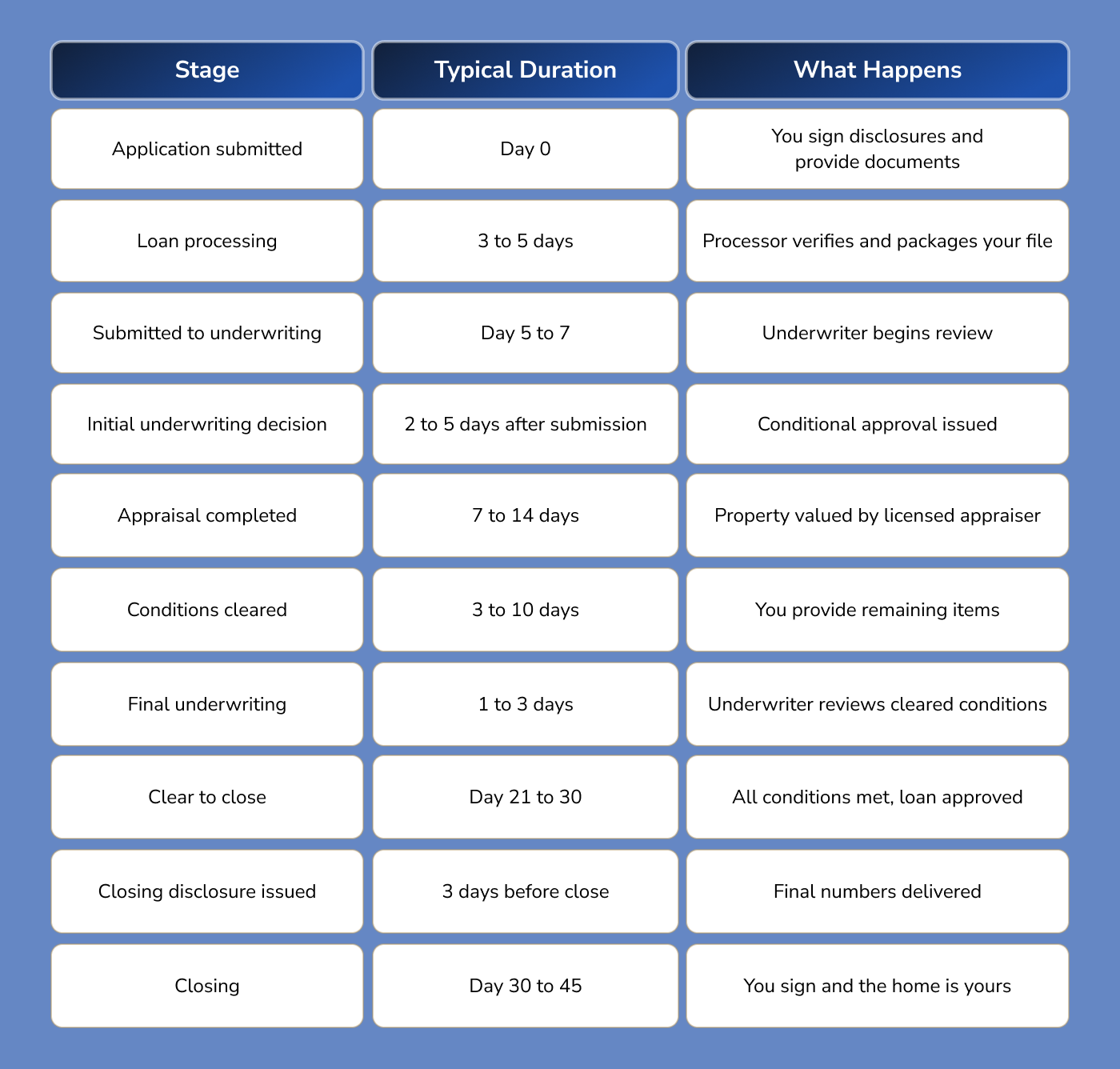
Every file is different, but this gives you a realistic frame. Before your application even reaches underwriting, having your documents organized makes a significant difference.
Conditional Approval vs Clear to Close: What's the Difference?
This is one of the most misunderstood parts of the underwriting process, so it is worth slowing down on.
Conditional approval
A conditional approval means the underwriter has reviewed your file and is willing to approve the loan, subject to specific conditions being met. Common conditions include:
Updated bank statements
A letter of explanation for a job change or large deposit
Proof of homeowners insurance
Final paystubs covering the most recent pay period
Title commitment review
Appraisal review
You are not done yet. You are conditionally approved. Most loans hit this stage first.
Clear to close
Clear to close (CTC) means every condition has been satisfied, the underwriter has signed off, and the lender is ready to fund the loan at closing. Once you have CTC, your closing disclosure is issued and the three day waiting period required by federal law begins.
In short:
Conditional approval = "We will approve, if you give us X, Y, Z"
Clear to close = "Everything is approved, let's set the closing date"
Knowing where you are in this sequence helps you push the right thing at the right time. If you are conditionally approved with five outstanding items, focus on clearing those, not on calling the title company.
Common Reasons for Underwriting Delays
Even well-prepared buyers run into snags. Here are the issues that most often slow the mortgage underwriting timeline.
Large unexplained deposits. Any deposit outside your normal payroll triggers a sourcing request. Document everything.
Job changes during underwriting. Changing employers, switching from W-2 to 1099, or taking unpaid leave mid-process can require a full re-review.
New credit inquiries or new debt. Financing furniture, a car, or a credit card during underwriting can change your DTI and trigger a re-underwrite.
Appraisal issues. Low appraisals, required repairs (especially common with FHA and VA), or appraiser delays.
Incomplete tax returns. Self-employed borrowers often need two years of personal and business returns plus a year-to-date profit and loss statement.
Title issues. Liens, easements, or unresolved estate matters on the property.
Insurance shortfalls. Homes near coastal NH may need flood insurance or specialty coverage that takes time to bind.
A NextGen loan officer can flag most of these before they become problems by reviewing your full picture during pre-approval rather than at submission.
How to Speed Up Your Underwriting in New Hampshire
NH has a few quirks that affect underwriting timelines. High property taxes, older housing stock (especially in the Lakes Region and North Country), and condo concentration in seacoast towns can all add review time. Here is how to stay ahead.
Get fully pre-approved, not just pre-qualified. A real pre-approval means your income, assets, and credit have already been reviewed, which compresses the underwriting timeline.
Send documents in PDF, not photos. Underwriters reject blurry phone shots and request clean copies, which costs you days.
Respond to conditions within 24 hours. Speed compounds. Every condition you clear quickly keeps your file at the top of the underwriter's queue.
Do not change anything financial. No new credit, no new debt, no large transfers, no job changes. Do not even buy a refrigerator on financing until after closing.
Use a local broker. Brokers like NextGen work with multiple lenders, which means we can match your file to the underwriting team most likely to approve cleanly. We also know which NH towns flag specific underwriting concerns (private wells, septic, abutting commercial use, condo project warrantability).
For a clearer picture of what your monthly payment will look like once you close, our mortgage calculators let you model property taxes, insurance, and PMI based on real NH numbers.
How NextGen Mortgage Loans Can Help
The mortgage underwriting process is where most loans either close on time or fall apart. As a New Hampshire mortgage broker, NextGen Mortgage Loans works with multiple wholesale lenders, which means we can shop your file to the underwriting team that fits your situation best, whether you are a first-time buyer using NHHFA assistance, a self-employed borrower with non-traditional income, a veteran using your VA benefit, or a buyer relocating from out of state.
Going to a single bank locks you into one underwriting box. Working with a broker gives you multiple options and a better shot at competitive rates and a smooth approval. We offer no-cost consultations, fast pre-approvals, and end-to-end guidance from application to clear to close.
Frequently Asked Questions
How long does mortgage underwriting take in New Hampshire?
Most NH mortgage files complete underwriting in one to three weeks, with the full timeline from contract to close running 30 to 45 days. Complex files (self-employed, multi-property, unusual income) can take longer, while clean conventional files sometimes clear in under two weeks.
What is the difference between conditional approval and clear to close?
Conditional approval means the underwriter will approve your loan once you satisfy specific outstanding items. Clear to close means all conditions have been met and the lender is ready to fund at closing. Conditional approval comes first, clear to close comes last.
Can my loan be denied after conditional approval?
Yes, though it is uncommon if you do not change anything material. Loans are most often denied after conditional approval because the borrower took on new debt, missed a payment, changed jobs, or could not document a required condition. Keep your finances static through closing.
What hurts your chances during underwriting?
The most common red flags are large unexplained deposits, new credit inquiries, recent late payments, gaps in employment, and undocumented income sources. Underwriters also flag inconsistencies between your application and your bank statements, tax returns, or paystubs.
Do underwriters look at your bank statements?
Yes. Underwriters review at least the most recent two months of statements for every account you list on your application. They evaluate balances, the source of large deposits, and any patterns that suggest undisclosed debts or income.
Will underwriting check my credit again before closing?
Many lenders pull a soft credit refresh shortly before closing to confirm nothing has changed. New accounts, increased balances, or missed payments can trigger a re-underwrite and, in some cases, a loan denial.
What should I avoid doing during underwriting?
Do not apply for new credit, finance large purchases, change jobs, deposit unexplained cash, transfer large sums between accounts, or co-sign loans for others. Keep your financial life boring until you have the keys.

