
Mortgage Escrow Account Explained: A Guide for NH Buyers
A mortgage escrow account is a separate account your loan servicer uses to collect and pay your property taxes and homeowners insurance on your behalf. You pay into it monthly as part of your mortgage payment, and the servicer pays those bills when they come due. For New Hampshire homeowners, this matters more than in most states because NH carries one of the highest property tax burdens in the country.
This guide walks through how escrow works, when it is required, how shortages happen, and what to expect from the annual escrow analysis your servicer is legally required to provide.
What Is Escrow on a Mortgage?
Quick answer: Escrow on a mortgage is a holding account managed by your loan servicer that collects portions of your annual property taxes and homeowners insurance each month, then pays those bills on your behalf when they come due.
When you make your monthly mortgage payment, only part of it goes toward your loan. A typical payment includes four pieces, often called PITI:
Principal (the loan balance)
Interest
Taxes (property taxes)
Insurance (homeowners insurance, plus mortgage insurance if applicable)
The taxes and insurance portion does not go to your lender. It sits in your escrow account until the bill is due. The Consumer Financial Protection Bureau (CFPB) sets the rules for how servicers manage these accounts under the Real Estate Settlement Procedures Act (RESPA).
What Does a Mortgage Escrow Account Cover?
A typical mortgage escrow account covers:
Property taxes paid to your town or city
Homeowners insurance premiums
Flood insurance premiums (if your home is in a designated flood zone)
Private mortgage insurance (PMI) on conventional loans with less than 20% down, in some servicer setups
FHA mortgage insurance premiums (MIP) on FHA loans
It does not typically cover:
HOA or condo association dues
Utility bills
Personal property insurance
Optional warranties or service contracts
If you live in a condo in Manchester or Portsmouth, your HOA fee is separate. You pay that directly to the association.
Who Requires a Mortgage Escrow Account?
Whether you must have an escrow account depends on your loan type and how much you put down.
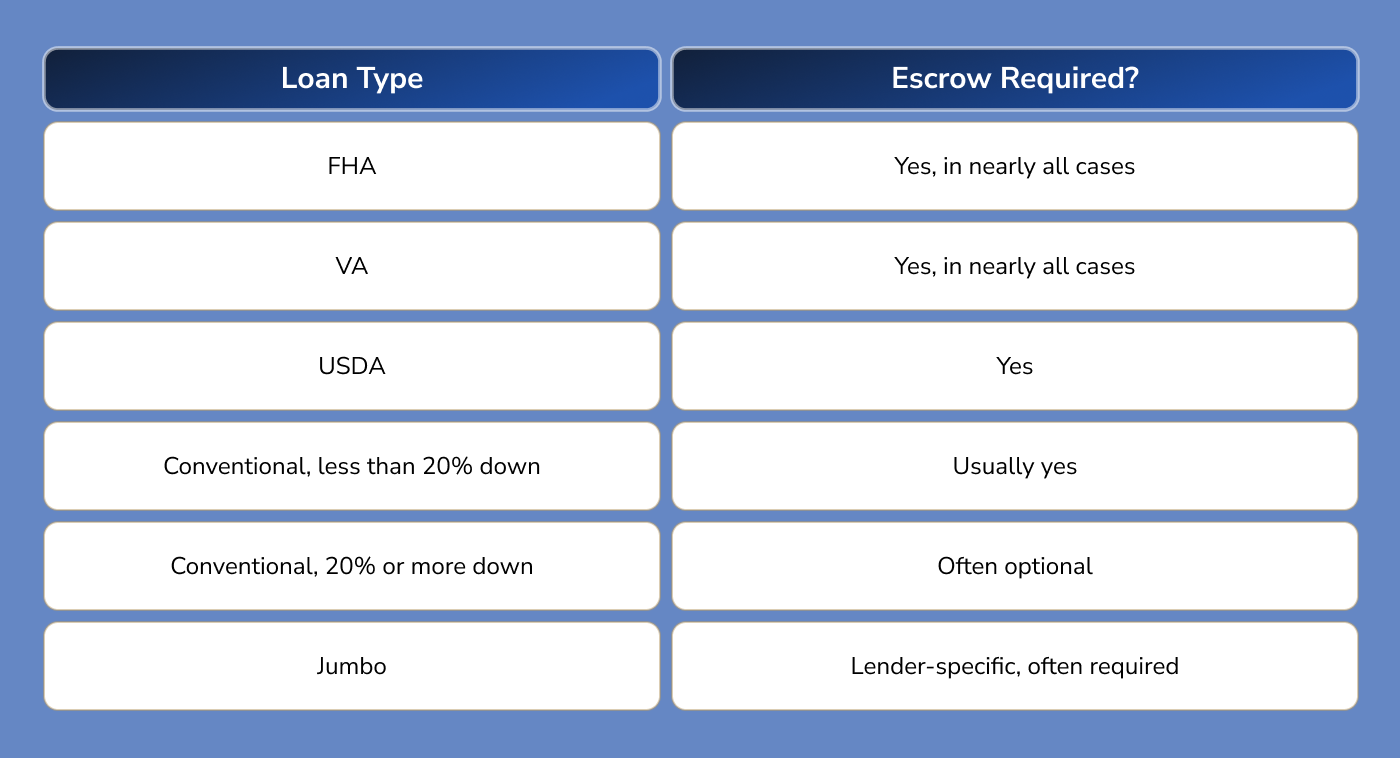
Government-backed loans (FHA, VA, USDA) almost always require escrow accounts. This is set by the agencies that insure or guarantee these loans (HUD for FHA, the Department of Veterans Affairs for VA, and USDA Rural Development).
Conventional loans (those backed by Fannie Mae or Freddie Mac) follow a different rule. If your loan-to-value ratio is above 80%, most lenders require escrow. Once you reach 20% equity, you may be able to request an escrow waiver, though some lenders charge a small rate adjustment for waiving.
If you are weighing loan types, a NextGen loan officer can walk through which programs fit your down payment and credit profile.
How Are Mortgage Escrow Payments Calculated?
Your servicer calculates your monthly escrow payment by adding up your projected annual tax and insurance bills, dividing by 12, and adding a cushion.
Here is the breakdown:
Estimate annual property taxes. For a new purchase, this is based on the seller's most recent tax bill or the assessed value times the local mill rate.
Estimate annual insurance premiums. Your homeowners insurance quote sets this number. Flood and PMI are added if applicable.
Add a cushion. Federal law (RESPA) lets servicers hold up to two months of escrow payments as a cushion against shortfalls.
Divide by 12. That number is added to your monthly principal and interest.
For a NH home with $8,000 in annual property taxes and $1,500 in homeowners insurance, the monthly escrow portion would be roughly $792 ($9,500 divided by 12), plus the cushion buffer.
Why Mortgage Escrow Matters Especially in New Hampshire
NH has no broad-based income or sales tax, which shifts more of the state's revenue burden onto property taxes. According to the New Hampshire Department of Revenue Administration, local property taxes fund the bulk of municipal and school district budgets across the state.
The Tax Foundation consistently ranks New Hampshire among the highest states for effective property tax rate. For a homeowner in towns like Claremont, Berlin, or parts of Hillsborough County, an annual property tax bill of $8,000 to $12,000 on a moderately priced home is not unusual.
This has two practical effects on your mortgage:
Your escrow payment is a larger share of your total monthly housing cost than it would be in a low-tax state.
An escrow shortage hurts more. When taxes go up (and in NH they often do, year over year), your monthly payment can jump meaningfully.
That makes understanding your escrow analysis critical, not optional.
What Is an Annual Escrow Analysis?
Quick answer: An annual escrow analysis is a yearly review your servicer is legally required to perform that compares what you paid into escrow against what was paid out, then adjusts your monthly payment for the year ahead.
Once a year, your servicer mails you an escrow analysis statement. It shows:
The opening balance of your escrow account
Every deposit you made
Every payment the servicer made (taxes, insurance, etc.)
The current balance
Projected disbursements for the next 12 months
Whether you have a shortage, surplus, or are on target
Your new monthly payment, if it changed
Read this document carefully. If your tax bill jumped, your monthly payment will rise to cover it. The CFPB requires servicers to send this statement at least once a year, and you can request one anytime.
What Causes a Mortgage Escrow Shortage?
A mortgage escrow shortage happens when the money paid out of your escrow account exceeds what you paid in over the analysis period. Common causes include:
Property tax increase. The most frequent cause in NH. Towns reassess and mill rates rise.
Homeowners insurance premium increase. Premiums have climbed in recent years across most of New England due to weather-related claims.
Underestimated initial escrow. New construction or recent purchases sometimes start with tax estimates that turn out to be low once the home is fully assessed.
Missed adjustment after a rate change. If insurance or PMI was reset mid-year, the servicer may not have caught up.
When you have a shortage, your servicer typically gives you two options:
Pay the shortage in a lump sum. This keeps your monthly payment lower going forward.
Spread the shortage across 12 months. Your monthly payment rises to cover both the shortage and the higher projected costs.
Most homeowners spread it. Just know that your monthly payment can rise by $100, $200, or more in a year where taxes and insurance both climb.
What Happens with an Escrow Surplus?
If you paid more into escrow than was needed, you have a surplus.
Federal RESPA rules say:
If the surplus is $50 or more, the servicer must send you a refund check (typically within 30 days of the analysis).
If the surplus is less than $50, the servicer can apply it to next year's escrow.
A surplus is generally a sign that your tax or insurance estimate was too high last year. Your monthly payment may go down slightly going forward.
Pros and Cons of a Mortgage Escrow Account
Pros
Forced budgeting. You never face a $10,000 tax bill all at once.
Lower risk of late payments that could trigger tax liens or insurance lapses.
Often required anyway if you put less than 20% down.
Some lenders offer slightly better pricing when you keep escrow rather than waive it.
Cons
You lose interest on money sitting in the escrow account (most servicers do not pay interest, though a few states require it).
Less control. You cannot time payments yourself or negotiate directly with your tax collector.
Servicer errors happen. Missed payments, miscalculations, and shortage surprises do occur, which is why reviewing your annual statement matters.
Payment volatility. Even with a fixed-rate mortgage, your total monthly payment can rise or fall each year as taxes and insurance change.
Can You Cancel a Mortgage Escrow Account?
Sometimes. The rules depend on your loan type and equity position.
Conventional loans: Once you reach 20% equity, many lenders allow you to cancel escrow. Some charge a small fee or rate adjustment.
FHA loans: Generally cannot cancel escrow.
VA loans: Cancellation is possible in some cases but rare.
USDA loans: Cannot cancel.
If you are confident you can manage large annual tax and insurance bills without a forced savings mechanism, canceling can free up cash flow. If you are not, keep it. A missed property tax payment in NH can trigger interest, penalties, and eventually a tax-deeded property process by the municipality.
Speak with a NextGen broker to compare options across multiple lenders if escrow flexibility matters to you.
How NextGen Mortgage Loans Can Help
NextGen Mortgage Loans is a New Hampshire-based broker, not a single bank. That means we shop your loan across multiple lenders to find the rate, structure, and escrow terms that fit your situation, whether you are buying your first home in Nashua, refinancing in Concord, or relocating from Massachusetts to the Lakes Region.
Our team can:
Walk you through how your monthly payment will be structured, including escrow
Compare loans with and without escrow waivers
Help you understand your annual escrow analysis if you already own
Get you pre-approved quickly, often within one business day
Ready to see what your real monthly payment would look like? Try our mortgage calculators or contact us for a no-cost consultation.
Frequently Asked Questions About Mortgage Escrow Accounts
Is a mortgage escrow account the same as earnest money?
No. Earnest money is a deposit you make when you sign a purchase agreement, held in escrow during the transaction by a title company or attorney. A mortgage escrow account is a long-term account managed by your loan servicer for taxes and insurance after closing.
Can my mortgage escrow payment change every year?
Yes. Your principal and interest stay fixed (on a fixed-rate loan), but your escrow portion is recalculated each year based on actual tax and insurance costs. In NH, this often means small annual increases as towns reassess.
Do I get my escrow money back when I sell or refinance?
Yes. When you pay off your loan through a sale or refinance, your servicer is required to refund any remaining escrow balance, usually within 20 business days of payoff. Confirm the refund mailing address with your servicer before closing.
Is mortgage escrow tax deductible?
The escrow payment itself is not deductible. However, the property taxes and (in some cases) mortgage insurance paid out of escrow may be deductible on your federal return, subject to limits like the SALT cap. Consult a tax professional for advice specific to your situation.
What happens if my escrow account does not have enough to pay my tax bill?
Your servicer is generally required to advance the funds and pay the bill on time, then collect the shortage from you over the following 12 months (or in a lump sum, your choice). Your home will not be exposed to a tax lien because of a servicer-side shortage.
Can I make extra escrow payments?
Yes. You can send additional funds toward escrow at any time, which can soften the impact of an upcoming shortage. Note that extra escrow payments are different from extra principal payments. Be clear with your servicer in writing about which one you intend.
How do I dispute an escrow analysis I think is wrong?
Send a written Notice of Error to your servicer (the address is usually on your statement, separate from the payment address). Under RESPA, the servicer has 30 business days to investigate and respond. Keep copies of your tax bills and insurance declarations to support your case.

