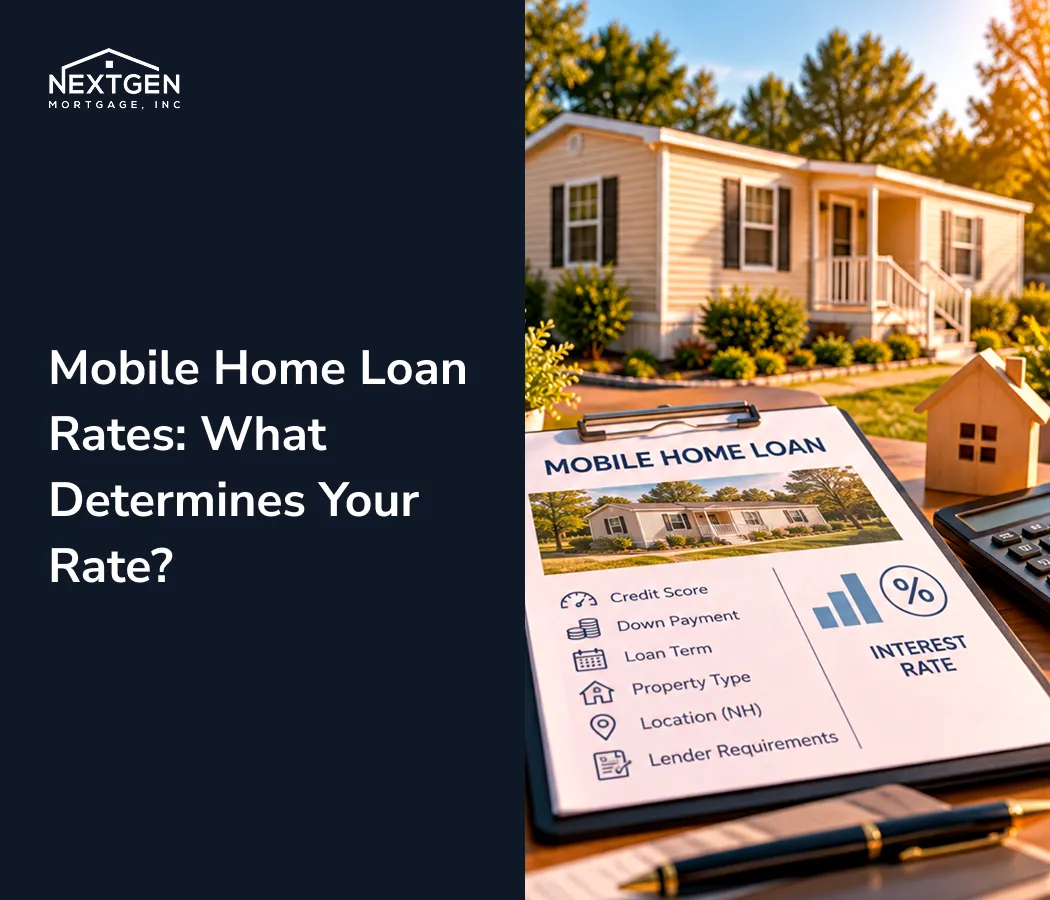
Mobile Home Loan Rates: What Determines Your Rate?
Mobile home loan rates depend on more than your credit score. The biggest factor may be how the home itself is financed.
A manufactured home that is permanently attached to qualifying land and treated as real property may be eligible for conventional or government-backed mortgage financing. A home located on leased land or financed separately from the land may instead require home-only or chattel financing. Those are different loan structures with different pricing.
Your credit, down payment, loan amount, term and current market conditions still matter, but they are only part of the picture. Understanding the property first can help you compare mobile home loan rates more accurately and avoid applying for a loan that does not fit the home you want to buy.
What Are Mobile Home Loan Rates in 2026?
There is no single national mobile home loan rate.
Rates vary substantially depending on whether the transaction is structured as a real-estate mortgage or a personal-property loan, along with the borrower’s qualifications and the property itself.
For context, Freddie Mac reported that the average U.S. 30-year fixed-rate mortgage was 7.28% as of October 1, 2026. That number tracks the broader mortgage market and should not be treated as the rate you will necessarily receive on a manufactured home.
Manufactured-home loans may price differently.
The Consumer Financial Protection Bureau has found an especially important distinction between manufactured-home mortgages and chattel loans. A chattel loan is secured by the manufactured home but not the underlying land, and CFPB research found that these borrowers generally paid higher interest rates than borrowers using mortgages secured by manufactured homes and real estate.
That means asking “What are mobile home loan rates today?” is only the beginning.
A better first question is:
How will this particular home be classified and financed?
Why Can Mobile Home Loan Rates Be Different From Regular Mortgage Rates?
Manufactured-home financing can fall into two fundamentally different categories.
A real-property mortgage is generally secured by both the manufactured home and the borrower’s interest in the land. A chattel or home-only loan is generally secured by the home itself rather than the underlying real estate.
CFPB research has found that chattel loans tend to carry higher interest rates and fewer of the protections associated with traditional mortgage financing.
The difference means two borrowers with similar incomes and credit scores could receive very different financing simply because one home sits on owned land and qualifies as real estate while the other sits on a leased lot.
This is why comparing a chattel quote directly with a conventional 30-year mortgage rate can be misleading. They are not necessarily equivalent products.
The 8 Factors That Can Affect Your Mobile Home Loan Rate
1. Whether You Need a Mortgage or a Chattel Loan
This is often the most important factor.
Fannie Mae's standard manufactured-housing mortgage requirements generally require the loan to be secured by both the manufactured home and the borrower’s interest in the land, with both legally classified as real property.
Freddie Mac likewise requires qualifying manufactured homes under its standard program to be permanently affixed and titled as real property.
A home that cannot meet real-property mortgage requirements may instead require specialty home-only financing.
Before comparing rates, determine which category applies.
2. Whether You Own the Land
Land ownership can dramatically change your financing options.
If you own the land, or are purchasing the home and land together, it may be possible to structure the transaction as a real-property mortgage if the home meets the applicable program requirements.
If you rent the lot inside a manufactured-home community, financing may follow a different path.
That does not automatically mean the home cannot be financed. It means you should compare programs designed specifically for that ownership structure.
In New Hampshire, this is particularly relevant because manufactured homes can be located on privately owned land as well as in resident-owned communities and other manufactured-home communities.
3. The Home's Age and HUD Status
The term “mobile home” is commonly used for many factory-built homes, but lenders make an important distinction.
HUD explains that manufactured homes constructed after June 15, 1976 must comply with the federal Manufactured Home Construction and Safety Standards and carry manufacturer certification showing compliance with the HUD Code.
Factory-built homes from before that date are commonly referred to as mobile homes rather than HUD-code manufactured homes.
Why does that matter?
Many standard mortgage programs require HUD-code manufactured housing. Older homes can therefore have fewer financing options and may need a specialty loan rather than conventional agency financing.
The home's age does not simply affect its value. It can determine which loan programs are available at all.
4. Foundation and Property Classification
A permanent foundation may open financing options that are unavailable to a home that remains personal property.
Freddie Mac requires qualifying manufactured homes under its standard mortgage program to be permanently affixed to a foundation and legally treated as real property.
Fannie Mae similarly requires qualifying manufactured-home mortgages to be secured by the home and the land as real property.
That is why buyers should investigate the foundation, title and land arrangement before relying on a quoted rate.
A rate is useful only if the home actually qualifies for the program behind that rate.
5. Your Credit Profile
Once the appropriate loan structure is established, your credit becomes one of the main borrower-specific pricing factors.
The CFPB states that higher credit scores generally make borrowers eligible for lower mortgage interest rates, while lenders may also evaluate credit history, existing debts, savings, income and assets.
The important distinction for manufactured-home buyers is that excellent credit does not necessarily turn a chattel loan into a conventional mortgage.
Improving your credit can strengthen the pricing available within the financing category your property qualifies for, but the property still has to meet the requirements of the underlying loan program.
6. Your Down Payment and Loan-to-Value Ratio
A larger down payment reduces how much of the purchase price the lender must finance.
CFPB guidance notes that, in general, larger down payments can result in lower interest rates because lenders have less exposure relative to the property's value.
For a manufactured-home buyer, the down payment can affect:
the amount financed;
the lender's risk;
available loan programs;
mortgage insurance or similar financing costs;
and potentially the rate offered.
Do not automatically put every available dollar into the down payment, however. Compare the rate improvement with the need to retain money for closing expenses, repairs, moving costs and reserves.
7. Your Loan Amount and Loan Term
The amount financed and repayment period can also affect pricing.
A shorter term often comes with a lower rate but a higher monthly payment. A longer term can reduce the monthly principal-and-interest payment while increasing the amount of interest paid over time.
Manufactured-home financing makes this particularly important because available terms can vary between standard mortgages and home-only financing.
Compare the complete combination of:
rate + term + amount financed + fees
rather than choosing based on the lowest advertised rate.
8. Market Conditions, Lender Pricing, Points and Your Rate Lock
Even two otherwise identical borrowers may receive different quotes from different lenders.
Rates change as broader financial markets move, and lenders apply their own pricing and program requirements.
You may also be offered the option to pay discount points. CFPB explains that one point equals 1% of the loan amount and that paying points generally provides a lower rate with that lender, while lender credits work in the opposite direction: less money upfront in exchange for a higher rate.
Rate-lock length can matter as well. CFPB notes that a locked rate can still be affected by material changes to the loan application, such as the loan amount, credit score, income, appraisal or down payment.
Chattel Loan vs. Mortgage: Why the Difference Matters
A chattel loan finances the manufactured home as personal property rather than financing the home and land together as real estate.
That structure can be useful when a traditional real-property mortgage is not available, including some homes located on leased land.
But borrowers should understand the cost difference.
CFPB research found that manufactured-home chattel borrowers generally face higher interest rates than manufactured-home mortgage borrowers.
Factor | Home-Only / Chattel Financing | Real-Property Mortgage |
Primary collateral | Manufactured home | Home plus qualifying real estate |
Land ownership | Often not required | Typically important |
Title | Often personal property | Real property |
Rate structure | Frequently higher | Often closer to mortgage pricing |
Available term | Varies by lender | May extend to traditional mortgage terms |
Property requirements | Specialty lender rules | Agency/program requirements |
Best use case | Parks, leased land or homes outside agency rules | Qualifying home permanently associated with owned real estate |
Neither category is automatically the correct answer for every buyer.
The goal is to identify the loan that actually fits the property and then compare pricing within that category.
If you're not sure which category applies, reviewing the property before submitting multiple applications may save time and unnecessary credit inquiries.
Does Owning the Land Help You Get a Lower Mobile Home Loan Rate?
Owning the land can help because it may make real-property mortgage financing available, assuming the manufactured home also meets the applicable title, foundation and program requirements.
Fannie Mae requires both the manufactured home and the borrower's interest in the land to secure eligible standard manufactured-home mortgages.
Freddie Mac also allows certain land equity to count toward the borrower's equity contribution when the borrower owns the land where the home will be permanently attached, subject to program requirements.
However, owning the land does not guarantee a particular rate.
The lender still needs to evaluate the home itself, title status, foundation, appraisal, loan program and borrower qualifications.
Think of land ownership as something that may open another financing path, not as an automatic interest-rate discount.
How Much Can a Rate Difference Change Your Payment?
Even a modest difference in interest rate can materially change the payment on a long-term loan.
Consider an illustrative $120,000 loan amortized over 20 years:
Interest Rate | Approx. Monthly Principal & Interest |
9% | $1,080 |
10% | $1,158 |
11% | $1,239 |
Moving from 9% to 11% adds roughly $159 per month in principal and interest in this example.
This is only an illustration. It does not include taxes, insurance, lot rent, closing costs, financing fees or other charges, and it is not a rate quote.
That is also why the loan term matters.
A longer repayment term could produce a lower monthly payment even at a higher rate, while potentially costing more in total interest over the life of the loan.
Use NextGen's mobile home loan calculator to compare different rates, down payments and terms before evaluating an actual loan offer.
Mobile Home Loan Rates in New Hampshire
New Hampshire buyers should pay particular attention to the land underneath the home.
A manufactured home may be located:
on land you own;
on land you are purchasing with the home;
in a privately owned manufactured-home community;
or in a resident-owned community, commonly called a ROC.
The financing path may differ between those situations.
The New Hampshire Community Loan Fund, for example, offers its own long-term fixed-rate manufactured-home financing for eligible homes located in New Hampshire resident-owned communities or on land the homeowner owns or is purchasing.
This makes New Hampshire different from markets where buyers may have fewer established financing channels for community-based manufactured housing.
For buyers comparing a property in Nashua, Manchester, Concord, the Seacoast or elsewhere in New Hampshire, the practical question should therefore be:
What financing does this specific property qualify for?
Only after answering that question should you compare rates.
How Can You Improve Your Mobile Home Loan Rate?
You cannot control the broader rate market, but several parts of your application are within your control.
Start by determining whether the property qualifies for real-property mortgage financing. A better borrower profile does not help much if you are comparing the wrong loan type.
Then review your credit reports and scores well before applying. CFPB recommends checking for errors because inaccurate information can lower your score and potentially increase the rate you are offered.
If possible, also evaluate whether a larger down payment meaningfully changes pricing. Do not assume it will. Ask the broker or lender to price more than one scenario.
For example:
Option A: 10% down
Option B: 15% down
Option C: 20% down
Compare not just the interest rate but also cash required at closing, monthly payment, APR and total financing cost.
Finally, avoid opening unnecessary new credit shortly before applying. A change in your credit profile can affect qualification or pricing, and CFPB notes that changes to credit can even affect some loans after a rate has been locked.
How Should You Compare Mobile Home Loan Offers?
Do not compare mobile home loans using the interest rate alone.
The interest rate tells you the annual cost of borrowing the principal. APR is broader.
CFPB defines APR as a measure that includes the interest rate plus certain other charges such as points, broker fees and other loan costs.
When comparing two offers, look at:
Compare | Why It Matters |
Interest rate | Determines interest charged on the principal |
APR | Helps reflect certain additional financing costs |
Loan term | Changes monthly payment and total interest |
Down payment | Changes cash required and amount financed |
Points | May trade higher upfront cost for a lower rate |
Lender credits | May reduce upfront cost in exchange for a higher rate |
Fixed vs. adjustable rate | Determines whether the rate can change |
Prepayment terms | Affects flexibility if you refinance or pay early |
Total monthly housing cost | May include insurance, taxes and lot rent in addition to the loan |
CFPB recommends comparing Loan Estimates rather than focusing only on the advertised rate and notes that fees, points, mortgage insurance and closing costs can materially affect the total cost of a mortgage.
For manufactured-home financing that does not use the same mortgage disclosures, request the equivalent written breakdown of the rate, APR, term, payment, fees and prepayment conditions before committing.
What Should You Do Before Choosing a Mobile Home Loan?
Start with the property, not the rate advertisement.
Confirm the home's year, HUD status, foundation, title, land ownership and community structure. Those facts can determine whether you are comparing standard mortgage programs or specialty home-only financing.
Next, review your credit and available down payment.
Then compare multiple scenarios using the same loan amount and term so the quotes are actually comparable.
If you are buying a manufactured or mobile home in New Hampshire, NextGen Mortgage Loans can review the property and borrower scenario across the financing programs available through its lender network. NextGen is a mortgage broker rather than the direct lender funding the mortgage, so actual rates, approval, terms and program eligibility depend on the lender, property, borrower qualifications, market conditions and underwriting.
Before requesting a quote, you can also use the mobile home loan calculator to see how different rates, terms and down payments could change your estimated monthly payment.
What is a good interest rate for a mobile home loan?
There is no universal “good” mobile home loan rate because chattel loans and real-property mortgages are different products. The appropriate comparison depends on your home, land ownership, credit, down payment, term and loan structure. Compare several equivalent offers rather than comparing your quote with a generic national mortgage average.
Why are mobile home loan rates sometimes higher than regular mortgage rates?
Mobile home rates can be higher when the home is financed as personal property rather than as real estate. CFPB research has found that manufactured-home borrowers using chattel loans generally pay higher interest rates than those using manufactured-home mortgages.
What credit score do you need for a mobile home loan?
There is no single credit-score requirement for every mobile home loan. Requirements vary by lender and loan program. A stronger credit profile generally improves your chances of receiving more favorable pricing, but the property's title, foundation, age and land arrangement can determine which programs are available in the first place.
Can you get a 30-year loan on a manufactured home?
Yes, some qualifying manufactured homes can receive traditional long-term mortgage financing. Fannie Mae and Freddie Mac both support mortgages secured by qualifying manufactured homes, although property, title, land and underwriting requirements apply.
Does owning the land lower your mobile home loan rate?
Owning the land does not automatically lower your rate, but it can make additional mortgage programs available when the home is permanently affixed and treated as real property. Having access to real-property mortgage financing may produce different pricing than home-only financing.
Can you finance a mobile home built before 1976?
Standard agency mortgage options are much more limited for factory-built homes constructed before the HUD Code took effect. HUD states that manufactured homes built after June 15, 1976 must comply with its federal construction and safety standards. Older mobile homes may therefore require a specialty financing program rather than a standard manufactured-home mortgage.
Should I compare APR or interest rate on a mobile home loan?
Compare both. The interest rate reflects the cost of borrowing the principal, while APR incorporates the interest rate plus certain additional financing charges. CFPB recommends looking beyond the rate alone when comparing loan offers.

