

How Often Can You Refinance Your Mortgage? A Guide for New Hampshire Homeowners
There is no legal limit on how often you can refinance your mortgage, but most loan programs require a seasoning period of six to twelve months between refinances. The right answer for you depends on your loan type, your current lender's overlay rules, and whether the math actually works in your favor.
This guide breaks down exactly how often you can refinance in 2026, the seasoning requirements for conventional, FHA, VA, and USDA loans, and the questions New Hampshire homeowners should ask before pulling the trigger on a second (or third) refinance.
How Often Can You Refinance? The Short Answer
Quick answer: You can refinance as many times as you want over the life of your loan, but each refinance typically requires a waiting period of 6 to 12 months from your previous loan, depending on the loan program and whether you are doing a rate-and-term or cash-out refinance.
There are three things that actually limit how often you can refinance:
Loan program seasoning rules set by Fannie Mae, Freddie Mac, FHA, VA, or USDA
Lender overlays, which are stricter rules individual lenders add on top of program guidelines
The break-even math, meaning whether the savings outweigh the closing costs
You could technically refinance every year if rates kept dropping and the numbers made sense. In practice, most homeowners refinance once every 5 to 7 years, with bursts of activity when rates fall sharply.
Refinance Seasoning Requirements by Loan Type
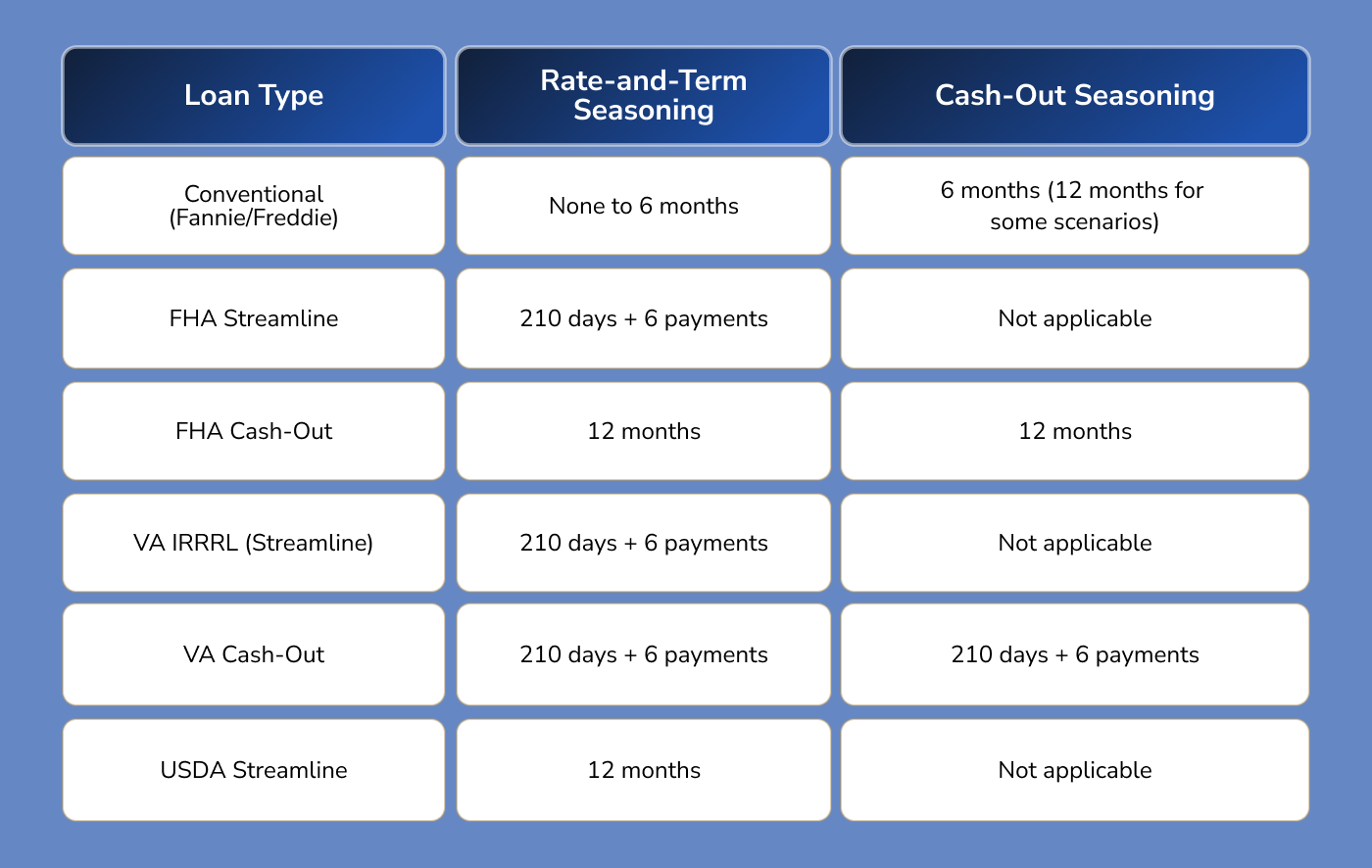
Seasoning requirements are the minimum time between refinances set by the agency that backs your loan. Here is how they break down in 2026.
Conventional Loans
For a standard rate-and-term conventional refinance, Fannie Mae and Freddie Mac do not impose a hard waiting period in most cases. You may be able to refinance within weeks of closing on your purchase if a better rate becomes available. That said, many lenders add a 6-month overlay before they will refinance their own loan, mostly to recoup origination costs.
For a conventional cash-out refinance, you generally need to have owned the home for at least 6 months. There are exceptions for inherited properties and certain delayed financing scenarios, but the 6-month rule is the standard.
FHA Loans
FHA seasoning rules are more rigid because the program is backed by HUD and designed for long-term affordability.
FHA Streamline Refinance: According to HUD, you must wait at least 210 days from the first payment due date on your existing FHA loan, and you must have made at least 6 consecutive monthly payments before applying.
FHA Cash-Out Refinance: HUD requires 12 months of on-time payments and at least 12 months of ownership before you can pull cash out.
The Streamline program is one of the fastest ways to lower your rate without a full appraisal or income re-verification, which is why so many FHA borrowers use it when rates drop.
VA Loans
For veterans and active-duty service members, VA refinance rules were tightened by the Economic Growth, Regulatory Relief, and Consumer Protection Act of 2018.
VA IRRRL (Interest Rate Reduction Refinance Loan): You must wait 210 days from the first payment due date and have made at least 6 consecutive monthly payments.
VA Cash-Out Refinance: Same 210-day and 6-payment seasoning rule applies.
The VA also requires a "net tangible benefit" test, meaning the refinance has to genuinely benefit you (typically a rate reduction of at least 0.50% on a fixed-to-fixed refinance). If you are a veteran in NH considering a refinance, our VA loan specialists can walk you through whether you qualify for an IRRRL.
USDA Loans
USDA Rural Development loans, which are common in northern and western New Hampshire, require 12 months of on-time payments before you can refinance through the USDA Streamline or Streamline-Assist programs.
How Soon Can I Refinance After Buying a Home?
This is one of the most common questions we hear from new homeowners, especially when rates drop shortly after closing.
The answer depends entirely on your loan type:
Conventional rate-and-term: Often immediately, though many lenders impose a 6-month wait
Conventional cash-out: 6 months minimum
FHA, VA, USDA: 6 to 12 months minimum, depending on program
Even when seasoning rules allow an early refinance, you need to weigh closing costs against monthly savings. Refinancing a 30-year mortgage you took out 90 days ago wipes out the small amount of principal you have paid down and resets your amortization clock. That is fine if rates have fallen meaningfully, but a marginal rate drop usually does not justify the cost.
A NextGen loan officer can run break-even numbers for you in about 15 minutes and tell you straight whether refinancing now or waiting makes more sense.
Why Lenders Have Minimum Time Between Refinances
The minimum time between refinances exists for a few reasons:
Loan churning protection: Federal regulators introduced VA and FHA seasoning rules specifically to prevent lenders from "churning" borrowers into back-to-back refinances that cost more in fees than they save in interest.
Investor requirements: Mortgage-backed securities investors expect loans to perform for a minimum period before being paid off through refinance.
Cost recovery: Lenders incur real costs (underwriting, appraisal, title) when originating a loan and want time to recoup them.
The Consumer Financial Protection Bureau (CFPB) has flagged refinance churning as a consumer protection issue, particularly in the VA market, which is part of why VA seasoning rules are now stricter.
When Refinancing Multiple Times Makes Sense (and When It Doesn't)
Refinancing more than once over the course of a mortgage is normal. Refinancing twice in 18 months because a salesperson called you with a "limited time offer" is usually not.
Refinancing again often makes sense when:
Mortgage rates have dropped at least 0.75% to 1.00% since your last refinance
Your credit score has improved significantly, qualifying you for a better tier
You want to remove private mortgage insurance (PMI) after building equity
You need to convert from an ARM to a fixed-rate loan before a rate adjustment
You want to shorten your loan term (e.g., from 30 years to 15 years) and the payment fits your budget
You have significant equity and a clear use for cash-out funds (debt consolidation at lower rates, home improvements, education)
Refinancing again rarely makes sense when:
Closing costs will take more than 3 to 5 years to recoup through monthly savings
You plan to sell or move within 2 to 3 years
The rate improvement is less than 0.50% with no other structural benefit
You are restarting a 30-year amortization schedule and adding years of interest
What It Costs to Refinance (and Your Break-Even Point)
Closing costs on a refinance typically run 2% to 6% of the loan amount, according to the CFPB. On a $400,000 mortgage, that is $8,000 to $24,000 in real money.
Your break-even point is calculated like this:
Total closing costs ÷ Monthly savings = Break-even months
Example: If your refinance costs $9,000 and lowers your payment by $250 per month, your break-even is 36 months. If you plan to stay in the home longer than that, the refinance pays off. If not, you lose money.
To run the numbers on your own situation, you can use our mortgage calculators to compare your current loan against a refinance scenario.
New Hampshire-Specific Considerations
If you own a home in New Hampshire, a few local factors affect how you should think about refinancing.
Property tax escrow: NH has some of the highest effective property tax rates in the country. When you refinance, your escrow account is reset, which can create temporary cash flow swings. Make sure your loan officer walks you through escrow reconciliation before closing.
County loan limits: The 2026 conforming loan limit set by the FHFA is $806,500 for one-unit properties in most NH counties, with higher limits in Rockingham and Strafford counties because of their proximity to the Boston metro area. Loans above the conforming limit move into jumbo territory, which has different refinance rules and pricing.
NHHFA programs: If your original loan was through a New Hampshire Housing Finance Authority program, refinancing to a conventional or FHA product is possible but you will lose any down payment assistance that was structured as a forgivable second lien before the forgiveness period is up. Read your original closing documents carefully.
Out-of-state borrowers: Many NH homeowners moved up from Massachusetts during 2020-2024 and bought at higher rates. If you are in this group and rates fall, you may be a strong refinance candidate. Speak with a NextGen broker to compare options across multiple lenders.
How NextGen Mortgage Loans Can Help
As a New Hampshire-based mortgage broker, NextGen Mortgage Loans works with multiple wholesale lenders, which means we can shop your refinance across a range of rates and program guidelines instead of forcing you into one bank's box. That broker advantage matters most when seasoning rules, lender overlays, or unique borrower situations (self-employment, high DTI, recent credit events) come into play.
We offer no-cost refinance consultations where we run the break-even math, review your current loan terms, and tell you honestly whether refinancing now is worth it. If it is not, we will tell you that too.
Ready to find out if refinancing makes sense for your situation? Contact a NextGen loan officer for a free, no-obligation review of your mortgage.
Frequently Asked Questions
How often can you refinance your mortgage in a year?
There is no legal cap, but practical limits apply. Most homeowners cannot refinance more than once per year because of seasoning rules (typically 6 to 12 months) and because closing costs eat up savings. In a falling-rate environment, refinancing once every 12 to 18 months can make sense if the rate drop is significant.
Does refinancing hurt your credit score?
A refinance triggers a hard credit inquiry, which typically drops your score by a few points temporarily. Closing your old mortgage and opening a new one also slightly affects your credit history age. Most borrowers see their score recover within a few months, and the long-term financial benefit usually outweighs the short-term ding.
Can I refinance if I just bought my house?
Sometimes, yes. For conventional rate-and-term refinances, you may be able to refinance within weeks of closing if your lender allows it. For FHA, VA, and USDA loans, you typically need to wait 6 to 12 months. Even when allowed, the math rarely works unless rates have dropped substantially.
What is a refinance seasoning requirement?
Refinance seasoning requirements are the minimum waiting periods set by loan programs (Fannie Mae, Freddie Mac, FHA, VA, USDA) before you can refinance an existing mortgage. They typically range from 0 to 12 months and are designed to prevent loan churning and protect investors who hold mortgage-backed securities.
What is the minimum time between refinances?
The minimum time between refinances depends on your loan type. Conventional rate-and-term refinances often have no waiting period, while FHA, VA, and USDA programs require 210 days plus 6 payments or 12 months of on-time payments. Cash-out refinances typically require 6 to 12 months of seasoning regardless of loan type.
Do I need a new appraisal every time I refinance?
Not always. FHA Streamline and VA IRRRL refinances generally do not require a new appraisal. Conventional refinances may qualify for an appraisal waiver through Fannie Mae or Freddie Mac's automated underwriting if you have sufficient equity and clean credit. Cash-out refinances almost always require a full appraisal.
Will refinancing reset my loan to 30 years?
Only if you choose a 30-year term. You can refinance into a 15, 20, or 25-year term to keep your payoff date on track. If you took out a 30-year loan five years ago and refinance into another 30-year, you will be paying for 35 years total. Many borrowers refinance into a shorter term when rates allow, which builds equity faster and saves substantially on lifetime interest.
This article is for informational purposes only and does not constitute financial, legal, or tax advice. Consult a tax professional or attorney for guidance specific to your situation.

