Fixed Rate vs Adjustable Rate Mortgage
Fixed rate vs adjustable rate mortgage: which is better in 2026 depends on how long you plan to stay in the home. A fixed-rate mortgage locks your interest rate for the life of the loan, giving you predictable payments. An adjustable-rate mortgage (ARM) starts with a lower rate that can change over time. For most buyers in New Hampshire and beyond, a fixed rate offers the stability that makes sense in today's market.
Why This Decision Matters Right Now
The gap between fixed and adjustable mortgage rates in 2026 is tighter than it was just a few years ago. That matters because the traditional argument for choosing an ARM, a significantly lower starting rate, is less compelling when fixed rates are only slightly higher. Meanwhile, New Hampshire's housing market remains competitive, with median home prices in Hillsborough County hovering well above national averages. Choosing the wrong loan type can cost you tens of thousands of dollars over the life of your mortgage, or leave you exposed to payment shock if rates rise sharply. This is not a decision to make based on a quick online quiz. It requires a clear-eyed look at your timeline, your risk tolerance, and what the current rate environment actually means for you.
What Is a Fixed-Rate Mortgage and Who Should Get One?
A fixed-rate mortgage is exactly what it sounds like: the interest rate you close with stays the same for the entire loan term. If you lock in a 30-year fixed today, your rate in year 28 is identical to your rate in year 1. Your principal and interest payment never changes, no matter what the Federal Reserve does.
The Core Benefit: Predictability
Predictability is worth paying for, especially when household budgets are already stretched. With a fixed-rate loan, you can plan your finances years in advance. There are no surprise increases, no refinancing urgency triggered by rate adjustments, and no anxiety every time financial news breaks.
Who Fixed Rate Works Best For
Buyers planning to stay in the home 7 or more years
First-time homebuyers who want simplicity and payment stability
Borrowers in high-rate environments where locking in makes strategic sense
Anyone with a tight monthly budget who cannot absorb a potential payment increase
If you're buying a home in Nashua or Manchester and this is where you plan to put down roots, a fixed-rate mortgage is almost always the right call. The peace of mind alone has real financial value.
What Is an ARM and When Does It Actually Make Sense?
An adjustable-rate mortgage starts with a fixed introductory period, typically 5, 7, or 10 years, then adjusts annually based on a market index. A 5/1 ARM, for example, holds its initial rate for five years, then adjusts once per year after that. The initial rate on an ARM is often lower than a comparable fixed-rate mortgage, which can translate into real savings during the intro period.
The Risk You Need to Understand
After the fixed period ends, your rate can move up or down. Most ARMs have rate caps, meaning the rate can only increase by a set amount per adjustment and over the life of the loan. But even a 2% increase in your interest rate can add hundreds of dollars to your monthly payment. Borrowers who took ARMs in 2019 expecting to refinance before adjustments hit learned a hard lesson when rates rose sharply in 2022 and 2023.
Who ARM Works Best For
Buyers who plan to sell or refinance before the fixed period ends
Borrowers who are highly confident rates will drop within their adjustment window
Military families or other buyers with defined short-term housing timelines
High-income borrowers who can absorb payment increases without hardship
The key question with an ARM is not 'what is the starting rate?' It is 'what happens if I am still in this home when the rate adjusts?' If the honest answer makes you uncomfortable, go fixed.
Fixed Rate vs Adjustable Rate Mortgage in 2026: Side-by-Side
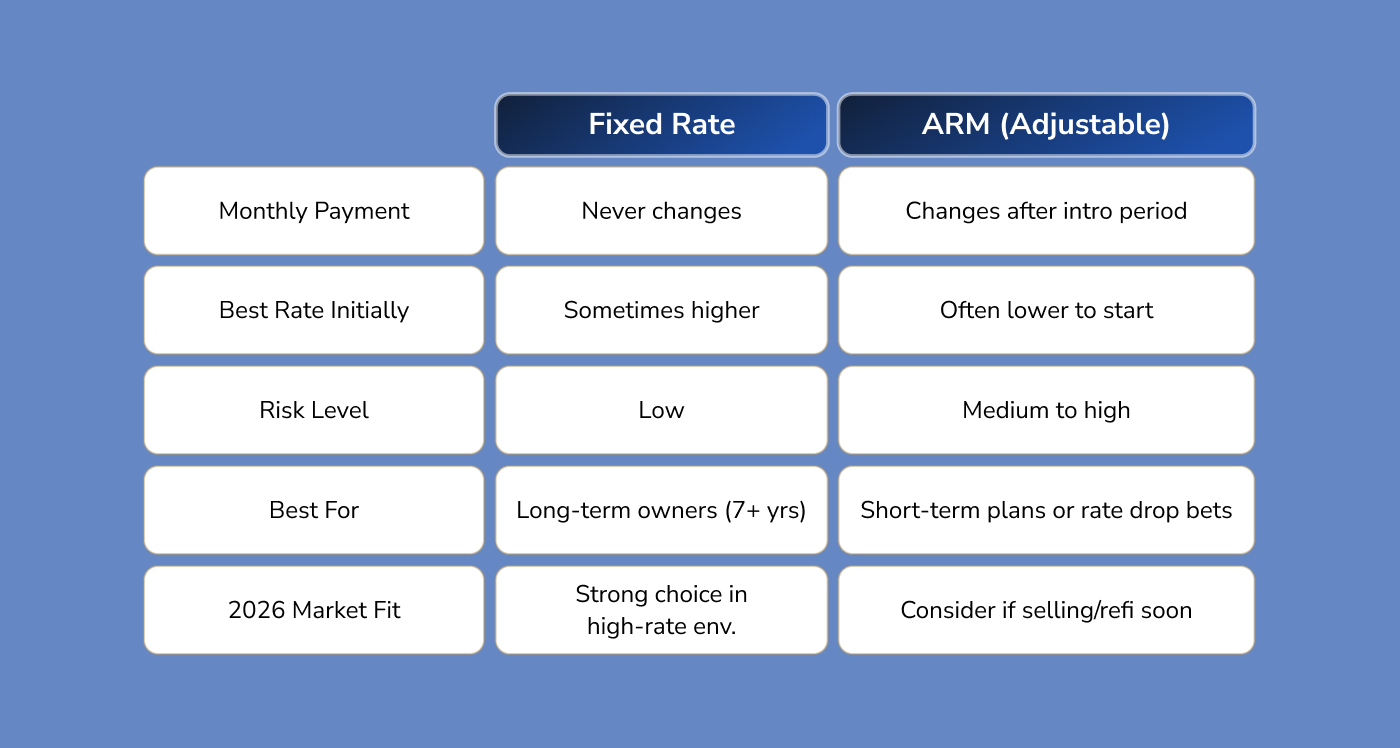
Rate note: Rates and program details are subject to change. Contact a NextGen Mortgage Loans loan officer for current figures as of spring 2026.
How to Choose the Right Mortgage for Your Situation
Three questions will help you make this call clearly.
1. How long will you be in the home?
If you know you are staying 10 or more years, a fixed rate almost always wins on total cost and peace of mind. If you are confident you will sell within five years, an ARM's lower starting rate could save you real money. The problem is that life rarely follows the plan. Job transfers, family changes, market shifts, all of these affect how long you stay. Build in a cushion.
2. What is your risk tolerance?
Mortgages are not investments where higher risk means higher reward. With an ARM, higher risk means potential payment instability. If an extra $300 to $500 per month in your mortgage payment would cause genuine financial hardship, you do not have the risk tolerance for an ARM, regardless of what the starting rate looks like.
3. What does the rate environment look like?
The Consumer Financial Protection Bureau (CFPB) recommends comparing the Annual Percentage Rate (APR) rather than the note rate when evaluating loan options, because APR captures fees and provides a more accurate comparison. In 2026, when fixed and ARM rates are relatively close, the math often favors fixed unless you have a very short time horizon. Speak with a licensed loan officer at NextGen Mortgage Loans to run the actual numbers for your specific loan amount and timeline.
How NextGen Mortgage Loans Can Help You Decide
At NextGen Mortgage Loans, we do not run your application through an algorithm and spit out a yes or no. A real loan officer reviews your full picture, your income, your timeline, your goals, and helps you model out the actual cost difference between a fixed and adjustable rate mortgage for your specific situation. We are headquartered in Nashua, New Hampshire (NMLS# 1621958) and licensed in MA, ME, and FL, so we understand local market conditions that generic national lenders often miss. Our 14-day closing capability means you can move fast when you find the right home. Whether you are leaning toward a fixed-rate mortgage or want to explore our ARM options, get in touch with our team or apply directly through our secure portal.
Disclaimer: Disclosure: This content is for educational purposes only and does not constitute financial advice. Loan programs, rates, and eligibility requirements are subject to change. NextGen Mortgage Loans is licensed in NH (NMLS# 1621958), MA (MB1621958), ME (1621958), and FL (MBR4542), RI (#20265029LB). Contact a licensed loan officer to discuss your specific situation.
Frequently Asked Questions
Is a fixed rate or adjustable rate mortgage better in 2026?
A: For most buyers in 2026, a fixed-rate mortgage is the better choice because fixed and ARM rates are relatively close, and the stability of a fixed payment protects you from future rate increases. An ARM can make sense if you plan to sell or refinance within five to seven years. Talk to a loan officer at NextGen Mortgage Loans to compare the numbers for your exact situation.
How much lower is an ARM rate compared to a fixed rate right now?
A: The spread between a 5/1 ARM and a 30-year fixed mortgage varies, but in 2026 it is often less than one percentage point. Historically, ARMs offered a larger initial discount. The smaller the gap, the weaker the case for accepting the uncertainty of an adjustable rate. Always verify current rates with a licensed loan officer, as rates change daily.
Can I refinance out of an ARM if rates go up?
A: Yes, you can refinance an ARM into a fixed-rate mortgage, but refinancing costs money. You will typically pay 2% to 5% of the loan amount in closing costs, and you will need to qualify at the new rate. Refinancing is not guaranteed, particularly if your financial situation or home value has changed. Do not take an ARM assuming a refinance will be easy or inexpensive.
What are the rate caps on an adjustable rate mortgage?
A: Most ARMs have three caps: an initial cap (how much the rate can increase at the first adjustment), a periodic cap (how much it can increase each subsequent year), and a lifetime cap (the maximum increase over the loan's life). A common structure is 2/2/5, meaning the rate can go up 2% at first adjustment, 2% per year after that, and no more than 5% total. According to the CFPB, borrowers should always confirm cap details in writing before closing.
Does NextGen Mortgage offer both fixed and adjustable rate mortgages in New Hampshire?
A: Yes. NextGen Mortgage Loans offers both fixed-rate and adjustable-rate mortgage options for buyers in NH, MA, ME, and FL. Our loan officers can walk you through the current rate environment and help you model both options based on your timeline, loan amount, and financial goals.
The Bottom Line
Fixed rate vs adjustable rate mortgage is not a trick question. For most buyers in 2026, especially those putting down roots in New Hampshire and looking for long-term stability, a fixed-rate mortgage wins. It is predictable, it is reliable, and in the current rate environment, the cost difference rarely justifies the risk of going adjustable. That said, your situation is your situation. If you have a clear short-term timeline and the financial cushion to handle rate adjustments, an ARM could save you money. The smartest move is to model both options with a real loan officer. Connect with the team at NextGen Mortgage Loans today and get a clear, honest answer based on your numbers.

