
FHA Streamline Refinance: The Complete Guide for New Hampshire Homeowners
An FHA streamline refinance lets you replace your existing FHA loan with a new one at a lower rate, usually without an appraisal, without income verification, and with far less paperwork than a standard refinance. If you bought your New Hampshire home with an FHA loan and rates have dropped since then, this is often the fastest, cheapest way to cut your monthly payment.
This guide walks through every requirement, the net tangible benefit test, what happens with appraisals, how rates and costs work in 2026, and the exact steps to apply. If you want a personalized look at your numbers, a NextGen loan officer can run them in about 15 minutes.
What Is an FHA Streamline Refinance?
An FHA streamline refinance is a refinance program offered by the Federal Housing Administration (FHA) that allows current FHA borrowers to refinance into a new FHA loan with reduced documentation and underwriting.
Quick answer: It is "streamlined" because the FHA waives several traditional underwriting steps. Most borrowers do not need a new appraisal, do not need to verify income, and do not need to provide updated employment documentation.
There are two versions:
Non-credit qualifying streamline. No income verification, no debt-to-income calculation, no new credit decision based on full underwriting. The lender confirms your mortgage payment history and a few other items.
Credit qualifying streamline. The lender pulls credit and verifies income. This version is required in certain situations, such as when removing a borrower from the loan.
Both options are only available if you already have an FHA-insured mortgage. You cannot use a streamline to refinance a conventional, VA, or USDA loan into an FHA loan.
Who Qualifies? FHA Streamline Requirements at a Glance
The fha streamline requirements are set by HUD in FHA Handbook 4000.1 and apply nationally, including across all New Hampshire counties.
To qualify, you generally need to meet all of the following:
You have an existing FHA loan. This is the threshold requirement.
You have made at least 6 monthly payments on your current FHA mortgage.
At least 210 days have passed since the closing date of your existing FHA loan.
Your payment history is clean. No late payments in the most recent 6 months, and no more than one 30-day late payment in months 7 through 12.
The refinance must produce a net tangible benefit to you (covered in detail below).
You receive no more than $500 cash back at closing. The streamline is not a cash-out refinance.
There is no minimum credit score set by HUD for the non-credit qualifying version, but individual lenders typically set their own overlays, often 580 to 620. A broker can shop your file across multiple lenders to find the most flexible overlay.
The Net Tangible Benefit Test Explained
The fha streamline net tangible benefit rule is the single most misunderstood piece of this program. HUD requires that the refinance actually save you money or improve your loan structure in a defined way.
You meet the net tangible benefit test if your refinance does one of the following:
Reduces your combined principal, interest, and mortgage insurance premium (MIP) payment by at least 5%. This is the most common path.
Refinances an adjustable-rate mortgage (ARM) into a fixed-rate mortgage within specific rate parameters set by HUD.
Reduces the term of your loan in a way that meets the structural requirements outlined in the handbook.
Note that the 5% test is on principal + interest + MIP combined, not just the rate. So a small rate drop combined with a lower MIP factor (because FHA MIP rates have changed since you closed) can easily push you over the threshold even when a rate-only comparison looks marginal.
If you bought your NH home in 2022 or 2023 at a higher rate, there is a strong chance you already pass this test at today's rates. A 30-second look at your closing disclosure tells the story.
FHA Streamline No Appraisal: How It Actually Works
One of the biggest advantages of this program is that it is an fha streamline no appraisal refinance for most borrowers. HUD allows lenders to use the original appraised value from when you bought the home as the value for the new loan.
This matters in New Hampshire for two specific reasons:
You are protected if values dropped. Even if your home is worth less today than when you bought it (rare in most NH markets but possible in pockets), the streamline still works.
You save the appraisal fee. Appraisals in NH typically run $500 to $700. That is real money kept in your pocket.
There are exceptions. If you want to roll closing costs into the new loan, some lenders will require an appraisal to verify there is enough equity. If you choose the credit qualifying version, an appraisal may also be requested. Your loan officer should walk you through whether your specific scenario triggers either case.
FHA Streamline Refinance Rates and Costs in 2026
Fha streamline refinance rates generally track the broader 30-year fixed FHA market and are often slightly lower than conventional refinance rates because of the FHA's insurance backing. Freddie Mac publishes weekly average mortgage rate data that is a useful directional benchmark, though your actual rate will depend on your credit, loan size, and lender.
Costs to expect:
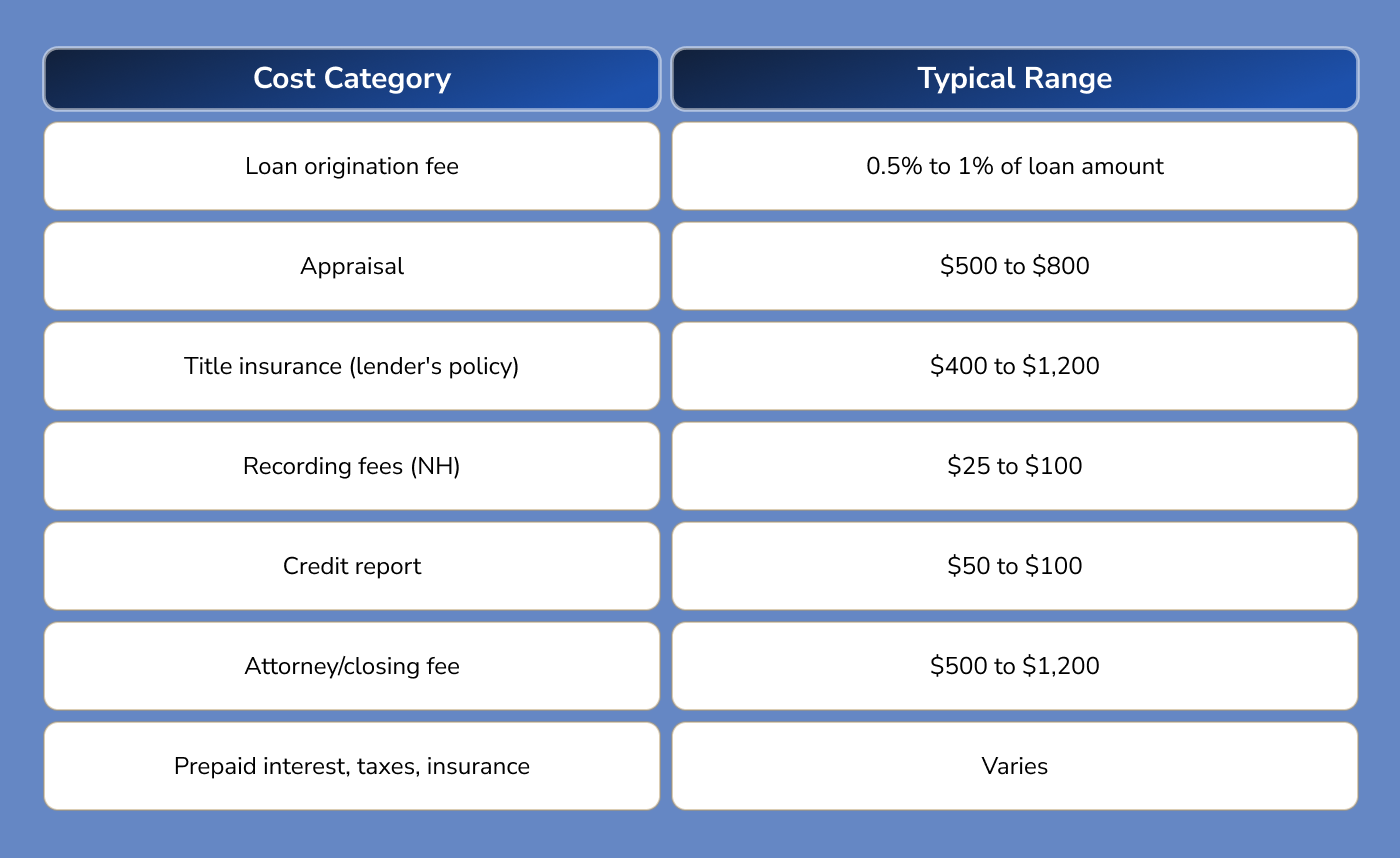
The upfront MIP looks scary on paper, but if you are refinancing within 36 months of your original FHA closing, you are entitled to a partial refund of the original upfront MIP that gets credited against the new one. The refund decreases each month, starting at 80% in month 1 and dropping by roughly 2 percentage points per month after the first year.
For a personalized cost breakdown, our mortgage calculators can model your scenario, or a NextGen broker can pull live numbers across multiple lenders.
Step-by-Step: How to Apply for an FHA Streamline in New Hampshire
The process is meaningfully shorter than a purchase or standard refinance. Most NH streamlines close in 18 to 30 days.
Confirm you have an FHA loan. Check your closing disclosure or current mortgage statement. The presence of monthly MIP is a strong indicator.
Check the 210-day and 6-payment timeline. Pull your closing date and count forward.
Pull your last 12 months of mortgage statements to confirm clean payment history.
Get rate quotes from a broker. Brokers like NextGen can compare offers across multiple lenders in one application, which matters because lender pricing on streamlines varies more than on purchase loans.
Lock your rate. Once you choose a lender, lock for 30 to 45 days.
Provide minimal documentation. Usually just ID, mortgage statement, and homeowners insurance declaration page for non-credit qualifying. Credit qualifying adds pay stubs, W-2s, and bank statements.
Sign closing documents. NH allows remote online notarization for many refinances, which means you can close from your kitchen table.
If you are also evaluating whether to refinance versus stay put, our refinance loan options page lays out the alternatives.
FHA Streamline vs. Conventional Refinance: Which Is Better?
Many NH homeowners with FHA loans wonder whether they should streamline or switch to a conventional loan to drop mortgage insurance entirely.
The decision usually comes down to equity and credit:
If you have less than 20% equity, the FHA streamline is almost always cheaper and easier. A conventional refinance requires private mortgage insurance (PMI) below 20% equity, and PMI on a recently-purchased home is often higher than FHA MIP for borrowers with mid-tier credit.
If you have 20% or more equity and credit above 740, a conventional refinance may save you more long-term because you can drop mortgage insurance entirely. This requires a full appraisal.
If you have 20% or more equity but lower credit, run both scenarios. The math is not obvious.
NH home values have risen meaningfully since 2020, so homeowners who bought before 2022 may have crossed the 20% equity threshold without realizing it. This is a conversation worth having with a broker who can model both paths.
Common Mistakes NH Homeowners Make
A few patterns we see repeatedly:
Calling the original lender first and stopping there. Your servicer is one of dozens of FHA-approved lenders. Their pricing is rarely the most competitive.
Focusing only on rate. A 0.125% rate difference matters less than $2,000 in lender credits or fees over the first few years.
Forgetting the MIP refund. If you are within 36 months of your original FHA closing, that refund is yours and should be applied to your new upfront MIP.
Waiting for "the bottom" of rates. Rates that pass the net tangible benefit test today are real savings today. You can refinance again later if rates drop further.
Assuming all NH lenders price the same. They do not. Broker access to multiple wholesale lenders is the cleanest way to surface the best offer.
How NextGen Mortgage Loans Can Help
NextGen Mortgage Loans is a New Hampshire-based mortgage broker, which means we shop your loan across multiple wholesale lenders rather than offering a single institution's pricing. For an FHA streamline refinance, this matters more than most loan types because lender overlays and pricing on streamlines vary widely.
We will:
Confirm in minutes whether you meet the 210-day, 6-payment, and net tangible benefit thresholds
Pull live rates from multiple FHA-approved lenders so you see real comparisons, not estimates
Calculate your MIP refund eligibility and apply it to your scenario
Handle the file from application to closing, with most NH streamlines closing in 18 to 30 days
There is no cost to get a quote and no obligation to proceed. Contact a NextGen loan officer to see your numbers, or use our mortgage calculators to model the savings yourself first.
Frequently Asked Questions
How long does an FHA streamline refinance take to close?
Most FHA streamline refinances in New Hampshire close in 18 to 30 days. The timeline is shorter than a purchase loan or standard refinance because there is no appraisal in most cases and reduced documentation. Lender capacity and how quickly you return signed disclosures are the two biggest variables.
Can I get cash out with an FHA streamline?
No. The FHA streamline limits cash back at closing to $500. If you want to tap equity, you would need an FHA cash-out refinance or a conventional cash-out refinance, both of which require a full appraisal and standard underwriting.
Do I need to live in the home as my primary residence?
Generally, yes. FHA streamline refinances are intended for primary residences, though there are limited exceptions for properties that were originally purchased as a primary residence and later converted. Talk to a broker about your specific situation if the property is no longer your primary home.
Will my mortgage insurance go away after refinancing?
Probably not. FHA loans originated after June 2013 with less than 10% down require MIP for the life of the loan, and a streamline refinance does not change that. If you have meaningful equity and want to eliminate mortgage insurance, a conventional refinance is the path, though it requires a new appraisal.
What credit score do I need for an FHA streamline?
HUD does not set a minimum credit score for the non-credit qualifying version. Individual lenders typically require 580 to 620. Brokers with access to multiple wholesale lenders can often find a home for borrowers in the 580 to 619 range when a single bank would decline.
Can I switch from a 30-year to a 15-year FHA loan with a streamline?
Yes, and this is a popular use of the program for NH homeowners who have built income since their original purchase. The shorter term must still meet the net tangible benefit requirements, and most borrowers easily clear that threshold given the rate differential between 30-year and 15-year FHA loans.
Is the upfront MIP refund automatic?
The refund is calculated automatically by HUD based on the months elapsed since your original FHA closing, but it must be applied at closing on the new loan. Make sure your loan officer explicitly references the MIP refund in your loan estimate so you can verify it is being credited.

