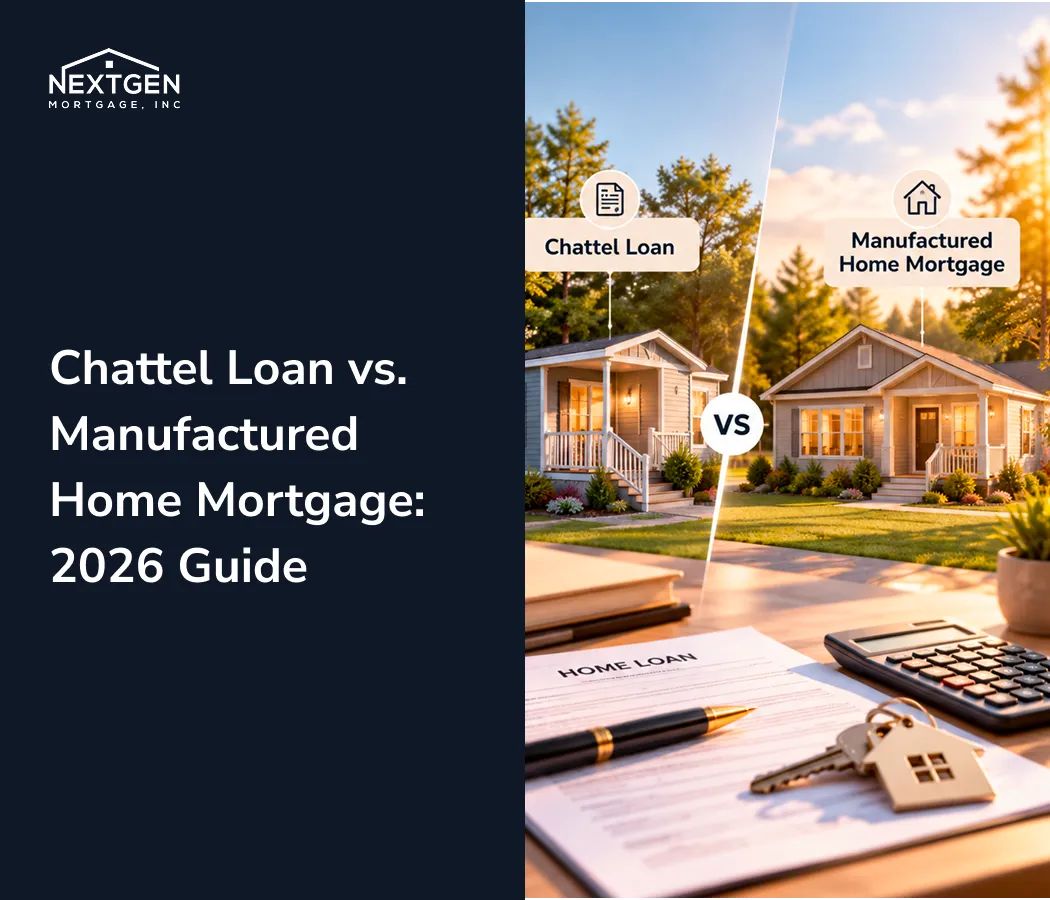
Chattel Loan vs. Manufactured Home Mortgage: 2026 Guide
A chattel loan finances a manufactured home primarily as personal property, while a manufactured home mortgage finances qualifying real estate. The difference affects what secures the loan, which properties qualify, repayment terms, interest costs, refinancing options, and sometimes the closing process.
Land ownership is one of the biggest factors, but it is not the only one. The home's legal classification, foundation, title status, age, HUD certification, community structure, and the specific loan program can all determine whether a traditional mortgage is available.
For manufactured-home buyers in New Hampshire, the answer can be especially nuanced because state law and certain resident-owned communities create financing possibilities that do not fit the usual “own land or use chattel” rule.
Chattel Loan vs. Manufactured Home Mortgage at a Glance
Factor | Chattel Loan | Manufactured Home Mortgage |
What secures the loan? | Primarily the manufactured home | Real-property interest, generally including the home and qualifying interest in the land |
Property classification | Often personal property | Real property |
Land ownership required? | Usually no | Commonly required, although some qualifying leasehold/ROC structures may work |
Interest cost | Generally higher | Generally lower for comparable borrowers |
Loan term | Often shorter | May extend to traditional mortgage terms |
Foundation requirements | Often more flexible | Usually stricter |
Home age/HUD requirements | Depends on lender | Agency programs generally have stricter standards |
Refinancing options | More limited | Broader when the property remains mortgage-eligible |
Common use case | Home in a park, leased lot, or property outside agency guidelines | Qualifying home permanently installed and eligible as real property |
CFPB research has found that chattel borrowers generally pay higher interest rates and have fewer refinancing opportunities than borrowers using manufactured-home mortgages.
That does not mean a mortgage is always available or that a chattel loan is automatically the wrong choice. The property itself determines much of the answer.
What Is a Chattel Loan for a Manufactured Home?
A chattel loan is financing secured by the manufactured home rather than a traditional mortgage lien on the home and land as real estate.
This structure is commonly used when the buyer owns the home but rents the land beneath it, such as in a manufactured-home community. It can also be useful when a home does not meet the property requirements of FHA, VA, USDA, Fannie Mae, Freddie Mac, or another mortgage program.
The practical advantage is flexibility. A specialty home-only lender may accept property situations that a conventional mortgage lender cannot.
The tradeoff is cost. Chattel financing generally carries higher borrowing costs than comparable real-property mortgage financing, although pricing varies by lender, home, down payment, credit profile, loan size, and market conditions. CFPB research has consistently identified a pricing gap between the two financing markets.
For current program details, NextGen explains its New Hampshire specialty financing on its mobile home chattel loan page.
What Is a Manufactured Home Mortgage?
A manufactured home mortgage is a real-estate loan secured by a manufactured home that meets the applicable mortgage program's property and title requirements.
Depending on the property and borrower, financing may be available through conventional, FHA, VA, or USDA programs.
For example, Fannie Mae generally requires a manufactured-home loan to be secured by a perfected lien on real property consisting of the manufactured home and the borrower's interest in the land. The home must also be legally classified as real property under applicable state law.
Freddie Mac likewise has detailed requirements governing manufactured-home construction, occupancy, title, appraisal, and underwriting. Homes built to the federal HUD Code on or after June 15, 1976 may potentially qualify when the other program requirements are satisfied.
NextGen outlines these options in its FHA, VA and conventional manufactured home loan guide.
What Are the Biggest Differences Between a Chattel Loan and a Mortgage?
1. The collateral is different
With a chattel loan, the lender's collateral is primarily the manufactured home.
With a real-property mortgage, the lien generally attaches to the real estate securing the transaction. That usually means the home plus the borrower's qualifying interest in the land.
This distinction is one reason mortgage financing and chattel financing are priced differently.
2. Legal classification matters
A manufactured home can be treated differently depending on state law, title documentation, installation, and financing structure.
For a traditional secondary-market mortgage, simply calling the property “real estate” is not enough. The lender must be able to establish the required legal interest and lien structure for the applicable loan program.
Fannie Mae, for example, specifically requires manufactured homes securing its eligible loans to be legally classified as real property and subject to the required perfected lien.
3. Owning the land expands your options
Owning the land often makes mortgage financing easier because the home and land may be financed together as real property.
But land ownership is only one requirement.
The home may still need to satisfy rules relating to:
construction date;
HUD certification;
permanent installation or foundation;
title;
appraisal;
property condition;
occupancy;
loan-program eligibility.
That is why a buyer can own both the land and the manufactured home and still discover that a particular mortgage program will not accept the property.
4. Chattel loans generally cost more
The most important financial difference is usually the interest cost.
CFPB analysis found that manufactured-home borrowers using chattel financing tend to pay higher rates than manufactured-home borrowers using mortgages. Chattel borrowers have also historically been less likely to refinance.
The exact difference should be determined using real loan quotes rather than a generic national rate range.
NextGen maintains a separate guide to current chattel loan rates and their cost drivers.
5. Mortgage terms can be longer
Traditional mortgage programs can provide repayment periods similar to mortgages on site-built homes.
Chattel loan terms vary by lender and may be shorter. A shorter term can increase the required monthly payment even when the amount borrowed is relatively modest.
That makes it important to compare:
rate + term + monthly payment + total interest
rather than looking at the interest rate alone.
6. Chattel financing may accommodate properties a mortgage will not
A manufactured home can fall outside standard mortgage guidelines because of its age, title, foundation, installation, land arrangement, or another property characteristic.
Specialty home-only financing may still be available in some of those cases.
This is why a manufactured home that receives a “no” from one mortgage lender is not necessarily impossible to finance. It may simply need a different financing structure.
7. Refinancing can be different
A real-property manufactured-home mortgage generally participates in the broader mortgage market, creating more potential refinancing paths when the borrower and property qualify.
The chattel market is smaller and more concentrated, and CFPB research has found lower refinancing activity among chattel borrowers.
For a buyer expecting to refinance later, that distinction deserves attention before the original purchase loan is chosen.
Does Owning the Land Automatically Qualify You for a Mortgage?
No. Owning the land improves the likelihood that mortgage financing will be available, but it does not automatically make the manufactured home eligible.
A lender may still need to verify that the home qualifies under the selected program.
For many standard manufactured-home mortgage programs, that means reviewing the home's construction standard, title, permanent installation, appraisal and other property requirements.
A useful way to think about it is:
Land ownership opens the mortgage door. The property's documentation and condition determine whether the loan can actually go through it.
This distinction is especially important before making an offer on an older manufactured home.
Can You Get Financing if the Manufactured Home Is on Leased Land?
Yes. A manufactured home on leased land can be financed, but a standard real-property mortgage may not be the financing path.
Home-only chattel financing is one common solution because the lender can take a security interest in the home without financing the underlying land.
FHA Title I provides another important option. HUD permits Title I financing for a manufactured home located on a leased site, subject to program requirements. HUD currently requires an initial lease term of at least three years and advance written notice requirements if the lease is terminated.
Some specialized community structures can also create additional possibilities.
That is why buyers should determine how the land is owned before assuming which financing is available.
Is FHA Title I a Chattel Loan or a Mortgage?
FHA Title I sits between the two categories people usually think about.
The FHA Title I Manufactured Home Loan Program can finance:
a manufactured home;
a manufactured-home lot;
or the home and lot together.
HUD specifically permits a manufactured home financed under Title I to be classified as either personal property or real estate depending on the transaction.
That means a buyer who does not own the land should not assume that government-backed financing is impossible.
FHA Title I is distinct from the more familiar FHA Title II mortgage program.
HUD also changed the Title I loan-limit methodology in 2024 so limits can be adjusted using manufactured-home pricing data rather than remaining fixed indefinitely.
Actual program availability still depends on finding an FHA-approved lender participating in Title I and meeting the applicable underwriting requirements.
What Is Different About Manufactured Home Financing in New Hampshire?
New Hampshire is one of the most important states in which to avoid oversimplifying the chattel-versus-mortgage distinction.
New Hampshire law has unusual treatment of manufactured housing
New Hampshire statutes provide circumstances in which manufactured housing placed on a site and connected to required utilities is treated as real estate for conveyance and related purposes. State law also permits lenders to treat manufactured housing as realty when securing financing.
However, this does not mean every New Hampshire manufactured home automatically qualifies for FHA, VA, USDA, Fannie Mae, or Freddie Mac financing.
Federal and investor-specific eligibility requirements still apply.
This is the distinction borrowers need to understand:
state-law treatment of the home and mortgage-program eligibility are related, but they are not identical questions.
Resident-owned communities can change the financing picture
New Hampshire also has a significant resident-owned community, or ROC, market.
In an ROC, residents collectively own the community land through a cooperative structure rather than paying rent to an outside park owner.
New Hampshire Housing currently offers its Home Preferred Manufactured Housing ROC program in qualifying communities, providing conventional financing options subject to program and borrower eligibility. Its list of approved communities changes over time and includes individual approval expiration dates.
This creates a particularly important question for buyers around Nashua and elsewhere in southern New Hampshire:
Is the property in an investor-owned park, a resident-owned cooperative, or on individually owned land?
Those three situations can lead to very different financing options.
Before accepting a chattel quote for a home in a New Hampshire community, verify whether the community has an approved ROC financing path.
What Should Massachusetts Buyers Know?
Massachusetts buyers should also confirm the property's legal status before assuming that every manufactured-home transaction works like a conventional house purchase.
The Massachusetts Attorney General maintains dedicated manufactured-housing guidance covering the rights and responsibilities of residents and manufactured-housing community owners.
Massachusetts authorities have also recognized that the legal treatment of a mobile or manufactured home can depend on the property's physical and legal characteristics rather than its factory-built origin alone.
As a result, the correct financing structure should be established from the actual title, land arrangement, home installation, and lender requirements.
NextGen's current program information lists agency manufactured-home financing in Massachusetts, while its specialty home-only program is currently advertised for New Hampshire and Florida.
How Much Can the Loan Type Change Your Payment?
Consider a purely illustrative example.
Assume two buyers each finance $120,000.
One receives a chattel loan at an illustrative 9.5% for 20 years.
The other receives a mortgage at an illustrative 7.0% for the same 20-year period.
Example | Chattel Loan | Mortgage |
Loan amount | $120,000 | $120,000 |
Illustrative rate | 9.5% | 7.0% |
Illustrative term | 20 years | 20 years |
Principal & interest | About $1,119/mo. | About $930/mo. |
Approximate total interest | $148,454 | $103,286 |
In this hypothetical example, the financing-rate difference changes principal and interest by roughly $188 per month and approximately $45,000 over 20 years.
These rates are examples only, not current loan quotes. Actual pricing varies by borrower, property, loan program, lender and market conditions.
If you want to model the numbers for a specific home, use NextGen's mobile home loan calculator to compare different loan assumptions.
What Should You Check Before Making an Offer on a Manufactured Home?
Before choosing the loan, determine exactly what you are buying.
Ask for the following information as early as possible:
Do you own the land, lease the lot, or receive an ownership interest through a cooperative?
What year was the home manufactured?
Does the property have HUD certification documentation where required?
How is the home currently titled?
Is the home permanently installed, and what type of foundation does it have?
Is the property in a manufactured-home community or resident-owned community?
Does the community itself need lender approval?
Are you buying only the home or the home and land together?
Which loan programs has the property already been evaluated for?
If a mortgage is unavailable, is specialty home-only financing available?
Answering these questions before the appraisal or underwriting stage can prevent a buyer from structuring an offer around financing the property cannot support.
Which Loan Option Makes More Sense for Your Situation?
A manufactured home mortgage generally deserves the first look when the property qualifies, because it may provide lower borrowing costs, longer terms, and broader refinancing options.
A chattel or home-only loan becomes particularly valuable when the property does not fit the real-property mortgage system, including many leased-lot, community, older-home, or nonstandard-property situations.
The important question is not simply, “Which loan has the lower rate?”
It is:
Which financing structures are actually available for this specific home, and what will each one cost after rate, term, down payment, fees, lot rent, and future refinancing options are considered?
For buyers in New Hampshire, NextGen Mortgage Loans can review both standard manufactured-home mortgage programs and its currently available specialty home-only financing before you commit to one structure. NextGen is a mortgage broker rather than the lender funding the loan, so eligibility, terms, rates and approval depend on the property, borrower qualifications, lender requirements, underwriting and market conditions.
FAQs
Is a chattel loan the same as a mobile home loan?
A chattel loan is one type of mobile or manufactured-home loan, not a synonym for every manufactured-home financing option. It generally finances the home without treating the transaction as a conventional mortgage on real property. Manufactured homes that meet the necessary property requirements may instead qualify for FHA, VA, USDA, or conventional mortgage financing.
Can I get a manufactured home mortgage without owning the land?
Sometimes, but the options are more limited. Most traditional manufactured-home mortgage programs require an eligible real-property interest, although certain approved leasehold or community structures can qualify. FHA Title I can finance a manufactured home on leased land, and certain qualifying New Hampshire ROCs have specialized conventional financing options.
Can I convert a chattel loan into a mortgage later?
Potentially. A borrower may be able to refinance into a real-property mortgage if the home, title, land interest, foundation and borrower meet the new loan program's requirements at that time. Buying the land or changing the home's legal classification alone does not guarantee eligibility, so the property should be reviewed before planning around a future refinance.
Why are chattel loan rates usually higher?
Chattel loans are secured primarily by the home rather than the broader real-estate collateral used for a traditional mortgage. The chattel lending market is also smaller and operates differently from the conventional mortgage secondary market. CFPB research has found higher rates among chattel borrowers compared with manufactured-home mortgage borrowers.
Can FHA finance a manufactured home in a mobile home park?
FHA Title I may finance a manufactured home located on a leased site when HUD's requirements are met. HUD requires qualifying lease protections, including an initial three-year lease term and advance notice provisions for lease termination. FHA Title II mortgage eligibility follows a different set of real-property requirements.
Does owning land mean I should avoid a chattel loan?
Not automatically, but mortgage financing should generally be evaluated before choosing home-only financing when you own the land. The home may still fail a standard mortgage program because of its age, foundation, title or other property conditions. Comparing every available structure is more useful than choosing based solely on land ownership.
Can a manufactured home in a New Hampshire ROC get conventional financing?
Some can. New Hampshire Housing currently provides conventional financing through its Home Preferred Manufactured Housing ROC program in qualifying resident-owned communities. Community approval, borrower eligibility and other program requirements still apply, and the approved-community list should be checked at the time of application.

