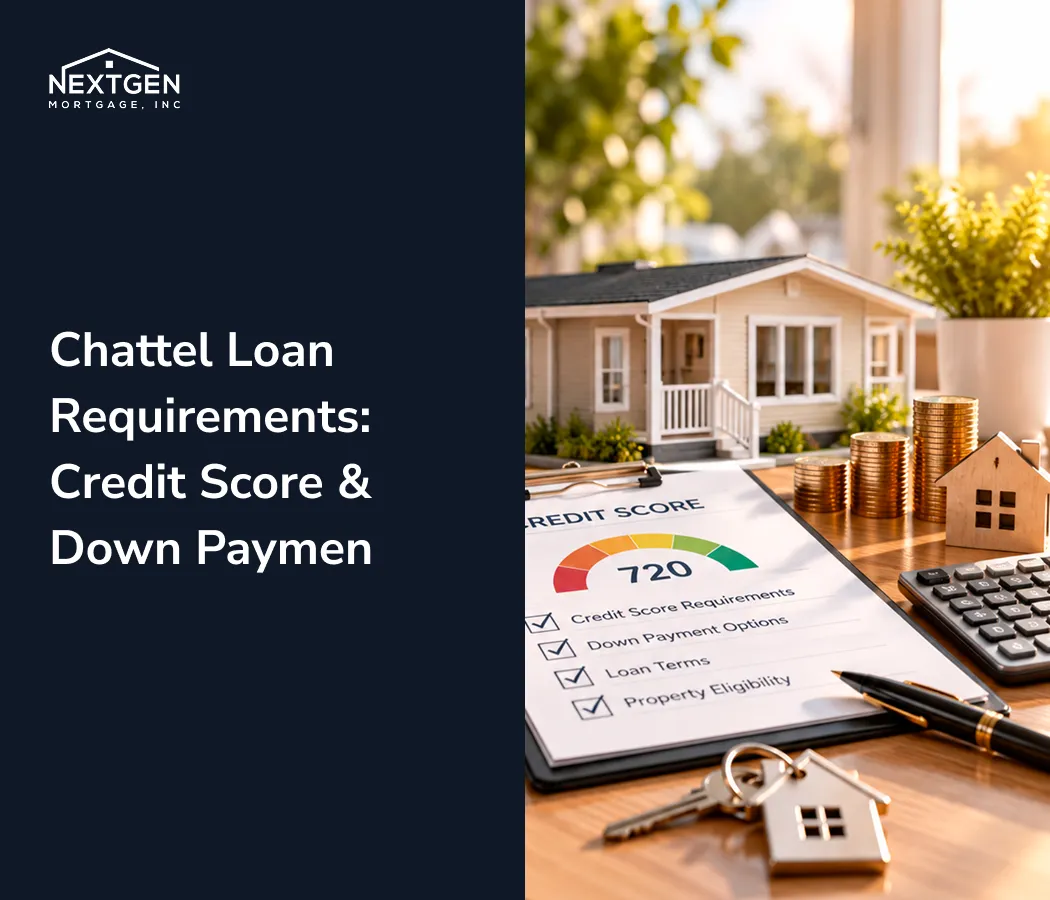
Chattel Loan Requirements: Credit Score & Down Payment
Chattel loan requirements vary by lender, so there is no single credit score, down payment, or loan term that applies to every manufactured-home buyer. Lenders typically evaluate your credit history, down payment, income, debt-to-income ratio, the age and condition of the home, where it will be located, and whether it will be your primary residence.
Some specialty manufactured-home lenders consider borrowers with credit scores in the 500s, while others require scores in the mid-600s. Down payments may start around 5% for some qualified borrowers but can rise substantially when credit or property risk is higher. Published specialty-lender terms commonly extend 20 to 25 years, while some programs can go as long as 30 years. 21st Repòs
Chattel Loan Requirements at a Glance
Here is the practical starting point:
Requirement | What to Expect |
Credit score | No universal minimum. Published specialty programs range from no stated minimum to 550, 660 or higher |
Down payment | Often 5% or more; lower-credit files may require substantially more |
Loan term | Commonly 15–25 years; certain specialty programs extend to 30 years |
Income | Documented ability to repay is generally required |
DTI | Lender-specific; home payment, other debts and often lot rent are considered |
Land ownership | Not usually required for home-only chattel financing |
Permanent foundation | Not required by every chattel program |
Home age | Depends heavily on lender; some programs finance pre-1976 homes |
Title | The home normally serves as the collateral rather than the underlying land |
Community approval | May be required if the home is located in a manufactured-home park |
Insurance | Typically required by the lender |
A chattel loan is generally secured by the manufactured or mobile home itself rather than a mortgage on the land. That structure is particularly useful when the home sits in a manufactured-home community or on leased land. CFPB research distinguishes these personal-property loans from manufactured-home mortgages secured by both the home and land. Consumer Financial Protection Bureau
What Credit Score Do You Need for a Chattel Loan?
There is no universal minimum credit score for a chattel loan.
Credit requirements are set by the individual lender or loan program, and the score is only one part of the underwriting decision.
Published lender guidelines illustrate the range. Triad currently advertises a minimum score of 550 for its home-only program. Credit Human says it generally looks for 660 or higher, although its manufactured-home program is not available in New Hampshire or Massachusetts. Another major specialty lender states that it has no minimum credit score for most home-only financing but typically requires substantially more money down for borrowers below 575. triadfs.com
That is why a statement such as “you need a 575 credit score for a chattel loan” is too broad.
What happens when your credit score is lower?
A lower score does not always mean automatic denial. It can instead change the structure of the loan.
The lender may require:
a larger down payment;
a lower loan-to-value ratio;
a shorter repayment term;
stronger documented income;
lower overall monthly debt;
a home with stronger collateral value;
or a combination of these factors.
For example, one national specialty lender currently states that applicants below a 575 score may need approximately 35% down, while stronger borrowers can qualify with considerably less. 21st Repòs
This makes credit score + down payment + property more useful than looking at credit score by itself.
How Much Down Payment Do You Need for a Chattel Loan?
A 5% down payment is a reasonable starting point for some chattel programs, but the actual requirement can range from very little down for a strong borrower to 20%, 35% or more for a higher-risk file.
Current lender examples show how wide the range can be. Credit Human publishes home-only down-payment tiers of 5%, 10%, 20% and 35%. Another specialty lender reports typical requirements between 5% and 35%, with zero-down financing reserved for highly qualified borrowers. Credit Human MH Lending
Can you get a chattel loan with zero down?
Potentially, but zero-down chattel financing is not a standard entitlement.
It is generally limited to specific lenders, programs or highly qualified applicants. A borrower should not assume that seeing “0% down available” means their transaction will qualify for it.
Factors that can affect your required down payment include:
credit score and credit history;
purchase price;
home age;
new versus used home;
single-section versus multi-section home;
primary residence versus second home or investment property;
whether the home is in a park or on private land;
lender loan-to-value limits;
and the borrower's overall financial profile.
Putting more down can also reduce the loan amount and may improve the pricing or terms offered.
Before changing your budget, run the purchase through NextGen's mobile home loan calculator to compare how different down payments affect the estimated payment.
How Long Are Chattel Loan Terms?
Private chattel loan terms commonly range from about 15 to 25 years, although the exact maximum depends on the lender and home.
Credit Human publishes terms of up to 20 years for home-only financing, while 21st Mortgage publishes terms of up to 25 years for home-only loans. NextGen's current specialty mobile-home program lists terms extending as long as 30 years for eligible files. Credit Human MH Lending
A longer term lowers the scheduled monthly principal-and-interest payment but usually increases the total interest paid over the life of the loan.
A shorter term does the opposite: the monthly payment rises, but the loan is repaid sooner.
This is especially important with chattel financing because personal-property loans have historically carried higher rates than comparable real-property mortgages. CFPB research has found significant cost differences between manufactured-home chattel loans and manufactured-home mortgages. Consumer Financial Protection Bureau
Other Requirements Chattel Lenders Consider
Credit score and down payment receive most of the attention, but they are only part of the approval.
Income and employment
Lenders need to determine whether your income is sufficient and reasonably reliable enough to support the payment.
Depending on the borrower and lender, documentation may include:
recent pay statements;
W-2s;
tax returns;
bank statements;
Social Security or retirement income documentation;
self-employment records;
proof of identity and residence.
Triad's published purchase process, for example, specifically notes verification of income, employment, residency and identity during underwriting. triadfs.com
Debt-to-income ratio and lot rent
Your debt-to-income ratio, or DTI, compares recurring monthly debt obligations with gross monthly income.
With a home in a manufactured-home community, do not look only at the loan payment. Lot rent or site rent can materially affect affordability and underwriting.
Lenders may evaluate the combined housing obligation rather than treating the home payment in isolation.
NextGen's current specialty home-only program states that qualifying DTI may extend as high as 65% for that specific program. That should not be treated as a universal chattel-loan limit; other lenders may require a materially lower ratio. nextgenmortgageloans.com
Home age and condition
The property itself is collateral, so lenders care about what they are financing.
They may evaluate:
year manufactured;
make and model;
number of sections;
physical condition;
location;
purchase price;
appraised or estimated value;
whether the home will remain at its current site;
and whether major repairs are needed.
This is one reason manufactured-home lenders often cannot issue a meaningful approval based on borrower credit alone. The specific home matters.
Foundation
A permanent foundation is not required for every chattel loan.
That is one of the biggest differences from many FHA, VA and conventional manufactured-home mortgage programs.
For example, 21st Mortgage states that it finances certain manufactured homes with or without a permanent foundation, including homes in parks and on leased property. NextGen's specialty program similarly lists block-and-post, pier and existing foundation configurations as potential options. 21st Repòs
Title and collateral
In a home-only chattel transaction, the lender's security interest is generally tied to the manufactured home rather than a mortgage on the land.
The distinction matters because a manufactured home may be treated as either personal property or real property depending on the financing structure and applicable state rules. CFPB specifically defines manufactured-home personal-property loans as loans secured by the home but not the land. Consumer Financial Protection Bureau
Community or park approval
Loan approval does not necessarily mean you are approved to live in the community.
If the manufactured home sits in a park, cooperative or leased-land community, the buyer may also need to satisfy that community's residency or occupancy process.
Make sure this happens early enough that you do not reach the end of underwriting only to discover a separate community approval problem.
Insurance
The lender will normally require adequate insurance covering the manufactured home.
Insurance availability and cost can also vary based on the home's age, condition, location and construction.
Can You Finance an Older or Pre-1976 Mobile Home?
Yes, some specialty chattel programs finance older mobile homes, including certain homes built before the federal HUD Code took effect in June 1976.
However, this is highly program-specific.
Many agency mortgage programs impose stricter age, certification, foundation and property-classification requirements. A specialty chattel program may have substantially more flexibility because it is financing the home as personal property rather than trying to make it fit a standard agency mortgage.
NextGen's current specialty mobile home chattel loan program states that eligible properties may include pre-1976 homes, homes without a HUD certification label and homes that do not sit on a traditional permanent foundation. nextgenmortgageloans.com
That makes the home's year, title status and existing foundation three of the first things to establish when comparing financing.
Private Chattel Loan vs. FHA Title I vs. Land-Home Mortgage
These structures are related, but they should not be treated as interchangeable.
Feature | Private Chattel Loan | FHA Title I | Land-Home Mortgage |
Collateral | Usually home only | Home, lot or both depending on transaction | Home and real estate |
Land ownership required? | Usually no | No for home-only transaction | Usually yes |
Credit rules | Set by lender | FHA Title I underwriting rules | Depends on FHA, VA, USDA or conventional program |
Down payment | Lender-specific | Generally 5% above 500 MDCS; 10% at 500 or below | Program-specific |
Home-only maximum term | Lender-specific; some reach 25–30 years | 20 years + 32 days | Often up to 30 years |
Permanent foundation | Not always | Program/property rules apply | Usually required for manufactured-home mortgage |
Primary residence | Depends on private program | Required | Depends on mortgage program |
Under HUD's current Title I rules, a borrower with a Minimum Decision Credit Score above 500 may be eligible for up to 95% LTV, while a score of 500 or below is limited to 90% LTV. HUD also permits a manufactured home financed under Title I to be placed on a leased site, subject to program requirements. hud.gov
The FHA Title I maximum term for a manufactured-home unit is currently 20 years plus 32 days. hud.gov
The important point is that FHA Title I requirements should not be quoted as the requirements for every chattel loan.
Chattel Loan Requirements in New Hampshire and Massachusetts
The borrower requirements may look similar across states, but the community structure and available financing options can change the best loan path.
New Hampshire: check whether the community is a ROC
New Hampshire buyers should determine whether the home is located in a traditional investor-owned park or a resident-owned community, or ROC, before assuming a private chattel loan is the only option.
The New Hampshire Community Loan Fund currently offers Welcome Home Loans for qualifying pre-owned manufactured homes in ROCs or on land the buyer owns or is purchasing. Published program features include fixed rates, terms from 5 to 30 years, low down payments and no stated minimum credit score, although satisfactory repayment history is required. communityloanfund.org
That can materially change the financing comparison.
New Hampshire also added resale-disclosure protections for ROC units effective January 1, 2026. Prospective buyers can obtain information such as association financials, anticipated capital expenses, fees and recent special assessments before the contract date. General Court of New Hampshire
For a buyer near Nashua, Manchester, Hudson, Merrimack or elsewhere in southern New Hampshire, confirming the community structure early can prevent you from comparing the wrong financing products.
Massachusetts: park approval is a separate consideration
Massachusetts manufactured-home community buyers should also distinguish loan approval from residency approval.
Massachusetts guidance explains that communities may evaluate a prospective resident's financial ability to pay rent, but they generally may not deny an application solely because of one factor such as a credit score when other reasonable evidence demonstrates the ability to pay. The current Attorney General guide also describes a 10-day community application review period. Massachusetts Government
That means buyers should coordinate the financing application and community application rather than treating them as unrelated last-minute steps.
What Documents Do You Need for a Chattel Loan?
Exact documentation varies by lender, but preparing the following before applying can reduce delays:
Government-issued identification and Social Security or tax identification information.
Recent income documentation.
Employment information.
Bank or asset statements if funds are needed for the down payment or closing.
Purchase agreement or asking price.
Home year, manufacturer, model and dimensions.
Home serial or identification information when available.
Property or community address.
Community name and monthly lot rent, if applicable.
Proposed down payment.
Insurance information when requested.
Information about the seller, dealer or retailer.
Specialty manufactured-home lenders commonly require specific property information before they can accurately evaluate the transaction. 21st Repòs
How to Improve Your Chances of Chattel Loan Approval
Focus on the parts of the file that affect both borrower risk and collateral risk.
First, know the home before applying. Obtain the year, make, model, dimensions, location, price and community information.
Second, check your credit reports. Fix genuine reporting errors and avoid opening unnecessary new debt immediately before the application.
Third, preserve cash. Even if a low-down-payment option exists, having additional funds available can create more lender options.
Fourth, calculate your housing cost including lot rent. A $900 loan payment plus $700 in monthly site rent is a $1,600 housing obligation before insurance and other costs.
Fifth, get community approval moving early. This is especially important when purchasing a home already located in a manufactured-home park.
Sixth, compare financing structures, not just lenders. If you own the land or the property could qualify as real property, compare chattel financing with land-home mortgage options before choosing.
Which Financing Structure Fits Your Home?
A simple framework can narrow the answer quickly.
You are buying the home but leasing the land:
Chattel or another home-only manufactured-housing program is usually the first place to look.
The home is in a manufactured-home park:
Check chattel financing and determine whether the park is a ROC or has another financing arrangement.
The home is older or does not meet agency property standards:
Specialty chattel financing may offer more flexibility.
You own the land and the home meets real-property requirements:
Compare a land-home mortgage before automatically choosing chattel financing.
You have lower credit:
Do not assume you are automatically disqualified. Ask how a larger down payment or a different specialty program changes eligibility.
You are buying in New Hampshire:
Check the community's ROC status before deciding a private chattel loan is your only option.
You can compare the payment impact first with NextGen's manufactured and mobile home loan calculator, then review the broader manufactured home financing options available for the property.
What Should You Do Next?
Start with the home, not just your credit score.
Find out:
the year and type of home;
whether you own or lease the land;
the monthly lot rent;
whether the community requires buyer approval;
how much you plan to put down;
and whether the home could qualify for a real-property mortgage instead.
Then compare the programs that actually fit that property.
NextGen Mortgage Loans is a mortgage broker rather than the lender funding the transaction. Its role is to review the borrower and property scenario and compare available financing options through lender partners. NextGen currently lists manufactured-home and specialty home-only financing among the programs it can arrange. nextgenmortgageloans.com
If you're buying a mobile or manufactured home in New Hampshire or Massachusetts, having the home details available before your financing conversation will usually produce a much more useful answer than asking only, “What credit score do I need?”
6. FAQs
What credit score do you need for a chattel loan?
There is no universal minimum chattel-loan credit score. Current specialty lenders publish requirements ranging from no stated minimum to 550 or 660 depending on the program. Lower credit scores may require a larger down payment or different loan structure, so qualification depends on the complete borrower and property profile. 21st Repòs
How much down do you need for a mobile home chattel loan?
Some chattel programs start around 5% down, while others can require 10%, 20%, 35% or more depending on credit, occupancy and the property. Zero-down options exist with certain lenders for highly qualified borrowers but should not be treated as a standard chattel-loan requirement. 21st Repòs
Can I get a chattel loan with bad credit?
Possibly. Specialty manufactured-home lenders may consider borrowers with lower credit scores, but a weaker credit profile can increase the required down payment or change the available interest rate and loan term. Income, DTI, home value, occupancy and payment history can also affect approval.
Do chattel loans require a permanent foundation?
Not always. Some private chattel lenders finance manufactured or mobile homes on piers, block-and-post systems or other nonpermanent setups because the home itself is the collateral. Traditional manufactured-home mortgage programs generally have stricter foundation and real-property requirements. 21st Repòs
Can you get a 30-year chattel loan?
Some specialty programs offer terms up to 30 years, but that is not universal. Many home-only chattel programs top out around 20 to 25 years. FHA Title I manufactured-home-only financing has a maximum term of 20 years plus 32 days. 21st Repòs
Does lot rent count when qualifying for a chattel loan?
Lot or site rent can affect affordability and underwriting because it remains part of your monthly housing cost even though it is not included in the home loan. Borrowers should provide the lender with accurate community rent and fee information when applying.
Can a pre-1976 mobile home qualify for a chattel loan?
Certain specialty chattel programs finance pre-1976 mobile homes even when they lack the HUD certification required by many traditional manufactured-home mortgage programs. NextGen's current specialty program specifically lists pre-1976 homes among the property types it can consider. nextgenmortgageloans.com

