Bank Statement Loans: A Guide for Self-Employed NH Buyers
A bank statement loan lets self-employed New Hampshire borrowers qualify for a mortgage using 12 or 24 months of bank deposits instead of tax returns. If you write off most of your business income to lower your tax bill, this program shows your real cash flow and unlocks financing that conventional underwriting often denies. This guide explains how bank statement loans work, who they fit, what NH borrowers typically need to qualify, and how the process compares to traditional mortgages.
What Is a Bank Statement Loan?
A bank statement loan is a non-QM mortgage that uses your bank deposits, not your tax returns, to verify income. Lenders review 12 or 24 months of personal or business statements and calculate qualifying income from your deposit history.
This product exists because the standard mortgage process breaks down for many self-employed borrowers. Conventional underwriting uses adjusted gross income from tax returns, which usually understates what you actually earn after legitimate write-offs.
Key takeaway: A bank statement loan qualifies you on deposit history, so business write-offs do not reduce your loan eligibility.
Who Bank Statement Mortgages Are Built For
These programs are designed for borrowers whose tax returns do not reflect their true ability to pay a mortgage. Common profiles in New Hampshire include:
Sole proprietors and LLC owners (consultants, IT, marketing, design)
Trades and contractors (electricians, plumbers, builders, landscapers)
1099 independent contractors and freelancers
Real estate investors and short-term rental hosts
Small business owners with significant deductions
Commission-only sales professionals
Restaurant, retail, and seasonal business owners
If you fall into one of these categories and a traditional lender has told you that your income is too low, a bank statement mortgage for self employed borrowers may give you a different result.
How Lenders Calculate Income From Bank Statements
Each lender has its own method, but most follow a similar framework. Here is what to expect:
You provide 12 or 24 months of statements from personal or business accounts.
The underwriter totals your eligible deposits and excludes transfers, refunds, loan proceeds, and one-time non-recurring items.
An expense factor is applied when business statements are used (often 50%, with some programs as low as 10% to 20% with a CPA letter or profit and loss statement).
The total is divided by 12 or 24 to produce your qualifying monthly income.
A simple example. If your business deposits total $300,000 over 12 months and the lender uses a 50% expense factor, your qualifying income is $12,500 per month ($150,000 divided by 12).
When you mix personal and business accounts, expect more scrutiny. Clean separation between personal and business banking makes the underwrite faster and the approval more predictable.
12 Month Bank Statement Loan vs 24 Month Programs
Bank statement loans come in two main variants. The right one depends on how your income has trended.
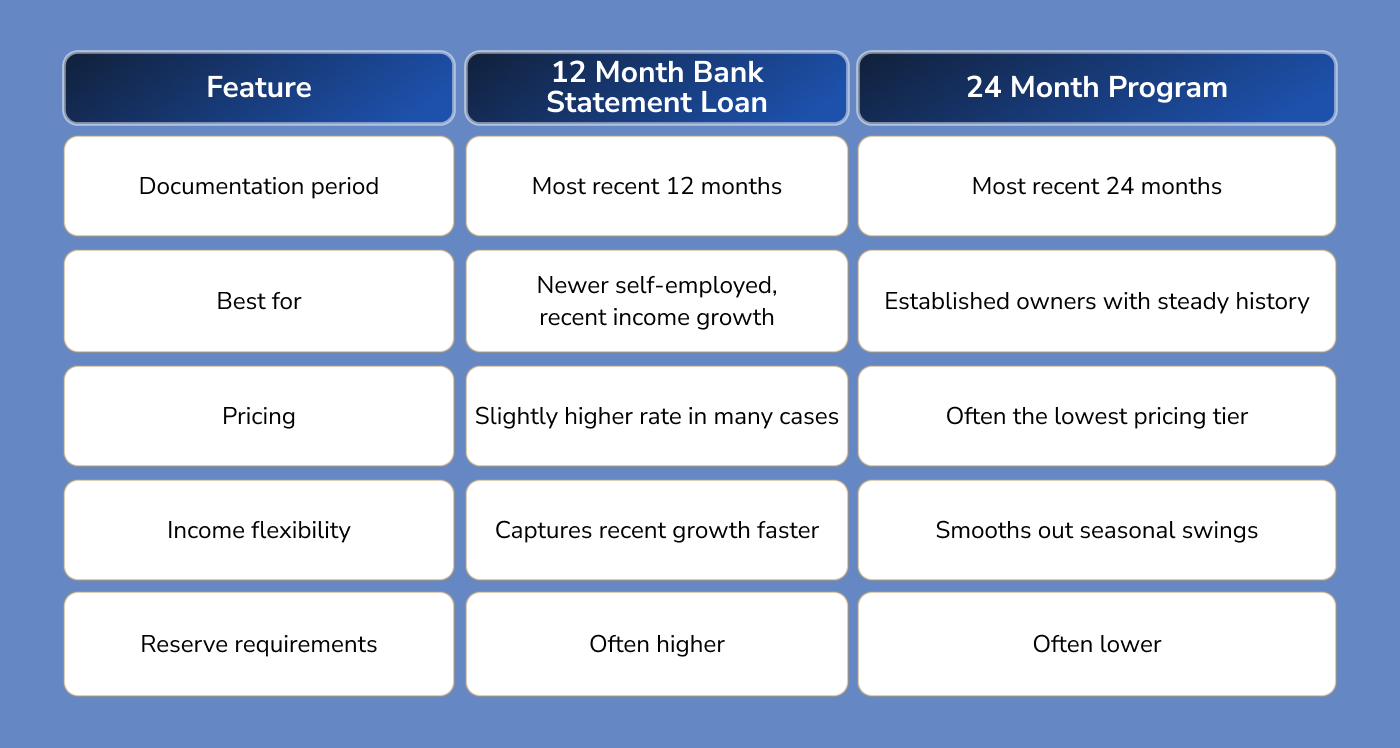
Choose a 12 month bank statement loan if your income grew significantly in the last year and a 24 month average would understate your current cash flow. Choose the 24 month program if your income has been steady, or if your business is seasonal and a longer window evens out the dips.
Typical Requirements for a Non-QM Bank Statement Program
Guidelines vary across investors, but most non qm bank statement program lenders look for:
Credit score: Typically 660 or higher, with the best pricing at 720 and above
Self-employment history: Usually two years, sometimes one year with strong compensating factors
Down payment: Often 10% to 20%, depending on credit score and loan amount
Cash reserves: Three to twelve months of mortgage payments held in liquid accounts after closing
Property types: Primary homes, second homes, and investment properties (occupancy rules vary)
DTI limits: Often up to 50%, more flexible than QM rules allow
Loan amounts can extend well into jumbo territory, which matters in higher-priced NH towns where conforming caps do not always cover the purchase price.
Bank Statement Loans vs Conventional and FHA Mortgages
If you can document income through tax returns and qualify for a conventional or FHA loan, those programs almost always offer better pricing. A bank statement program makes sense when:
Your tax returns show losses or low net income because of depreciation, vehicle expenses, home office, or Section 179 deductions
You have not yet filed two years of tax returns as a new business owner
Your conventional debt-to-income ratio is too high based on tax-return income
You have W-2 income that does not cover the loan, but business deposits that do
Conventional lenders want adjusted gross income. Bank statement lenders want cash flow. The same borrower can look unqualified to one and well-qualified to the other. A NextGen loan officer can run both scenarios and tell you which path produces the stronger approval and the better rate.
Pros and Cons of Bank Statement Loans
Advantages
Qualifies on real cash flow, not after-tax income
No tax returns required in most programs
Available for primary, second home, and investment properties
Higher loan amounts than conforming caps allow
Faster closings in some cases, since tax transcript ordering is not required
Trade-offs
Higher interest rates than conventional or FHA
Larger down payment in most cases
Stricter cash reserve requirements
Fewer lenders offer the product, so shopping matters
Pricing and expense factors vary widely between investors, which is why working with a broker who has access to multiple bank statement lenders typically produces a better outcome than going to a single bank.
What This Looks Like for New Hampshire Borrowers
New Hampshire has a high concentration of small business owners, tradespeople, and seasonal operators, which makes bank statement loans particularly useful here. According to the Federal Housing Finance Agency, the 2026 baseline conforming loan limit for one-unit properties is $832,750. Most NH counties sit at this baseline.
In higher-priced markets like Portsmouth, Hanover, and parts of the seacoast, purchase prices regularly push past the conforming cap. Bank statement programs frequently extend into jumbo territory, which gives self-employed buyers a way to compete in those towns even when conventional jumbo lenders demand two years of clean tax returns.
NH property taxes also play a role in qualifying. Towns with effective tax rates above the state average raise your monthly housing payment and your debt-to-income ratio. A bank statement loan that recognizes your true cash flow can offset that pressure when conventional underwriting cannot. If you want to see how a higher loan amount or property tax assumption affects your monthly payment, our mortgage calculators let you model different scenarios in seconds.
How the Bank Statement Loan Process Works
A typical bank statement mortgage moves through these stages:
Initial conversation. A NextGen broker reviews your income picture, credit, down payment, and target purchase price to confirm a bank statement loan is the right fit.
Document gathering. You provide 12 or 24 months of statements, identification, asset documentation, and a profit and loss statement if the program requires one.
Pre-approval. Once your file is reviewed, you receive a pre-approval letter you can use to make offers. Get started on pre-approval before house hunting in competitive NH markets.
Property under contract. Your broker locks your rate, orders the appraisal, and submits the file to underwriting.
Underwriting and conditions. The underwriter calculates qualifying income from your deposits, applies the expense factor, and clears any conditions.
Closing. You sign at the attorney's office and the loan funds. NH is an attorney-closing state, so factor that into your timeline.
Most bank statement loans close in 30 to 45 days, depending on how quickly you provide documents and how clean your statements are.
Common Mistakes That Slow Down Approval
A few things consistently cause delays or denials. Avoid them:
Large unexplained deposits. Anything outside normal business activity needs documentation showing the source.
Mixing personal and business funds. Clean accounts make underwriting faster.
Recent overdrafts or NSF charges. These can reduce qualifying income or trigger additional conditions.
Switching banks mid-process. Stay with the same accounts until you close.
Cash deposits that do not match invoices. If you run a cash-heavy business, keep clean records that tie deposits back to receipts.
A NextGen loan officer can walk you through your statements before formal underwriting and flag anything that might cause issues.
How NextGen Mortgage Loans Can Help
NextGen Mortgage Loans is a New Hampshire mortgage broker with access to multiple non-QM lenders that offer bank statement programs. Because we shop your file across investors instead of selling one bank's product, we can match you with the lender whose guidelines and pricing best fit your business profile, whether you need a 12 month bank statement loan to capture recent growth or a 24 month program to smooth out a seasonal business.
Our team works with NH self-employed borrowers across trades, real estate, hospitality, professional services, and small retail. We will review your statements, run the math, and tell you straight whether a bank statement loan, a conventional loan, or another option produces the best result for your situation. There is no cost to talk and no obligation to move forward.
Ready to see what you qualify for? Contact a NextGen broker for a no-cost consultation, or start your pre-approval online today.
Frequently Asked Questions
Are bank statement loans legitimate mortgages?
Yes. Bank statement loans are a regulated category of non-QM (non-Qualified Mortgage) loans that follow Consumer Financial Protection Bureau ability-to-repay rules. They use a different income verification method than conventional loans, but the lender still confirms you can afford the payment. They are originated, funded, and serviced like any other mortgage.
How much higher are bank statement loan rates compared to conventional?
Pricing varies by lender, credit score, loan-to-value, and property type, but bank statement loans typically carry rates above comparable conventional loans. The size of the gap depends on market conditions and your specific profile. Speak with a NextGen broker to compare today's rates across multiple lenders.
Can I use a bank statement loan to buy an investment property in New Hampshire?
In most cases, yes. Many bank statement programs allow primary residences, second homes, and investment properties, although down payment, reserve, and pricing requirements get stricter for non-owner-occupied loans. Guidelines vary by investor, so it is worth comparing options before you commit.
Do I need a CPA to qualify for a bank statement loan?
Not always, but a CPA-prepared profit and loss statement or expense letter can lower your expense factor, sometimes from 50% to as low as 10% or 20%, which raises your qualifying income. If you already work with a CPA, ask them to prepare a current P&L before you apply.
Can self-employed first-time homebuyers use a bank statement program?
Yes. There is no rule that bank statement loans are only for repeat buyers. First-time homebuyers who are self-employed often benefit the most, since they tend to have aggressive write-offs early in their business and would not otherwise qualify on tax returns. NHHFA programs are typically tied to conventional or FHA underwriting, so a bank statement loan is a separate path rather than a stacked benefit.
Will a bank statement loan affect my taxes?
The loan itself does not change your tax filing. However, the deductions that make a bank statement loan necessary are between you and your tax preparer. Consult a tax professional for advice specific to your situation, including whether reducing certain write-offs in the year before you apply for a conventional loan could save you more than the rate difference.
How long do I need to be self-employed to qualify?
Most bank statement programs require two years of self-employment, but some lenders accept one year with strong compensating factors like a high credit score, low loan-to-value, or significant cash reserves. If you are recently self-employed but have a track record in the same line of work as a W-2 employee, that history often helps your case.

