
Appraisal Gap Coverage: What NH Homebuyers Should Know
Appraisal gap coverage is a clause in your purchase offer where you agree to pay the difference, in cash, if the home appraises for less than your contract price. In a tight New Hampshire market, this clause can be the deciding factor between winning a bid and losing it, but it also shifts real financial risk onto you as the buyer.
This guide explains how appraisal gap coverage works, when it makes sense in NH, how much to offer, and what your options are if the appraisal came in low. By the end, you will know how to use this tool strategically rather than throw it into an offer because your agent suggested it.
What Is an Appraisal Gap?
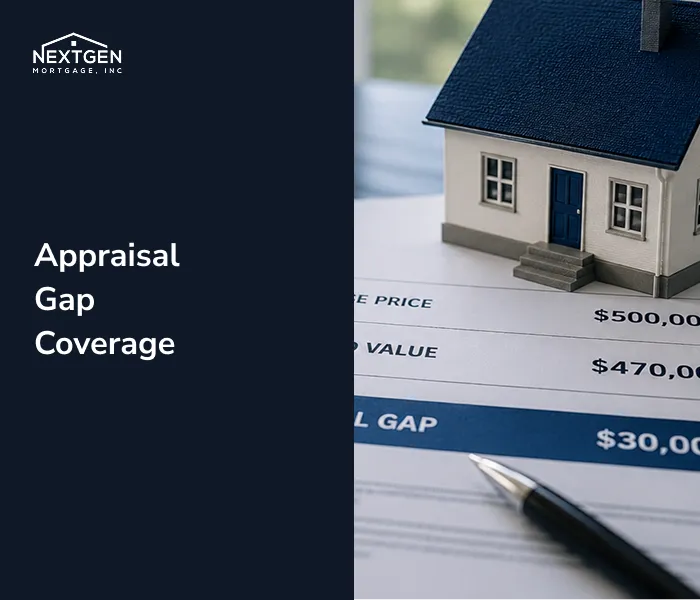
An appraisal gap is the dollar difference between a home's contract price and its appraised value when the appraisal comes in lower than what you agreed to pay.
Lenders base your loan amount on the lower of the two numbers, so if you agreed to pay $550,000 and the appraisal comes in at $530,000, the lender will only finance based on $530,000. The remaining $20,000 is the gap, and it has to come from somewhere if the deal is going to close.
Quick answer: An appraisal gap = contract price minus appraised value. Lenders lend on the appraised value, not the contract price.
This gap is more common in rising markets, multiple-offer situations, and neighborhoods where recent comparable sales have not caught up to current buyer demand. Parts of southern New Hampshire, especially Rockingham and Hillsborough counties, have seen this dynamic play out repeatedly over the last few years as buyers from Massachusetts compete with local move-up buyers.
What Is Appraisal Gap Coverage?
Appraisal gap coverage, sometimes written as an appraisal gap clause, is contract language that says you, the buyer, will cover some or all of an appraisal shortfall in cash rather than walk away or renegotiate.
A typical clause reads something like: "Buyer agrees to cover an appraisal gap of up to $25,000 with additional cash at closing." The number you commit to is the cap on your exposure.
This clause matters for two reasons. First, it tells the seller you are serious and financially capable of closing even if the appraisal comes in soft. Second, it protects you from being on the hook for an unlimited shortfall, because your liability stops at the cap you wrote into the contract.
It is not the same as waiving the appraisal contingency entirely. A waived contingency means you have no out at all if the appraisal comes in low. A capped gap clause gives you a defined ceiling on your risk.
Why Appraisal Gap Coverage Matters in New Hampshire
New Hampshire's housing inventory has been tight for several years, and southern NH towns within commuting distance of Boston tend to draw multiple offers on well-priced listings. According to data published by the New Hampshire Association of Realtors, median sale prices in many southern NH counties have outpaced gradual appraisal updates, which is the exact condition that produces appraisal gaps.
If you are buying in towns like Bedford, Nashua, Portsmouth, Salem, or Exeter, your agent will likely suggest some form of gap coverage on competitive listings. In rural northern counties, appraisal gaps are far less common because inventory moves slower and comps are more predictable.
For first-time homebuyers in New Hampshire, this is one of the harder pieces of the offer puzzle, because gap coverage requires liquid cash on top of your down payment and closing costs. A NextGen loan officer can walk you through how much cash you should preserve before you commit to a number on paper.
How an Appraisal Gap Clause Works
The mechanics are straightforward once you see the steps in order:
You and the seller agree on a contract price.
Your offer includes an appraisal gap clause with a stated maximum (for example, up to $20,000).
The lender orders an appraisal.
If the appraisal comes in at or above contract price, the clause is irrelevant and the deal proceeds normally.
If the appraisal comes in below contract price, you bring the gap amount (up to your stated cap) in cash at closing, in addition to your down payment.
If the gap exceeds your cap, you and the seller renegotiate or you exercise your appraisal contingency to walk away.
Key takeaway: The cap protects you. Without a cap, you have either fully waived the contingency or you have left the door open to unlimited exposure.
The cash for the gap is treated as additional down payment from the lender's perspective. This means your loan amount is unchanged, your loan-to-value ratio actually improves, but your out-of-pocket cash at closing goes up.
How Much Appraisal Gap Should You Offer?
The honest answer is: only as much as you can comfortably cover in cash without compromising your reserves, your down payment, or your closing costs.
A few practical anchors to help you think about the number:
Light gap coverage: $5,000 to $10,000. Useful as a goodwill signal in moderately competitive offers.
Moderate gap coverage: $10,000 to $25,000. Common in southern NH multiple-offer situations.
Aggressive gap coverage: $25,000 and up, or full waiver of the appraisal contingency. Reserved for buyers with substantial cash reserves and high conviction on the property.
Three questions to ask yourself before committing to a number:
After down payment, closing costs, and gap coverage, will I still have at least 2 to 3 months of mortgage payments in reserve?
How confident am I that the home will appraise at or above contract price based on recent comps?
If the appraisal came in $20,000 low, would I still want to buy this house at the contract price?
If the answer to that third question is no, you are likely overpaying, and gap coverage is the wrong tool. Negotiate harder or walk.
For buyers using NHHFA programs or low-down-payment loans, the math gets tighter quickly because most of your cash is already committed to the down payment. In those cases, lighter gap coverage or none at all is usually the right move.
What Happens If the Appraisal Came In Low?
If the appraisal came in low, you generally have four paths forward. Which one applies depends on your contract language and the size of the gap.
Renegotiate the Price
The cleanest outcome, when the seller is willing. The seller drops the contract price to match the appraisal, the lender finances based on the new lower price, and no extra cash is needed. Sellers are more open to this when their listing has been sitting or when the market has cooled since they accepted your offer.
Cover the Gap
If you have an appraisal gap clause, you bring the difference (up to your cap) in cash at closing. If the gap is larger than your cap, you can offer to bring the cap amount and ask the seller to meet you on the rest.
Request a Reconsideration of Value
If you believe the appraiser used poor comps or missed key features of the home, your lender can submit a reconsideration of value (sometimes called an ROV) with better comps, corrected square footage, or notes on missed upgrades. VA loans have a specific process called Tidewater, which gives the appraiser a chance to consider additional information before finalizing a low value. The Consumer Financial Protection Bureau and HUD both publish guidance on appraisal disputes if you suspect bias or error.
Walk Away
If you have an appraisal contingency in place and you cannot agree on a path forward, you can typically terminate the contract and recover your earnest money. This is exactly why removing the appraisal contingency entirely is risky and why a capped gap clause is usually the smarter middle ground.
Risks of Appraisal Gap Coverage
Gap coverage looks attractive in a hot market, but there are three real risks every buyer should weigh.
Cash drain at closing. Every dollar you commit to gap coverage is a dollar not in your savings. If the gap hits, your reserves take a real haircut at the worst possible moment, right after you bought a house.
Buying at a price the market does not support. A low appraisal is a data point. It is the lender's professional opinion that the home is not worth what you offered. Covering the gap means you are betting the appraiser is wrong or that future appreciation will catch up.
Refinance and resale implications. If you bought for $550,000 and the home appraises for $530,000, you are starting with $20,000 less equity than the contract suggests. This can affect future refinance options and your net proceeds if you sell within a few years.
This is one of the situations where a broker matters. A NextGen broker can compare loan structures across multiple lenders to see whether a different loan program (or a different down payment structure) gives you more flexibility on gap coverage without straining your reserves.
Comparison: Appraisal Gap Strategies
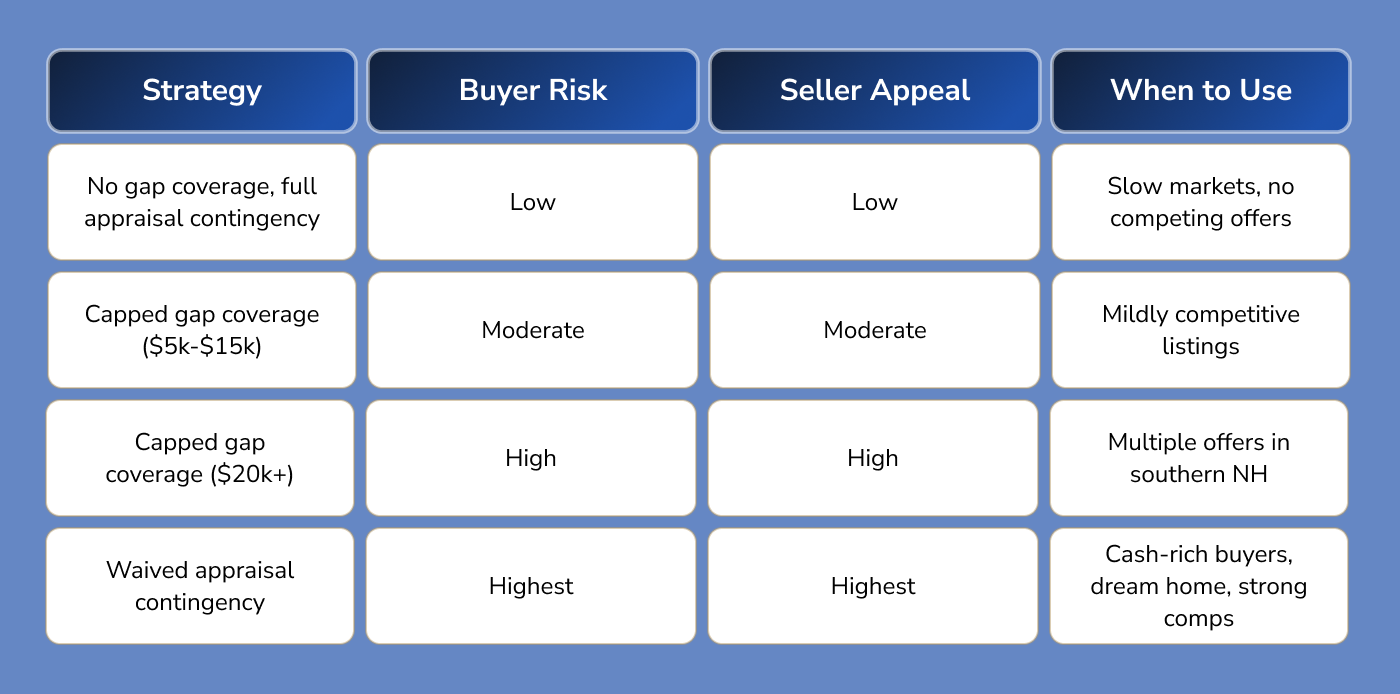
The right column is the one most buyers skip. There is no universally correct strategy, only the strategy that fits the listing, your finances, and your conviction on the home.
How NextGen Mortgage Loans Can Help
Appraisal gap decisions are easier when you have already run the numbers across multiple loan options. As a New Hampshire mortgage broker, NextGen Mortgage Loans works with multiple lenders, which means we can compare loan structures, down payment scenarios, and reserve requirements side by side rather than fitting you into one bank's box.
Before you write your next offer, it helps to know exactly how much cash you can commit to gap coverage without compromising your down payment, closing costs, or post-closing reserves. Our team can run that math with you in a short call and provide a pre-approval that strengthens your offer with sellers.
Contact a NextGen loan officer to talk through your offer strategy, or use our mortgage calculators to model different down payment and cash-to-close scenarios. Consultations are free, and there is no obligation to proceed.
Frequently Asked Questions
Is appraisal gap coverage the same as waiving the appraisal contingency?
No. Appraisal gap coverage commits you to cover a gap up to a stated maximum and preserves your right to walk away if the gap exceeds that cap. Waiving the appraisal contingency removes your ability to back out based on a low appraisal entirely, regardless of the size of the shortfall. The two are often confused, but the financial exposure is very different.
How common are low appraisals in New Hampshire?
Low appraisals are more common in rapidly appreciating markets and in multiple-offer situations where the contract price reflects bidding-war dynamics rather than recent comparable sales. They are more frequent in southern NH counties like Rockingham and Hillsborough than in slower-moving northern counties. Your real estate agent can pull recent appraisal data for the specific town and price range you are shopping.
Can I use gift funds to cover an appraisal gap?
In most cases, yes, but the gift must follow your loan program's documentation rules. Conventional, FHA, and VA loans all allow gift funds for down payment and gap coverage, but the donor must usually be a family member and must sign a gift letter confirming the funds do not need to be repaid. Talk to your loan officer before assuming gift funds will work for your specific scenario.
Does appraisal gap coverage affect my loan amount?
No, the loan amount is determined by the appraised value and your down payment percentage. Gap coverage is paid as additional cash at closing, which actually lowers your loan-to-value ratio. Your monthly payment is unchanged, but your cash needed at closing increases by the gap amount.
What if I cannot cover the full gap?
You and the seller will need to renegotiate, or you may need to exercise your appraisal contingency and terminate the contract. Some sellers will lower the price, some will split the gap, and some will hold firm and move to the next buyer. This is exactly why the cap on your gap clause matters: it defines the point at which you can step away.
Should first-time buyers offer appraisal gap coverage?
It depends on your cash position and the competitiveness of the listing. First-time buyers using low-down-payment programs (NHHFA, FHA, or 3% conventional) often do not have the liquidity to support meaningful gap coverage. A smaller cap, $5,000 to $10,000, can still serve as a goodwill signal without draining reserves. Larger caps usually make sense only for buyers with substantial cash savings.
Can the seller require appraisal gap coverage?
Sellers cannot legally require it, but in competitive markets they can absolutely prefer offers that include it. If listing agents are advising sellers to prioritize offers with strong gap coverage, your offer will be at a disadvantage without it. This is a market dynamic, not a contract requirement, and it shifts as inventory levels change. Consult a tax professional or attorney for advice specific to your situation when contract language gets complex.

