1099 Mortgage Loans: How NH Contractors Can Qualify
If you earn income as a 1099 contractor, freelancer, or gig worker in New Hampshire, a 1099 mortgage loan lets you qualify for a home using your 1099 forms instead of two years of tax returns. This matters because traditional underwriting often penalizes self-employed borrowers who write off legitimate business expenses, which lowers their taxable income and shrinks the loan amount they qualify for on paper.
This guide explains how 1099 mortgage loans work, who qualifies, what documentation lenders require, and what NH borrowers should know before applying.
What Is a 1099 Mortgage Loan?
Quick answer: A 1099 mortgage loan is a non-QM (non-qualified mortgage) program that uses the gross income reported on your 1099 forms to qualify you for a home loan, rather than the net income shown on your tax returns.
This loan type is designed for independent contractors, real estate agents, consultants, travel nurses, freelancers, truck drivers, and other self-employed borrowers who receive 1099-NEC or 1099-MISC forms instead of W-2s. Because lenders calculate qualifying income from gross 1099 totals (often with a small expense deduction), borrowers typically qualify for more home than they would using tax-return-based underwriting.
1099 mortgage loans are not government-backed. They are offered by private lenders and brokered through mortgage professionals like NextGen Mortgage Loans, who work with multiple non-QM lenders to find the best fit for your situation.
How 1099 Mortgage Loans Work in New Hampshire
In NH, 1099 mortgage loans follow the same general framework as in other states, with state-specific considerations around county loan limits, property taxes, and home prices.
Here is the basic flow:
Provide 1099s instead of full tax returns. Most lenders ask for one to two years of 1099 forms.
Lender calculates qualifying income. Underwriters typically use 90 percent of gross 1099 income, or apply a fixed expense ratio (often 10 to 20 percent), depending on the program.
Standard credit, asset, and property review. You still need to show credit history, reserves, and a property appraisal.
Loan is closed under non-QM guidelines. Rates and terms reflect the alternative documentation path.
Because NH has higher-than-average property taxes (NH ranks among the top states for effective property tax rates per the Tax Foundation), debt-to-income calculations can be tighter than in lower-tax states. A NextGen broker can model your DTI accurately before you make an offer.
Who Qualifies for a 1099 Only Mortgage Program?
A 1099 only mortgage program is built for borrowers whose primary income comes from 1099 work. Typical eligibility looks like this:
Income history: 12 to 24 months of 1099 income, often from the same line of work
Credit score: Generally 620 to 680 minimum, with better terms above 700
Down payment: 10 to 20 percent, depending on credit and reserves
Reserves: Two to six months of mortgage payments in savings or eligible accounts
Debt-to-income ratio: Usually capped at 43 to 50 percent
Borrowers who often benefit from this program include:
Real estate agents and brokers
IT consultants and software contractors
Travel nurses and locum medical providers
Long-haul truck drivers paid via 1099
Insurance agents and full-commission sales reps
Creative freelancers (designers, writers, photographers)
If you have mixed income (some W-2, some 1099), other programs may work better. Speak with a NextGen broker to compare options across multiple lenders before locking in a path.
1099 Mortgage Loans vs Conventional Loans
The main difference comes down to how income is calculated. Here is a side-by-side comparison:
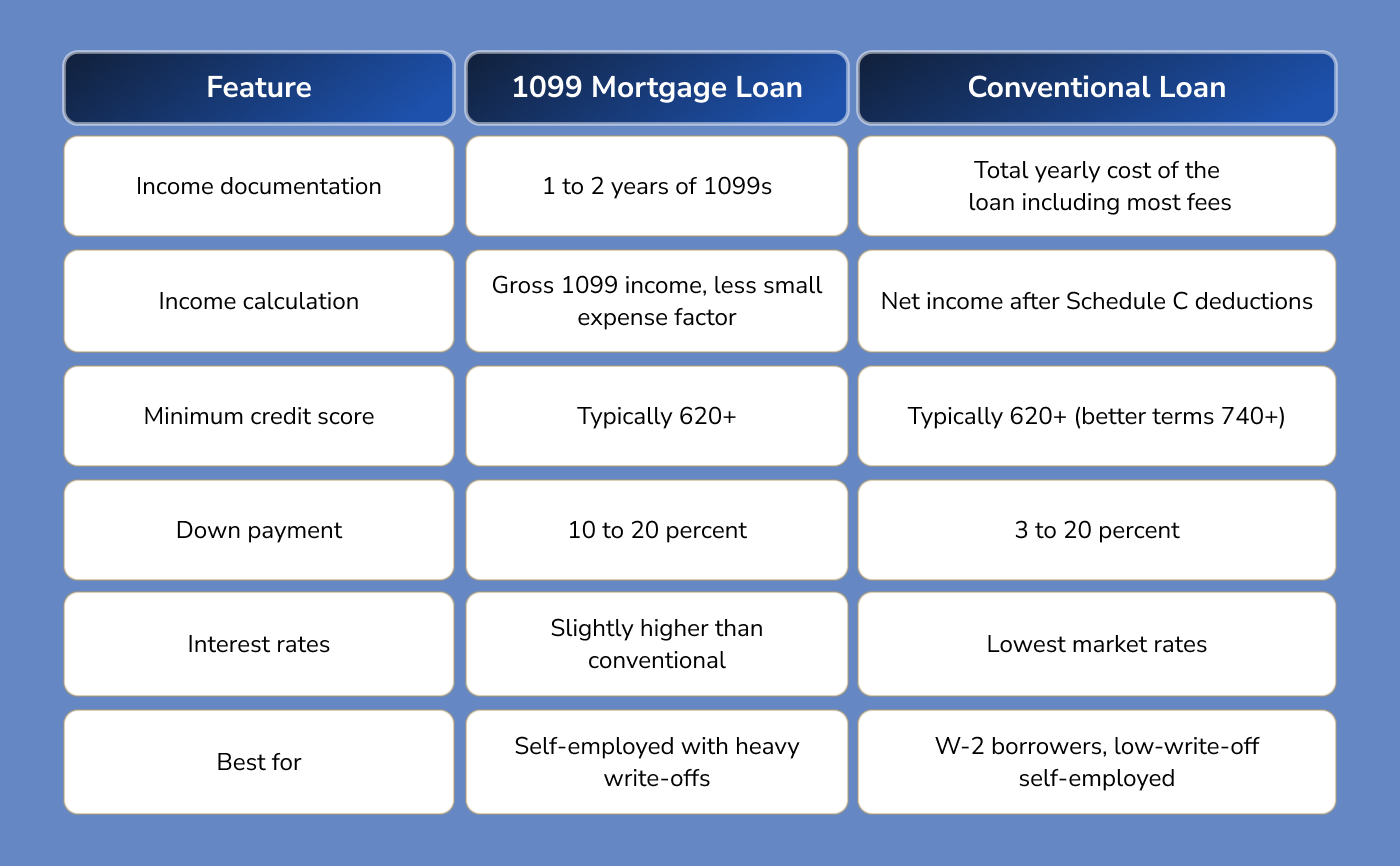
Conventional loans almost always offer the lowest rates. But if your tax returns show $45,000 in net income while your 1099s show $120,000 in gross income, a conventional lender may not approve you for the loan size you actually need. A 1099 mortgage solves that mismatch.
Documents You Need for a Mortgage for 1099 Contractors
A mortgage for 1099 contractors requires a slightly different document set than a conventional loan. Expect to provide:
1099 forms for the past one or two years (1099-NEC, 1099-MISC, or 1099-K depending on your work)
Year-to-date income proof, such as a profit-and-loss statement or invoices and deposits
Two months of bank statements for both personal and business accounts
Credit authorization for a tri-merge credit pull
Government-issued ID
Asset statements for down payment and reserves
Lease or current mortgage statement (for refinances or move-up buyers)
Business license or proof of self-employment (varies by lender)
Some programs require a CPA letter confirming you have been self-employed for a specific period. Others do not. The exact list depends on the lender, which is why working with a broker matters: a NextGen loan officer can walk you through document requirements in 15 minutes and route you to the lender whose program fits your file.
Pros and Cons of Freelancer Mortgage Options
Freelancer mortgage options come with real trade-offs. Knowing them upfront helps you decide whether a 1099 program is the right fit or whether another path makes more sense.
Pros:
Qualify based on gross income, not net after deductions
Faster qualification for borrowers with heavy business write-offs
Available for purchase, refinance, and cash-out refinance
Works for primary residences, second homes, and investment properties
No need to restructure tax returns or stop taking deductions
Cons:
Interest rates typically run 0.5 to 1.5 percent higher than conventional
Down payment requirements are generally higher
Fewer lenders offer the program, so shopping matters
Some lenders require longer self-employment history
Closing costs can run slightly higher
A bank statement loan is a related alternative. Instead of 1099s, the lender uses 12 or 24 months of business or personal bank deposits to calculate income. If your work is paid in cash or via invoices not reported on 1099s, a bank statement loan may fit better.
What New Hampshire Borrowers Should Know
NH-specific factors affect how a 1099 mortgage works in practice.
Loan limits. Conforming loan limits are set annually by the FHFA and apply uniformly across most NH counties. For non-QM 1099 loans, lenders often allow higher loan amounts than conforming limits, which helps in higher-priced markets like Rockingham County or parts of Hillsborough County.
Property taxes. NH has no state income tax but ranks high for property taxes. Annual property tax flows directly into your DTI calculation, so a $400,000 home in Manchester carries different qualifying math than the same priced home in Concord or Nashua.
NHHFA programs. The New Hampshire Housing Finance Authority offers down payment assistance and first-time buyer programs. Most NHHFA programs are designed around conventional, FHA, VA, and USDA loans, not non-QM 1099 programs. If you are a 1099 borrower hoping to use NHHFA assistance, you may need to qualify under a conventional path with strategic tax planning instead. A broker can run both scenarios and tell you which produces a better outcome. Consult a tax professional for advice specific to your situation.
Out-of-state buyers. If you are relocating from MA or another nearby state, NH lenders can still use your existing 1099 income, provided your work is portable or you have a contract to continue earning in NH.
How NextGen Mortgage Loans Can Help
NextGen Mortgage Loans is a New Hampshire mortgage broker with access to multiple non-QM and conventional lenders, including those that offer 1099 mortgage programs. Because we shop your file across several lenders, we often find better rates and more flexible terms than going to a single bank.
We work with NH residents and out-of-state buyers moving to NH, including first-time homebuyers, self-employed professionals, and borrowers with non-traditional income. Pre-approvals are typically completed within a few business days, and consultations are no-cost and no-obligation.
If you earn 1099 income and want to know exactly what you qualify for, contact a NextGen loan officer or run the numbers with our mortgage calculators before you start house hunting.
Frequently Asked Questions
Can I get a mortgage with only 1099 income?
Yes. A 1099 only mortgage program lets you qualify using only your 1099 income, without W-2s or full tax returns. You typically need 12 to 24 months of consistent 1099 income, a credit score above 620, and a 10 to 20 percent down payment.
How much income do I need for a 1099 mortgage loan in NH?
There is no fixed minimum. Lenders calculate qualifying income based on your gross 1099 totals minus an expense factor, then apply standard DTI ratios (usually 43 to 50 percent). The income you need depends on the home price, NH property taxes, and your other monthly debts. A broker can run the math in a single call.
Are 1099 mortgage rates higher than conventional rates?
Usually yes. 1099 mortgage loans are non-QM products, so rates typically run 0.5 to 1.5 percent above conventional rates. The trade-off is often worth it for self-employed borrowers who would qualify for far less under conventional underwriting.
How long do I need to be self-employed to qualify?
Most 1099 mortgage programs require at least 12 to 24 months of self-employment history in the same line of work. Some lenders accept shorter histories if you have a strong credit profile and reserves. Requirements vary by lender, so it pays to compare.
Can I use a 1099 mortgage for an investment property in NH?
Yes. Many 1099 mortgage programs allow purchases of primary residences, second homes, and investment properties, including single-family rentals and small multifamily homes in NH. Down payment requirements are higher for investment properties, often 20 to 25 percent.
Will writing off business expenses hurt my mortgage approval?
On a conventional loan, yes. Heavy Schedule C deductions reduce your net taxable income and the loan amount you qualify for. On a 1099 mortgage loan, write-offs do not affect qualification because the lender uses gross 1099 income, not your tax return. Consult a tax professional for advice specific to your situation.
Do I need a CPA letter to get a 1099 mortgage?
Some lenders require a CPA letter confirming your self-employment timeline; others do not. If you do not work with a CPA, a broker can route you to a lender whose program does not require one.

